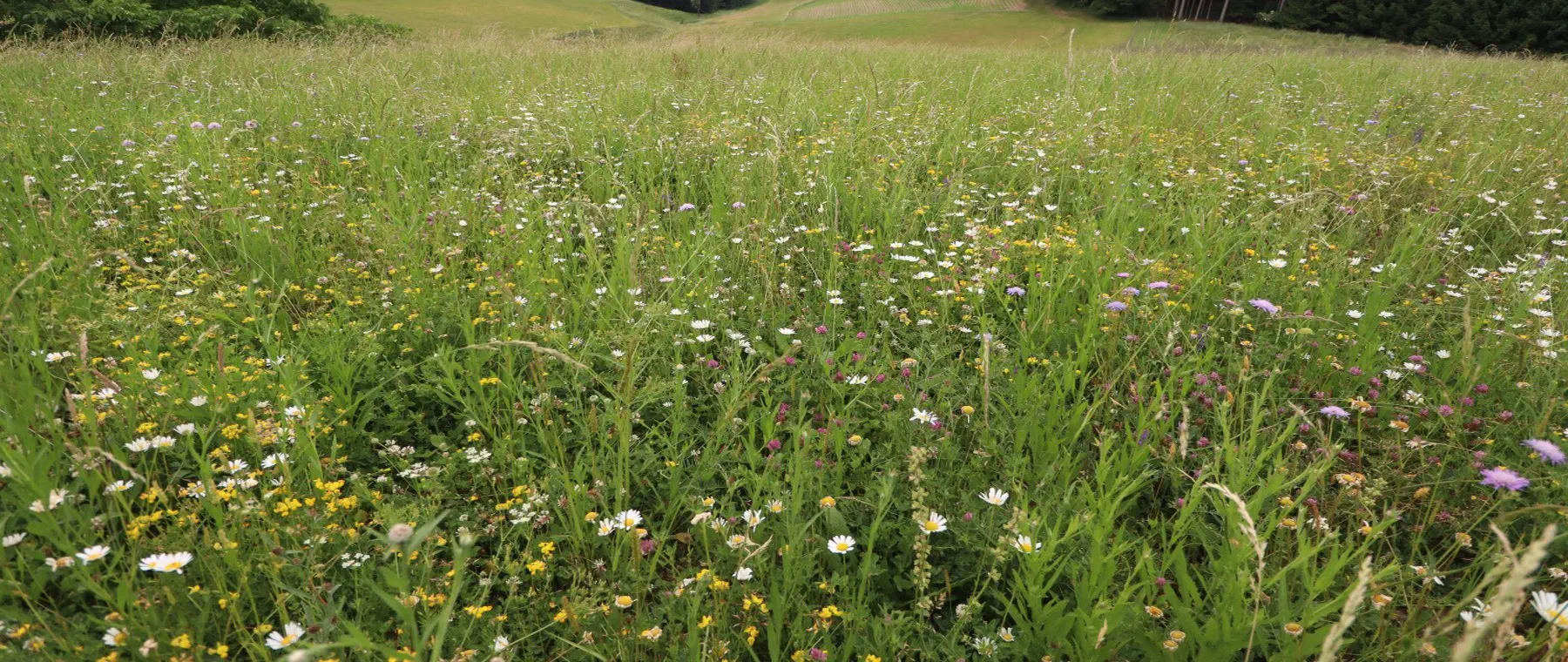
Eco-points in natural region D63
Oberpfälzer und Bayerischer Wald
For impacts in natural region D63, eco-points can be generated through the upgrading of woodland, bogs and valley floodplains of the Oberpfälzer und Bayerischer Wald. greeNature develops and manages BayKompV-compliant compensation land in the region and supports project developers from land acquisition through to official recognition.
Natural region D63 at a glance
Natural region D63 extends along the Czech border in north-eastern Bavaria, from the Oberpfälzer Wald in the north, through the Cham-Furth Depression, to the Bayerischer Wald and the Neuburger Wald near Passau. At around 7,530 km², it is among the largest low mountain range landscapes in Germany. Its highest elevation is the Großer Arber at 1,456 m, also the highest peak in Bavaria outside the Alps. Wooded ridges alternate with cleared enclaves, plateaus and the valley lowlands of the Regen, Naab and Ilz.
Geologically, the natural region is part of the Bohemian Massif, whose south-western edge it forms. The subsoil is shaped by crystalline basement rocks, above all granite, gneiss and mica schist. A striking feature is the Pfahl, a quartz reef that runs almost dead straight for around 140 kilometres from the Upper Palatinate to Upper Austria. On the acidic, nutrient-poor parent rock, mostly base-poor, in places waterlogged soils have developed.
The cool, moist montane climate, with high rainfall and a long-lasting snow cover, shapes the habitats. Characteristic are montane mixed woodland of beech, fir and spruce, montane spruce woodland at higher elevations, and numerous raised and fen bogs, regionally called Filze. Near-natural mountain streams, mat-grass swards and wet meadows complete the mosaic. The natural region is home to demanding species such as lynx, capercaillie, otter and freshwater pearl mussel.
Large parts of the natural region are protected, including the Bayerischer Wald National Park, Germany's first national park, several nature parks and a dense network of Natura 2000 sites. At the same time, the forestry imprint, with extensive spruce plantations, gives rise to considerable upgrading potential. Forest conversion, bog restoration and the development of near-natural watercourses offer technically high-quality approaches for compensation and eco-points under the BayKompV.
📍 Districts covered
🌿 Ecological features
- At 1,456 m, the Großer Arber is the highest elevation of the natural region and also the highest peak in Bavaria outside the Alps.
- The Pfahl, a white quartz reef, runs almost dead straight through the landscape for around 140 kilometres, rising in places as a striking rock ridge.
- With the Bayerischer Wald National Park, founded in 1970, Germany's first national park lies within this natural region.
- The severely endangered freshwater pearl mussel survives in some cold, clean streams, for example in the catchment of the Ilz.
- Lynx and European wildcat have once again found permanent habitat in the extensive, cross-border woodland.
- Numerous bogs, regionally called Filze, store carbon and are home to highly specialised animal and plant species.
✅ greeNature in this region
greeNature is active as a partner for compensation and eco-points in the eastern Bavarian region. We identify and secure suitable land in natural region D63, develop BayKompV-compliant measures from it such as forest conversion, bog rewetting or watercourse restoration, and coordinate these with the lower nature conservation authorities. From the initial site assessment through implementation to monitoring, we support project developers, municipalities, forestry operations and companies. This allows compensation obligations to be met on a sound technical basis and eco-points to be stockpiled early via an eco-account.
Typical measures in natural region D63
Forest conversion to montane mixed woodland
Converting structurally poor spruce plantations into climate-stable beech-fir-spruce mixed woodland with a high proportion of old and dead wood. This increases structure, species diversity and resilience, and creates upgrading potential for eco-points.
Bog restoration and rewetting
Rewetting drained raised and fen bogs (regionally Filze). This reactivates carbon stores, improves the water balance and preserves habitats for specialised bog species.
Watercourse and floodplain restoration
Removing artificial structures, restoring connectivity and near-natural development of streams and floodplains. Species such as freshwater pearl mussel, otter and kingfisher benefit from this.
Extensification of mountain and valley meadows
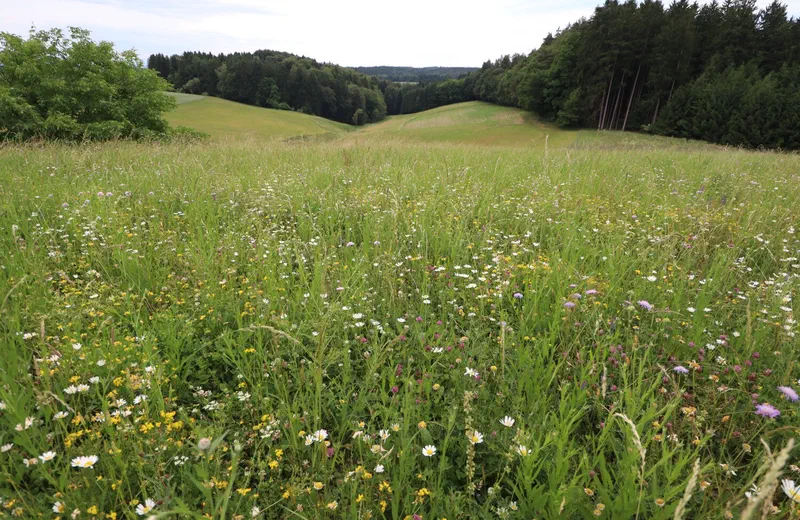
Extensive management of wet, litter and mountain meadows without fertiliser and with adapted mowing. This promotes species-rich grassland, mat-grass swards and flower-rich sites.
Habitat networking and structural enrichment
Creating hedgerows, field margins, woodland edges and stepping-stone habitats between the woodland areas. The network connects the habitats of European wildcat, hazel dormouse and reptiles.
Small water bodies and amphibian habitats
Creating and optimising sunlit, fish-free spawning waters for amphibians such as great crested newt and European tree frog. Such measures are frequently also suitable as advance CEF measures.
Protected species in the Oberpfälzer und Bayerischer Wald
Lynx
The lynx is the symbolic species of the Bayerischer Wald. Following its reintroduction, it uses the large, contiguous woodland areas on both sides of the Czech border and depends on connected habitats and sufficient prey.
Black stork
The black stork breeds hidden in low-disturbance old-growth stands and forages along near-natural forest streams and wet meadows. It is sensitive to disturbance and benefits from quiet, structurally rich woodland landscapes.
About this species ›European wildcat
The European wildcat is spreading again in the woodland of the Oberpfälzer und Bayerischer Wald. It requires deadwood-rich woodland, cover-rich field margins and a functioning habitat network between the woodland areas.
About this species ›Sand lizard
The sand lizard is strictly protected under Annex IV of the FFH Directive. It inhabits sunny woodland edges, embankments, railway and track routes, and nutrient-poor dry sites, and is among the species most frequently relevant to the special species protection assessment (saP) in construction projects.
About this species ›Northern crested newt
The northern crested newt is a species listed in Annex IV of the FFH Directive and spawns in sunlit, fish-free ponds and pools. For impacts on its habitats, advance compensation measures (CEF) in the form of new spawning waters are frequently required.
About this species ›Bats
Several strictly protected bat species live in the natural region, including barbastelle, Bechstein's bat and greater mouse-eared bat. They use old, cavity-rich woodland as well as buildings as roosts and must be regularly assessed in the case of demolition or forest impacts.
About this species ›Your route to eco-points in D63
Contact and enquiry
Tell us your compensation requirement and the natural region. We check availability.
Offer and advice
A transparent offer covering measure types, scope and availability.
Coordination with authorities
Full coordination with the lower nature conservation authority. We handle everything.
Long-term monitoring
Permanent securing of the land, management and documentation across the contract term.
Eco-points in neighbouring natural regions
All about natural region D63
Request eco-points in natural region D63
We will promptly prepare a transparent offer with matching eco-points held in stock in the Oberpfälzer und Bayerischer Wald.