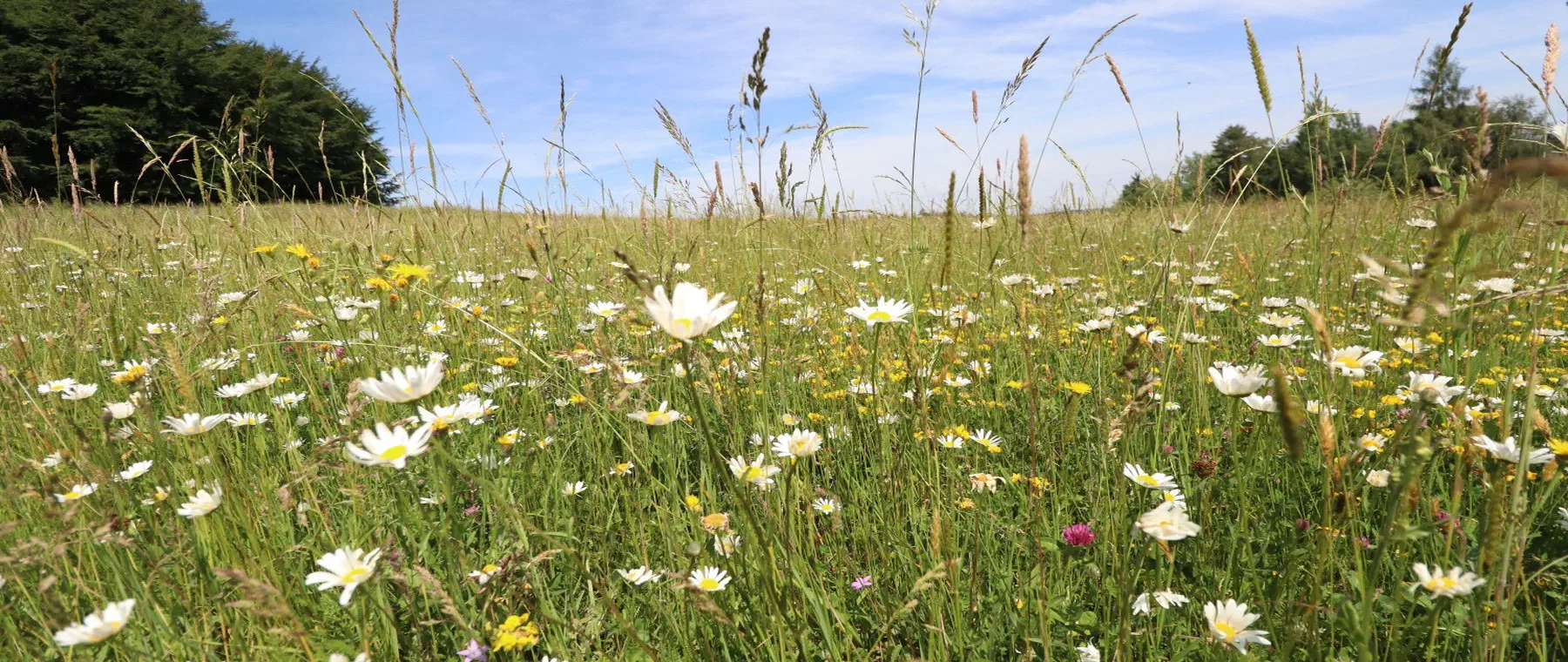
Eco-points in natural region D57
Neckar- und Tauberland, Gäuplatten
Eco-points in natural region D57 arise where Muschelkalk calcareous grassland, traditional orchards and the floodplains of the Neckar, Tauber, Kocher and Jagst are ecologically upgraded. greeNature develops and manages compensation land true to the natural region under Baden-Württemberg's Eco-Account Ordinance (ÖKVO), from conception through to permanent management, and operates nationwide.
Natural region D57 at a glance
Natural region D57, Neckar- und Tauberland, Gäuplatten, is the largest natural region unit in Baden-Württemberg by area. It extends from the Kraichgau and the Neckar basin, through the Hohenlohe plain, to the Tauberland and the Bauland, with small portions in the north-east around Rothenburg ob der Tauber in Middle Franconia. Characteristic are sparsely wooded, fertile Gäu landscapes with gently rounded to gently undulating relief.
Geologically, the layers of Muschelkalk shape the subsoil, in many places overlain by Lettenkeuper and by ice-age loess. Deep, fertile loamy soils (Parabraunerde) have developed from the loess, while shallow rendzina soils predominate on the more relief-rich Muschelkalk slopes. These soils carry one of the most intensive arable landscapes in south-west Germany.
The landscape is structured by the valleys of the Neckar and its tributaries Enz, Rems and Murr, as well as the Kocher, Jagst and Tauber. On the south- and south-west-facing valley slopes, viticulture is of great importance, interspersed with traditional orchards and heat-loving calcareous grassland. Wooded ridges such as the Strom- and Heuchelberg form refuges in the otherwise open farmland.
Because intensive use has made the farmland structurally poor in many places, there is considerable scope for compensation. Calcareous grassland can be restored through grazing and scrub clearance, traditional orchards and hedgerows connect habitats, and riparian buffer strips upgrade the floodplains. Baden-Württemberg's ÖKVO assesses such upgrades in eco-points, with compensation close to the natural region given technical priority, which makes site selection in area D57 especially important.
📍 Districts covered
🌿 Ecological features
- The largest group of natural region units in Baden-Württemberg by area, with a largely open, sparsely wooded Gäu landscape.
- Fertile loess soils over Muschelkalk, the basis of one of the most intensive arable landscapes in south-west Germany.
- Heat-loving Muschelkalk calcareous grassland on the south- and south-west-facing valley slopes.
- Traditional viticulture on the steep slopes of the Neckar, Kocher, Jagst and Tauber.
- Traditional orchards as a defining element of the cultural landscape and habitat for cavity-nesting birds.
- Richly structured river valleys of the Neckar, Enz, Kocher, Jagst and Tauber, with near-natural sections.
- Wooded ridges such as the Strom- and Heuchelberg as refuges within the open farmland.
✅ greeNature in this region
As a partner for compensation in Baden-Württemberg, greeNature develops eco-account and compensation land that fits the character of the Neckar- und Tauberland, Gäuplatten. We secure suitable land, plan the upgrade under the Eco-Account Ordinance (ÖKVO), implement the measures and document them for recognition by the lower nature conservation authorities, which manage the eco-account. Assessment is in eco-points. Where species protection requirements exist under § 44 BNatSchG, we design advance CEF measures that continuously secure the ecological function for the affected species. greeNature operates nationwide and knows the authorities and the state law of the region.
Typical measures in natural region D57
Developing and managing calcareous grassland
Restoration and permanent maintenance of open Muschelkalk calcareous grassland on the valley slopes through extensive grazing with sheep and goats and through scrub clearance. These heat-loving habitats are among the most species-rich in the natural region.
Creating and preserving traditional orchards
Creating new and replanting standard-trunk traditional orchards with extensive grassland use. Traditional orchards are a defining element of the Gäu landscape and a valuable habitat for little owl, cavity-nesting birds and bats.
Restoring watercourses and floodplains
Removing bank reinforcement, creating riparian buffer strips and developing floodplain forest on the Neckar, Enz, Kocher, Jagst and Tauber. Near-natural watercourses and wet hollows connect habitats and improve water retention.
Field margins and flowering areas
Creating extensive field margins, perennial flowering areas and skylark plots in the cleared Gäu farmland. Such structures support farmland birds, wild bees and other insects.
Dry-stone walls and cleared-stone ridges
Preserving and creating dry-stone walls, cleared-stone ridges and sunlit field margins at vineyard edges and embankments. They offer heat-loving species such as the sand lizard and numerous insects important refuges.
Species protection with CEF measures
Advance CEF measures under § 44 BNatSchG for sand lizard, skylark and bats, for example through sand lenses, habitat structures and roost provision, so that the ecological function for the affected species is continuously maintained.
Protected species in the Neckar- und Tauberland, Gäuplatten
Skylark
A characteristic species of the open Gäu and arable landscape. It nests on the ground and suffers from dense, uniform crop stands. Field margins and skylark plots improve its breeding success.
About this species ›Sand lizard
It inhabits vineyard edges, dry-stone walls, calcareous grassland and sunlit embankments. For this heat-loving species, stone ridges and structurally rich field margins are crucial as habitat and breeding ground.
About this species ›Kingfisher
On the near-natural sections of the Neckar, Kocher, Jagst and Tauber, the kingfisher breeds in steep banks. Eroding banks, clean waters and an abundant supply of small fish secure its habitat.
About this species ›Bats
Old traditional orchards and the broadleaf woodland of the Muschelkalk slopes are roosting and foraging habitat for several bat species. Roost provision and the preservation of structurally rich woodland promote their populations.
About this species ›European wildcat
The wooded ridges such as the Strom- and Heuchelberg serve as a refuge for the returning European wildcat. Woodland-edge design, old and dead wood, and habitat networks improve its habitat.
About this species ›Great crested newt
The great crested newt requires fish-free small water bodies with rich bankside vegetation. Newly created pools around woodland and farmland promote its populations in the natural region.
About this species ›Your route to eco-points in D57
Contact and enquiry
Tell us your compensation requirement and the natural region. We check availability.
Offer and advice
A transparent offer covering measure types, scope and availability.
Coordination with authorities
Full coordination with the lower nature conservation authority. We handle everything.
Long-term monitoring
Permanent securing of the land, management and documentation across the contract term.
Eco-points in neighbouring natural regions
All about natural region D57
Request eco-points in natural region D57
We will promptly prepare a transparent offer with matching eco-points held in stock in the Neckar- und Tauberland, Gäuplatten.