Eco-points in natural region D55
Odenwald, Spessart und Südrhön
Eco-points and compensation land in natural region D55 (Odenwald, Spessart und Südrhön), which extends across Bavaria, Hesse and Baden-Württemberg. greeNature develops and manages compensation measures true to the natural region, and selects the relevant procedure for each impact, from the BayKompV in the Bavarian Spessart to the Eco-Account Ordinance in Baden-Württemberg.
Natural region D55 at a glance
Natural region D55, Odenwald, Spessart und Südrhön, covers around 5,854 km² and lies at the tripoint of Bavaria, Hesse and Baden-Württemberg. It forms the first stage of the south-west German scarpland and is divided into the sub-landscapes Odenwald, Spessart, Südrhön and Büdinger Wald. The Spessart lies mainly in Bavaria (Lower Franconia), the Odenwald mainly in Hesse and Baden-Württemberg, and the Südrhön and Büdinger Wald in Hesse and Bavaria.
Geologically, the natural region is a Bunter sandstone low mountain range. Over wide areas, sandy and, in the east, sandy-loamy sediments of the Bunter sandstone determine the subsoil, on which acidic, nutrient-poor sites are common. In the western Odenwald (Bergsträßer and Böllsteiner Odenwald), crystalline basement rock is exposed. The Katzenbuckel (626 m) in the Baden-Württemberg part of the Odenwald, of volcanic origin, is the highest elevation of the natural region; in the Spessart, the Geiersberg reaches 585 m.
Ecologically, the extensive broadleaf woodlands are the defining feature. The Hochspessart carries one of the largest contiguous oak-beech woodland areas in Central Europe, with old oak stands of European importance. Spessart and Odenwald are among the most important refuges for the European wildcat in Germany. On the Bunter sandstone slopes and in the valley floodplains, open woodland, sandy calcareous grassland, traditional orchards and near-natural streams alternate, while watercourses such as the Elsava, Hafenlohr, Mümling and Gersprenz provide structurally rich habitats.
For the impact mitigation regulation under §§ 13 to 15 BNatSchG, the assessment procedure to be applied depends on the federal state where the impact occurs. In the Bavarian part, the BayKompV applies, with the habitat-value procedure; in the Hessian part, the compensation ordinance (KV); in the Baden-Württemberg part, the Eco-Account Ordinance (ÖKVO) with eco-points. The natural region offers high potential for compensation true to the natural region, in woodland, watercourses, open land and small water bodies.
📍 Districts covered
🌿 Ecological features
- Hochspessart, with one of the largest contiguous oak-beech woodland areas in Central Europe, old oak stands of European importance
- Spessart and Odenwald as core areas for the European wildcat in Germany
- Geo-Naturpark Bergstraße-Odenwald, recognised as a UNESCO Global Geopark
- Bayerischer Spessart, Hessischer Spessart and Neckartal-Odenwald nature parks
- Katzenbuckel (626 m), the highest elevation of the Odenwald, of volcanic origin
- Bunter sandstone shapes acidic, nutrient-poor sites; crystalline basement rock is exposed in the western Odenwald
- Extensive FFH and bird sanctuary areas in the Hochspessart, with black stork, woodpeckers and bats
✅ greeNature in this region
greeNature operates nationwide and knows the nature conservation requirements of all three federal states in natural region D55. We coordinate compensation projects with the responsible lower nature conservation authorities in Lower Franconia, in southern and eastern Hesse, and in the Neckar-Odenwald area, and select the relevant assessment procedure for each impact (BayKompV, the Hessian compensation ordinance or Baden-Württemberg's Eco-Account Ordinance). We support your project from land acquisition through measure planning to long-term management and documentation.
Typical measures in natural region D55
Near-natural forest conversion
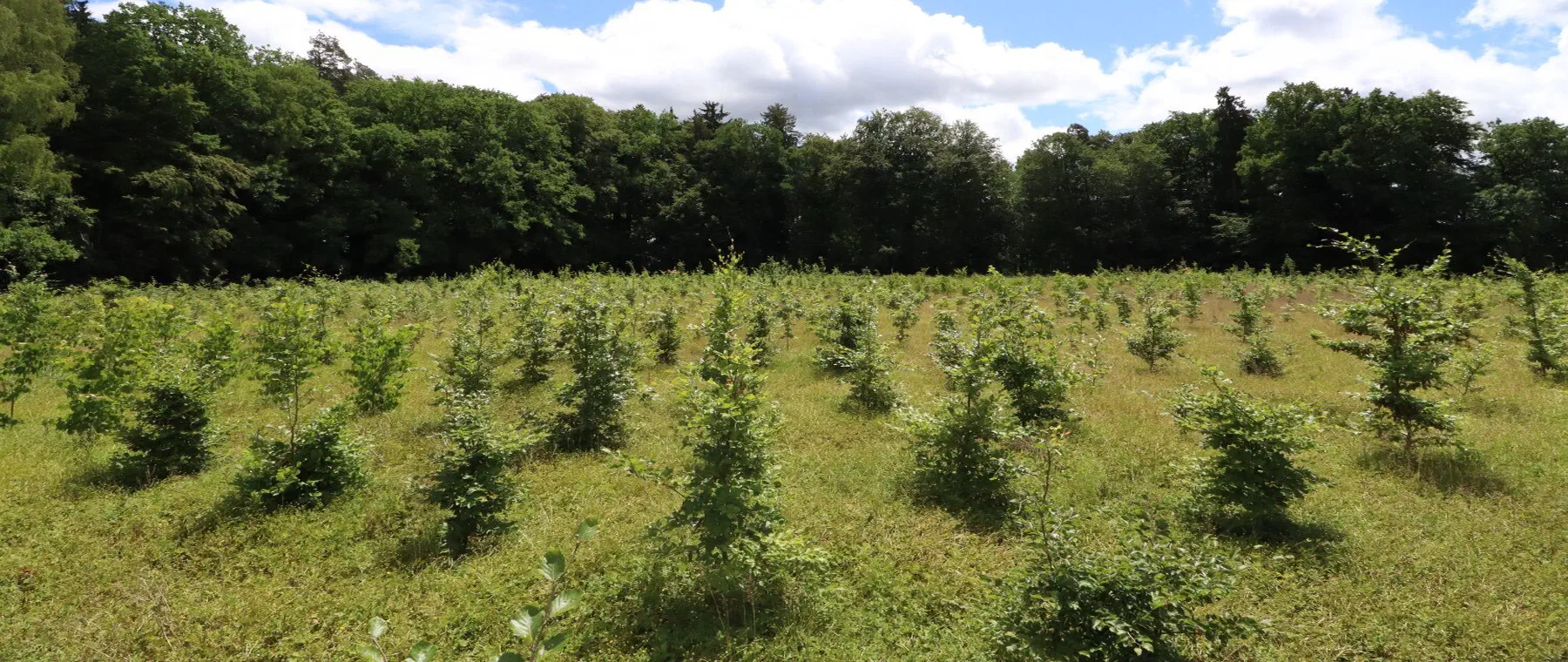
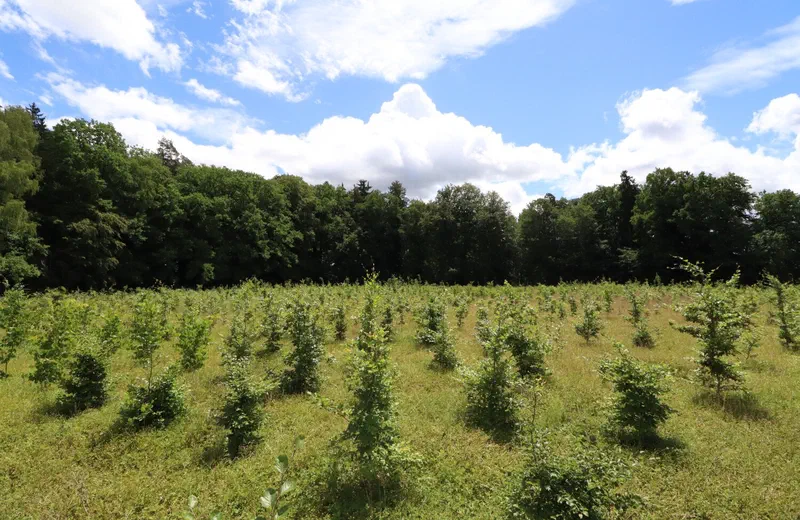
Converting non-native conifer plantations into climate-stable oak-beech mixed woodland, enriching them with habitat trees and structurally rich woodland-edge design, as habitat for European wildcat, bats and woodpeckers.
Old and dead wood concepts
Designating and permanently securing groups of habitat trees and old-growth islands in the Hochspessart and Odenwald, with targeted deadwood enrichment for xylobiont beetles such as the stag beetle and for cavity-dwelling species.
Stream and floodplain restoration
Restoration of the Spessart and Odenwald streams such as the Elsava, Hafenlohr, Mümling and Gersprenz, restoring connectivity and planting bankside woodland for kingfisher, bullhead and brook lamprey.
Traditional orchards and calcareous grassland
Creating and managing traditional orchards, and sandy and siliceous calcareous grassland on the Bunter sandstone slopes and in the foreland, supplemented by stone walls and dry-stone walls as structural and connectivity elements.
Open-land and reptile habitats
Developing and managing open woodland, sandy heaths and sunlit field margins for sand lizard and other reptiles, implementable as a CEF measure under § 44 BNatSchG.
Small water bodies and amphibian protection
Creating and restoring sunlit pools, forest ponds and meadow ditches, and rewetting spring-fed areas for yellow-bellied toad, great crested newt and fire salamander.
Protected species in the Odenwald, Spessart und Südrhön
European wildcat
Spessart and Odenwald are among the most important European wildcat populations in Germany. This FFH Annex IV species requires large, unfragmented broadleaf woodland with dead wood and cover. Woodland corridors, old-growth stands and habitat networks are relevant for compensation and CEF measures.
About this species ›Bechstein's bat and woodland bats
The old oak-beech woodlands of the Hochspessart are among the woodlands richest in bats in Central Europe. Cavity trees and roost networks for Bechstein's bat, greater mouse-eared bat and barbastelle can be specifically secured and developed.
About this species ›Black stork
The disturbance-sensitive black stork breeds in the extensive, quiet woodlands of Spessart and Odenwald and uses near-natural streams to forage. Nest protection, woodland-edge design and watercourse restoration are among the effective measures.
About this species ›Kingfisher
On the Elsava, Hafenlohr, Mümling, Gersprenz and other streams, the kingfisher breeds in near-natural eroding banks. Restored steep banks and structurally rich banks improve its habitat and that of numerous other watercourse species.
About this species ›Amphibians in woodlands and streams
Yellow-bellied toad, fire salamander, great crested newt and alpine newt inhabit spring-fed streams, forest pools and small water bodies. Creating sunlit spawning waters and rewetting wet sites are among the typical compensation measures.
About this species ›Hazel dormouse
The hazel dormouse, an FFH Annex IV species, lives in structurally rich woodland edges, shrubland and hedgerows of the low mountain range landscape. Connectivity structures of shrubs and open woodland margins promote the species and can be implemented as a CEF measure.
About this species ›Your route to eco-points in D55
Contact and enquiry
Tell us your compensation requirement and the natural region. We check availability.
Offer and advice
A transparent offer covering measure types, scope and availability.
Coordination with authorities
Full coordination with the lower nature conservation authority. We handle everything.
Long-term monitoring
Permanent securing of the land, management and documentation across the contract term.
Eco-points in neighbouring natural regions
All about natural region D55
Request eco-points in natural region D55
We will promptly prepare a transparent offer with matching eco-points held in stock in the Odenwald, Spessart und Südrhön.