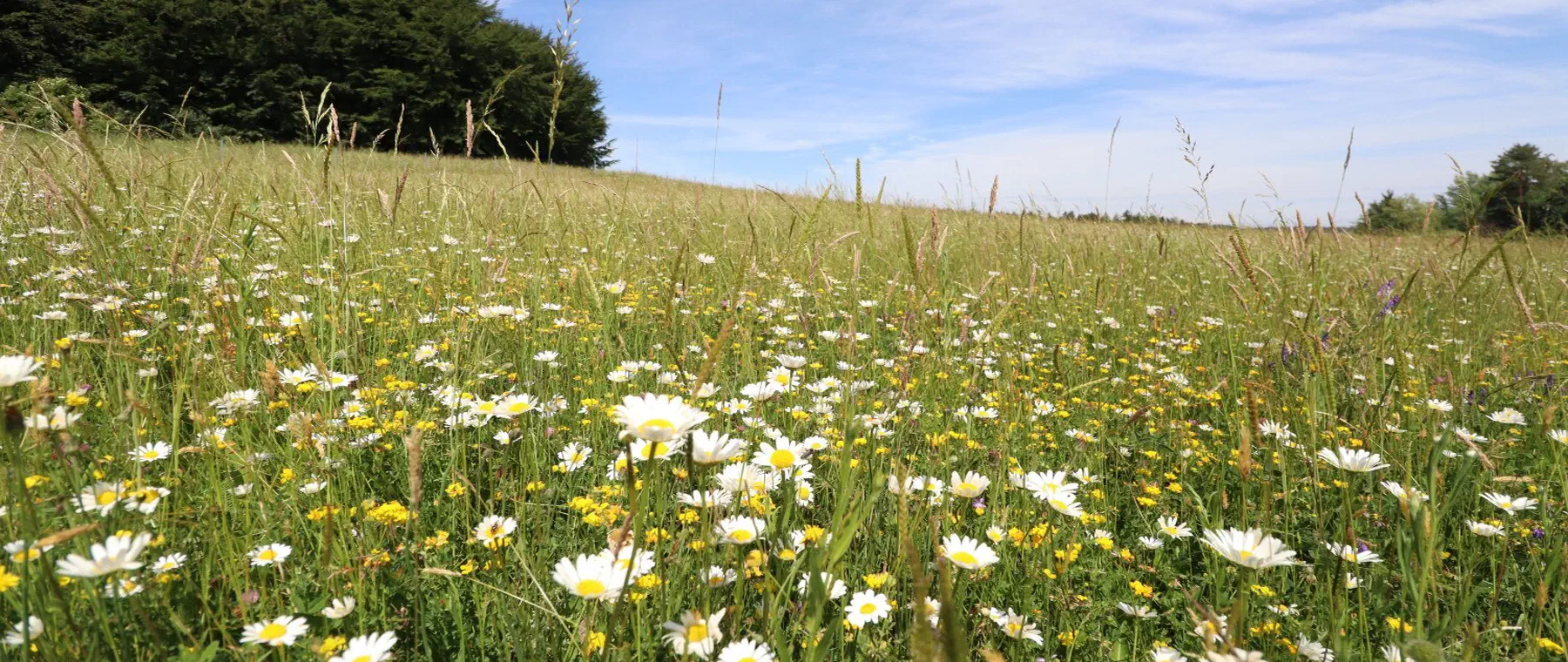
Eco-points in natural region D49
Gutland (Bitburger Land)
Eco-points and compensation measures in the natural region D49 Gutland und Luxemburger Sandstein, west and north of Trier. greeNature plans and implements nature-conservation enhancements under the Landeskompensationsverordnung (LKompVO) of Rhineland-Palatinate, and operates nationwide as a partner in doing so.
Natural region D49 at a glance
The natural region D49 Gutland und Luxemburger Sandstein lies in the far west of Rhineland-Palatinate, west and north of Trier, and extends with a narrow strip around Perl into Saarland. It forms the German continuation of the Luxembourg Gutland. Broad, undulating plateaus at around 400 metres elevation are structured by deeply incised valleys, running mainly north to south, of the Sauer, Prüm, Nims and Kyll.
The subsoil consists of limestones, clays and marls of the Muschelkalk and Keuper. In the west, the Ferschweiler Plateau shapes the landscape, where Luxemburger Sandstein, a lime-bound sandstone of the lower Lias, forms extensive rock formations and heavily fissured fringe areas. The fertile soils of the plateaus mainly carry arable land, while grassland remains confined to hillside locations and valley floors, and the steep slopes carry broadleaf woodland with widespread coppice management.
Of nature-conservation importance are the sandstone rock formations and ravine woodland of the Ferschweiler Plateau, calcareous grassland on the slope edges, the near-natural stream valleys, and the Mardellen, small standing water bodies of the plateaus. Parts of the natural region belong to the Südeifel Nature Park. FFH and Special Protection Areas protect, among other things, sandstone beech woodland, bat roosts and watercourse habitats, although the overall protected-area share is rather small-scale.
Impacts on nature and landscape must be compensated under sections 13 to 15 BNatSchG. In Rhineland-Palatinate, the Landeskompensationsverordnung (LKompVO) applies for this, with a standardised habitat value procedure, supplemented by the eco-account under section 16 BNatSchG for advance measures. For the Saarland parts, the local state law applies. Species protection under section 44 BNatSchG requires, in individual cases, advance CEF measures to secure the protection of breeding sites and resting places.
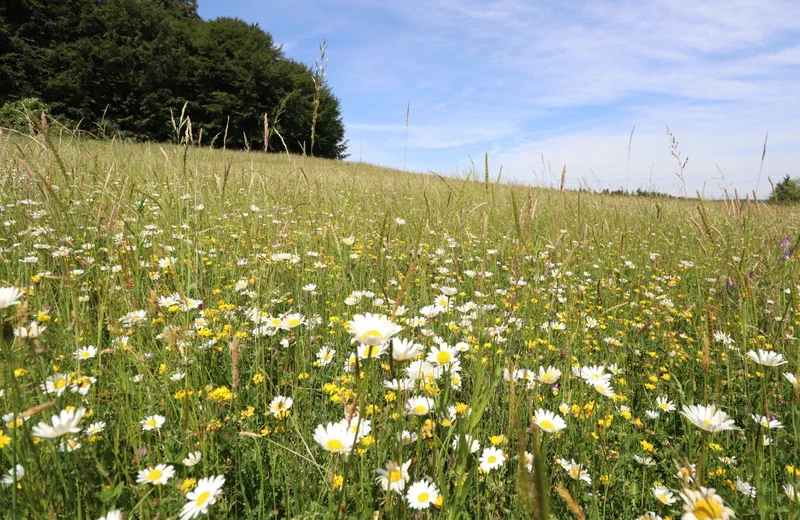
📍 Districts covered
🌿 Ecological features
- Ferschweiler Plateau with extensive rock formations of Luxemburger Sandstein and ravine woodland
- Deeply incised stream valleys of the Sauer, Prüm, Nims and Kyll with near-natural watercourses
- Calcareous grassland and dry sites on the Muschelkalk slope edges
- Mardellen as characteristic small water bodies of the plateaus, valuable for amphibians
- The European wildcat and black stork as flagship species of the contiguous woodland areas in the Südeifel Nature Park
- Traditional coppice woodland and traditional orchard use as defining elements of the cultural landscape
- Bat roosts in sandstone caves and old adits
✅ greeNature in this region
greeNature operates nationwide and is familiar with the authorities responsible in the natural region, such as the Struktur- und Genehmigungsdirektion Nord and the lower nature conservation authorities in the Eifelkreis Bitburg-Prüm and the Landkreis Trier-Saarburg. We confidently apply the Rhineland-Palatinate habitat value procedure under the LKompVO, and take Saarland compensation law into account for the parts around Perl.
Typical measures in natural region D49
Extensively managed grassland on the plateaus
Conversion of intensive arable land into species-rich, extensively managed grassland on the plateaus, to benefit open-land species such as the skylark and to sustainably raise the habitat value.
Developing calcareous grassland
Restoration and management of calcareous grassland and semi-dry grassland on the Muschelkalk slope edges through scrub clearance and adapted grazing or mowing.
Restoring stream valleys
Restoration of the watercourses of the Prüm, Nims and Kyll with riparian buffer strips, floodplain woodland and structural enrichment, as habitat for the kingfisher and aquatic organisms.
Woodland conversion to broadleaf woodland
Conversion of structurally poor conifer plantations into site-appropriate oak-hornbeam and beech woodland, to connect woodland habitats for the European wildcat and hazel dormouse.
Mardellen and small water bodies
Creation and restoration of Mardellen and other small water bodies on the plateaus as spawning habitats for amphibians, where required as an advance CEF measure.
Hedgerows and traditional orchards
Creation of traditional orchards, hedgerows and field copses for habitat connectivity, and as guiding structures and roosts for bats and the hazel dormouse.
Protected species in the Gutland (Bitburger Land)
European wildcat
The contiguous broadleaf woodland of the Südeifel and the Gutland is among the core areas of the European wildcat. Woodland connectivity and low-disturbance stands secure its habitat.
About this species ›Black stork
The black stork breeds in low-disturbance, wooded stream valleys and depends on near-natural watercourses with a rich supply of food.
About this species ›Bats
Sandstone caves, rock crevices and old adits of the Ferschweiler Plateau provide important roosts. Guiding structures and woodland edges are important for hunting.
About this species ›Kingfisher
On the near-natural stream courses of the Prüm, Nims and Kyll, the kingfisher finds steep banks for breeding and structurally rich watercourse sections for foraging.
About this species ›Hazel dormouse
Coppice woodland, woodland edges, hedgerows and traditional orchards form the ideal habitat of the hazel dormouse, which depends on well-connected woody structures.
About this species ›Skylark
The open arable plateaus of the Gutland are breeding grounds for the skylark. Extensification and flowering strips improve food supply and cover.
About this species ›Your route to eco-points in D49
Contact and enquiry
Tell us your compensation requirement and the natural region. We check availability.
Offer and advice
A transparent offer covering measure types, scope and availability.
Coordination with authorities
Full coordination with the lower nature conservation authority. We handle everything.
Long-term monitoring
Permanent securing of the land, management and documentation across the contract term.
Eco-points in neighbouring natural regions
All about natural region D49
Request eco-points in natural region D49
We will promptly prepare a transparent offer with matching eco-points held in stock in the Gutland (Bitburger Land).