Eco-points in natural region D46
Westhessisches Berg- und Beckenland
Eco-points and full-service compensation in the natural region D46 Westhessisches Bergland. greeNature develops and manages compensation measures under the Hessian Kompensationsverordnung (KV), nationwide and with knowledge of the regional authorities.
Natural region D46 at a glance
The Westhessisches Bergland, also known as Westhessisches Berg- und Beckenland, extends mainly through Hesse and reaches into North Rhine-Westphalia with smaller parts. It covers around 4,700 square kilometres and is divided into wooded upland ranges such as the Kellerwald, the Burgwald and the Habichtswälder Bergland, as well as fertile basin landscapes such as the Westhessische Senke and the Amöneburger Becken. Geologically, Zechstein and Buntsandstein shape the subsoil, with Muschelkalk, Lower Jurassic, Tertiary and volcanic basalts occurring in places. The highest peak is the Wüstegarten in the Kellerwald, at a good 675 metres.
Characteristic are the extensive, in places old-growth-like European beech woodland. In the Kellerwald-Edersee National Park, they have been recognised as a UNESCO World Natural Heritage Site since 2011. This near-natural broadleaf woodland provides habitat for the European wildcat, black stork, Bechstein's bat and numerous deadwood-dependent species. The river and stream valleys of the Eder, Schwalm, Fulda and Lahn are home to the kingfisher and bullhead, while the open arable Börde areas of the basin locations are characterised by farmland species such as the skylark.
For impacts on nature and landscape, the nature-conservation impact mitigation regulation under sections 13 to 15 BNatSchG applies. In Hesse, the compensation requirement is determined in eco-points using the habitat value procedure of the Kompensationsverordnung (KV). Enhancements can be credited to an eco-account with the responsible nature conservation authority in advance and later debited for specific projects. Compensation and replacement should, wherever possible, be located within the same natural region or within the same and a neighbouring district.
Alongside land-based compensation, the special species protection under section 44 BNatSchG must be observed. Where a project affects the breeding sites or resting places of protected species, advance compensation measures (CEF measures) are required and must already be effective before the impact occurs. In FFH sites, the favourable conservation status (FCS) of the relevant species and habitat types must additionally be maintained.
📍 Districts covered
🌿 Ecological features
- Kellerwald-Edersee National Park, with a UNESCO World Natural Heritage Site of old beech woodland
- Kellerwald-Edersee and Habichtswald nature parks
- Highest peak the Wüstegarten in the Kellerwald, at a good 675 metres
- Extensive, in places old-growth-like European beech woodland with a high proportion of dead wood
- Fertile arable Börde areas in the Westhessische Senke, Kasseler Becken and Amöneburger Becken
- River systems of the Eder, Schwalm, Fulda and Lahn with numerous FFH and Special Protection Areas
✅ greeNature in this region
greeNature operates nationwide and is familiar with the administrative structures and state law in Hesse. For the natural region D46, we know the requirements of the Kompensationsverordnung, the habitat value procedure in eco-points, and the practice of managing eco-accounts at the lower nature conservation authorities of districts such as Waldeck-Frankenberg, Kassel, Schwalm-Eder and Marburg-Biedenkopf.
Typical measures in natural region D46
Near-natural woodland conversion
Development of site-native mixed beech and oak woodland, enrichment with old and dead wood, and designation of habitat trees to enhance structurally poor plantations.
Restoring watercourses and floodplains
Removal of channel modifications, planting of riparian woodland, and restoration of connectivity on the Eder, Schwalm, Fulda and Lahn, to benefit the kingfisher and bullhead.
Creating and managing traditional orchards
New planting and restoration of standard fruit-tree stands as species-rich habitat and a traditional landscape feature of the Hessian uplands.
Extensifying grassland
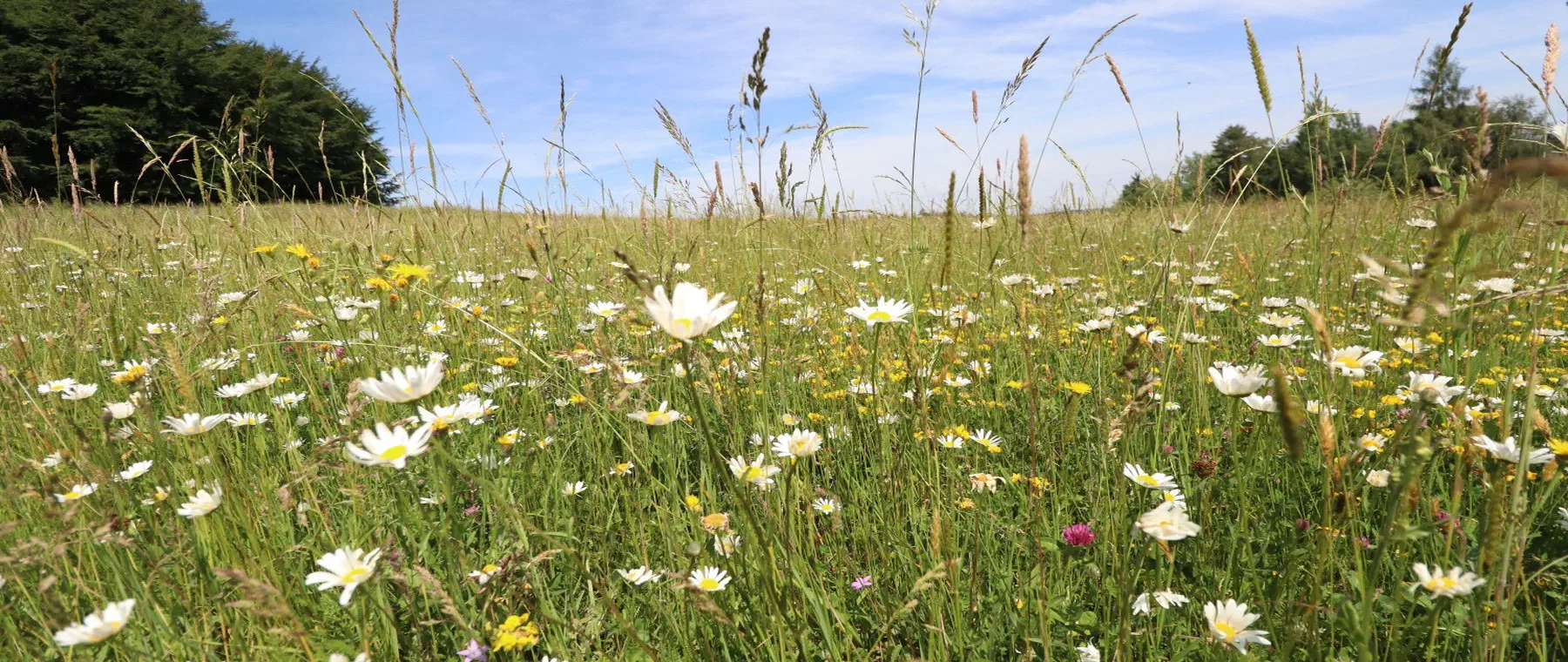
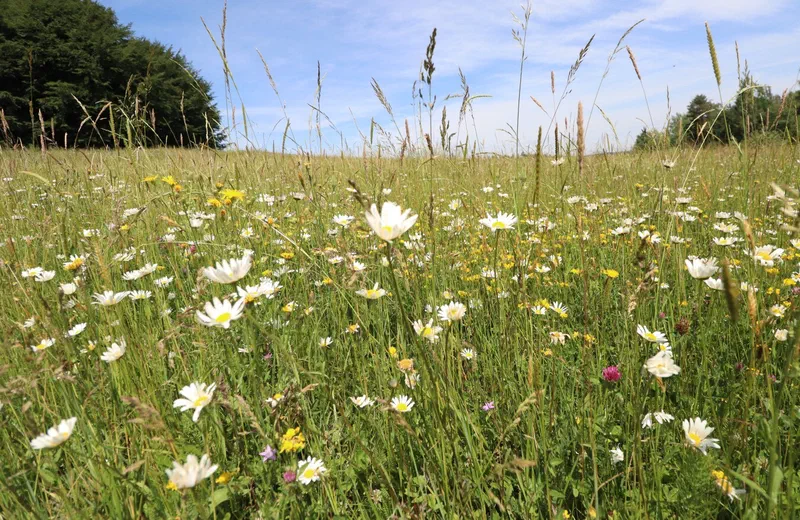
Conversion of intensively used land into species-rich, nutrient-poor grassland, and management of calcareous grassland and basalt domes through adapted mowing or grazing.
Developing hedgerows and field copses
Structuring cleared arable Börde areas with hedgerows, field margins and field copses, including as skylark plots and flowering strips in the sense of CEF measures.
Creating small water bodies for amphibians
Creation of new sunlit spawning waters and connected terrestrial habitats for amphibians such as the great crested newt, often as an advance species-protection measure.
Protected species in the Westhessisches Berg- und Beckenland
European wildcat
The European wildcat is regarded as a characteristic species of the large, unfragmented beech woodland in the Kellerwald and neighbouring woodland areas. It depends on structurally rich woodland with dead wood and quiet refuges.
About this species ›Black stork
The black stork, sensitive to disturbance, breeds in extensive, old broadleaf woodland and uses near-natural streams and wet meadows as foraging habitat. It is a planning-relevant species in the natural region.
About this species ›Bats
Woodland species such as Bechstein's bat find roosts and hunting habitats in the beech woodland, rich in old and dead wood. Roost trees and hunting grounds must be secured as part of species protection under section 44 BNatSchG.
About this species ›Hazel dormouse
The hazel dormouse inhabits structurally rich woodland, woodland edges and hedgerows with dense undergrowth. It is sensitive to the fragmentation of woody connections.
About this species ›Kingfisher
The kingfisher inhabits near-natural watercourses with clear water and steep banks, for example along the Eder, Schwalm and Lahn. Restored watercourse sections benefit its population.
About this species ›Skylark
In the open arable Börde areas of the basin locations, the skylark is a typical breeding bird of the open farmland. Skylark plots and flowering strips are proven measures to support it.
About this species ›Your route to eco-points in D46
Contact and enquiry
Tell us your compensation requirement and the natural region. We check availability.
Offer and advice
A transparent offer covering measure types, scope and availability.
Coordination with authorities
Full coordination with the lower nature conservation authority. We handle everything.
Long-term monitoring
Permanent securing of the land, management and documentation across the contract term.
Eco-points in neighbouring natural regions
All about natural region D46
Request eco-points in natural region D46
We will promptly prepare a transparent offer with matching eco-points held in stock in the Westhessisches Berg- und Beckenland.