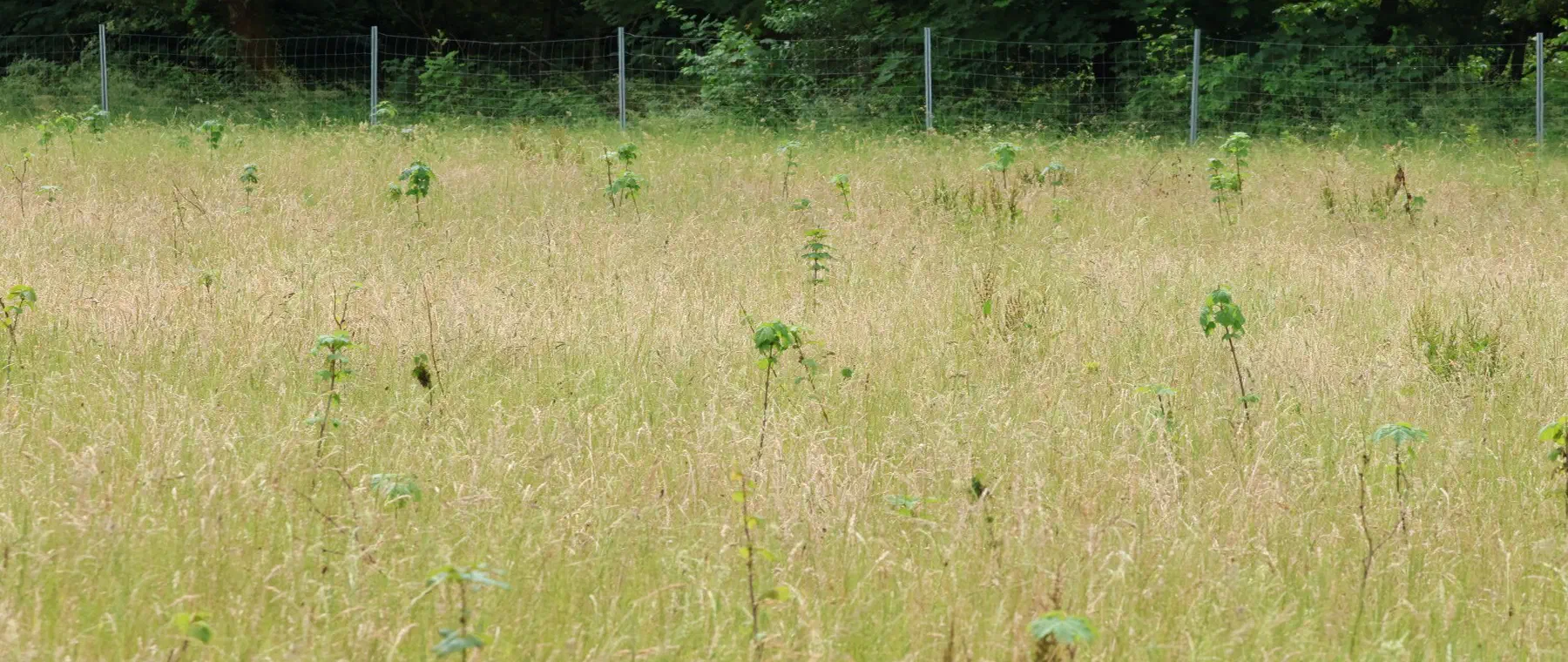
Eco-points in natural region D42
Hunsrück
Compensation and eco-points in the natural region D42 Hunsrück, assessed under the Landeskompensationsverordnung (LKompVO) of Rhineland-Palatinate. greeNature develops and manages compensation areas true to the natural region, from land acquisition to long-term management, operating nationwide and with knowledge of the responsible local authorities.
Natural region D42 at a glance
The natural region D42, the Hunsrück, forms an extensive, predominantly wooded central upland range in south-western Germany. It extends in a south-west to north-east direction over around 100 km between the Mosel, Nahe, Rhine and Saar, and covers an area of around 2,700 km². By far the largest part lies in Rhineland-Palatinate, with a smaller part in Saarland. Characteristic are elongated, domed ridges such as the Idarwald, Soonwald, Osburger and Schwarzwälder Hochwald, between which the somewhat lower-lying Hunsrückhochfläche, with its cleared settlement pockets, forms a transition. With the Erbeskopf (816 m), this is where the highest peak in Rhineland-Palatinate is located.
Geologically, the Hunsrück is almost entirely shaped by the Devonian. The subsoil consists of clay slate (Hunsrückschiefer), greywackes and the resistant Taunusquarzite, which form the ridges as hard backbones. These rocks have given rise mainly to shallow, acidic and nutrient-poor soils. In the cool, damp ridge locations, the Hangbrücher have formed as a special feature, small-scale acidic hillside bogs that are among the rarest habitats in the region.
Large parts of the Hunsrück are wooded, in many places with spruce plantations planted in the past century, alongside extensive beech and oak woodland. At its centre lies the Hunsrück-Hochwald National Park, jointly established by Rhineland-Palatinate and Saarland in 2015, which is home to one of the largest European wildcat populations in Europe and provides habitat for the black stork, black woodpecker and numerous bat species. Cool upland streams, montane hay meadows, mat-grass swards and the Hangbrücher complete the mosaic of valuable habitats. Many areas are part of the European Natura 2000 protected-area network as FFH and Special Protection Areas.
For impacts on nature and landscape, the impact mitigation regulation under sections 13 to 15 BNatSchG applies in Rhineland-Palatinate, in conjunction with the Landeskompensationsverordnung (LKompVO). The compensation requirement is determined using a habitat value procedure with habitat value points, set out in more detail in the state-wide practice guide. Enhancements can be stockpiled in advance through an eco-account and recorded in the compensation register. The link to the natural region is important here, because compensation and replacement should take effect, wherever possible, where the impact affects the landscape.
📍 Districts covered
🌿 Ecological features
- Hunsrück-Hochwald National Park, jointly run by Rhineland-Palatinate and Saarland, with one of the largest European wildcat populations in Europe.
- Hangbrücher, small-scale acidic hillside bogs that make up around a fifth of the national park area and occur in this form in hardly any other woodland area.
- Erbeskopf (816 m), the highest peak in Rhineland-Palatinate, with the wooded ridges of the Idarwald, Soonwald and Osburger and Schwarzwälder Hochwald.
- Devonian basement rocks (Hunsrückschiefer, Taunusquarzit, greywacke), from which shallow, acidic and nutrient-poor soils have developed.
- Extensive woodland areas, formerly planted as spruce plantations, with high potential for near-natural woodland conversion.
- Near-natural, cool upland streams such as the Ruwer and Dhron with occurrences of the bullhead, brook lamprey and kingfisher.
- Species of the open plateaus such as the skylark and red kite, alongside disturbance-sensitive woodland species such as the black stork and black woodpecker.
✅ greeNature in this region
greeNature operates nationwide and develops eco-account and compensation areas in the natural region D42 Hunsrück that suit the character of the landscape. We secure suitable land, plan the enhancement under the Landeskompensationsverordnung of Rhineland-Palatinate, and coordinate the measures with the lower nature conservation authorities as well as with landowners, forestry operations and municipalities. We are also familiar with the requirements of state law in the Saarland part of the natural region. From concept through implementation to long-term management, monitoring and documentation for recognition, project developers receive compensation from a single source. Where there is a need for species protection under section 44 BNatSchG, we design advance CEF measures that continuously secure the ecological function for the species affected.
Typical measures in natural region D42
Near-natural woodland conversion
Conversion of non-native spruce plantations into site-native beech and sessile oak woodland, together with the retention of old and dead wood. This strengthens structurally rich, climate-resilient woodland and creates habitat for cavity-nesting birds, bats and the European wildcat.
Rewetting hillside bogs
Blocking of drainage channels and rewetting of the Hangbrücher. These rare bog habitats store carbon, retain water in the landscape and are home to highly specialised plant and insect species.
Restoring upland streams
Removal of bank reinforcement and transverse structures, development of floodplain woodland fringes and riparian buffer strips on the Ruwer, Dhron and their tributaries. Near-natural, cool streams benefit the bullhead, brook lamprey and kingfisher.
Managing montane meadows and mat-grass swards
Retention and restoration of species-rich montane hay meadows, mat-grass swards and arnica meadows through adapted mowing and extensive grazing. These nutrient-poor open-land habitats are among the most valuable at higher elevations.
Hedgerows, field margins and traditional orchards
Creation and management of hedgerows, field copses, woodland edges and standard traditional orchards on the cleared settlement pockets of the Hunsrückhochfläche. Such features connect habitats and benefit farmland birds and insects.
CEF/FCS species protection
Creation of sunlit small water bodies for the yellow-bellied toad, securing of bat roosts, and development of woodland-edge and corridor structures for the European wildcat, aligned with the requirements of section 44 BNatSchG.
Protected species in the Hunsrück
European wildcat
The Hunsrück-Hochwald National Park is home to one of the largest European wildcat populations in Europe. This shy species needs extensive, low-disturbance broadleaf woodland with dead wood and structurally rich edges. Woodland conversion and habitat networking secure its habitats and movement corridors.
About this species ›Black stork
The black stork, sensitive to disturbance, breeds in quiet, stream-crossed woodland areas of the Hunsrück. It depends on large, undisturbed territories and near-natural watercourses as foraging habitat.
About this species ›Bats
Numerous bat species have been recorded in the Hunsrück and its national park, including Bechstein's bat and the greater mouse-eared bat. Old broadleaf woodland, caves and adits serve as roosts, and stands rich in old and dead wood as hunting grounds.
About this species ›Yellow-bellied toad
The yellow-bellied toad inhabits sunlit, sparsely vegetated small water bodies, water-filled vehicle ruts and quarries. As a strictly protected species under section 44 BNatSchG, it benefits from the targeted creation of new spawning waters through CEF measures.
About this species ›Hazel dormouse
The hazel dormouse lives in scrub-rich woodland edges, hedgerows and coppice woodland with a rich supply of fruit, buds and berries. Structurally rich transitions between woodland and open land are essential for it.
About this species ›Skylark
The skylark nests on the ground in the open, cleared settlement pockets of the Hunsrückhochfläche. It suffers from dense, uniform field stands; skylark plots, flowering strips and extensively managed field margins improve its breeding success.
About this species ›Your route to eco-points in D42
Contact and enquiry
Tell us your compensation requirement and the natural region. We check availability.
Offer and advice
A transparent offer covering measure types, scope and availability.
Coordination with authorities
Full coordination with the lower nature conservation authority. We handle everything.
Long-term monitoring
Permanent securing of the land, management and documentation across the contract term.
Eco-points in neighbouring natural regions
All about natural region D42
Request eco-points in natural region D42
We will promptly prepare a transparent offer with matching eco-points held in stock in the Hunsrück.