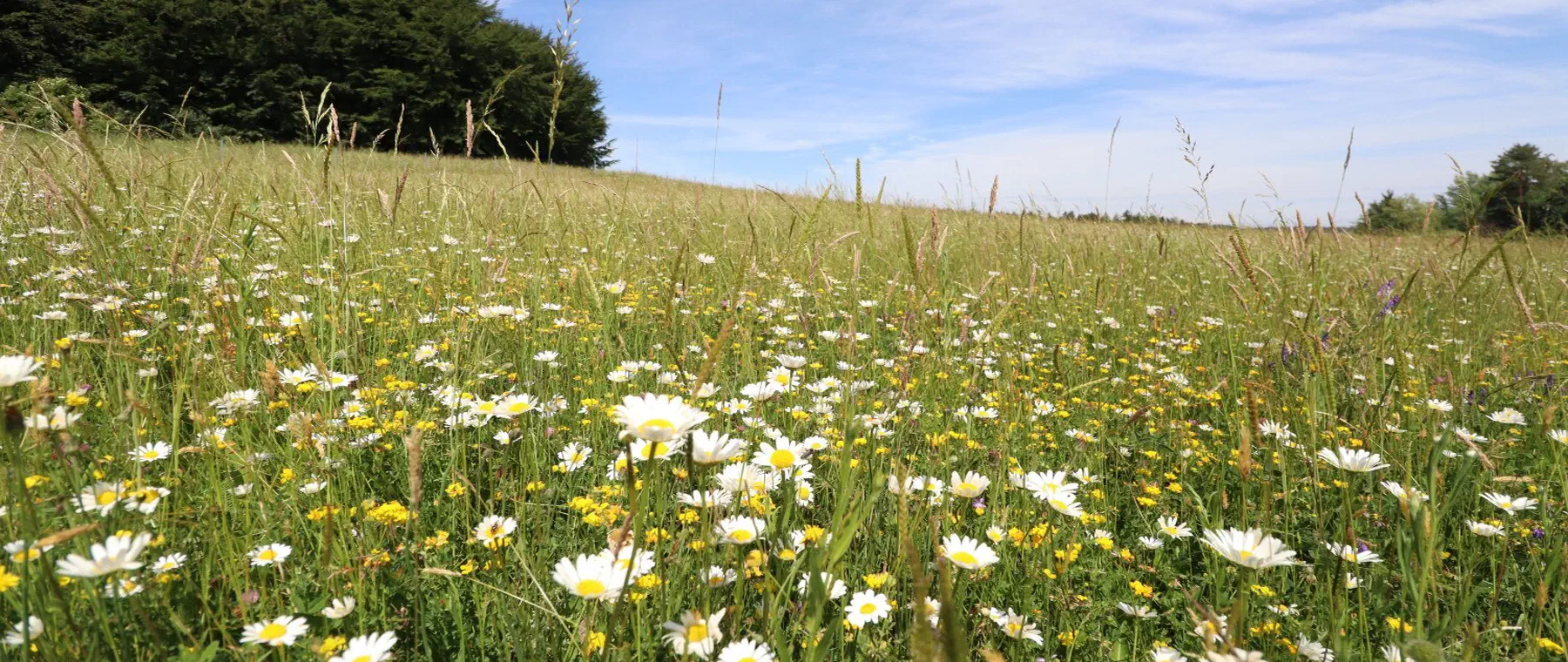
Eco-points in natural region D39
Westerwald
Immediately available eco-points and full-service compensation in the natural region D39 Westerwald. greeNature supports your project nationwide, with assessment under the Landeskompensationsverordnung (LKompVO) in Rhineland-Palatinate as well as the procedures in Hesse and North Rhine-Westphalia.
Natural region D39 at a glance
The natural region D39, Westerwald, is a basalt central upland range in the Rheinisches Schiefergebirge east of the Rhine. It covers around 3,278 km² and lies mainly in Rhineland-Palatinate, with parts in Hesse (the Lahn-Dill area, the Limburg-Weilburg area) and, in the north-west, in North Rhine-Westphalia. The natural region is bounded by the valleys of the Sieg, the Rhine, the Lahn and the Dill.
Geologically, the Westerwald rests on a basement of Devonian shales and greywackes, which was overprinted by volcanism with basalt during the Tertiary. The Hoher Westerwald has striking basalt domes, with the Fuchskaute at 657 m as the highest peak. The Kannenbäckerland around Höhr-Grenzhausen holds one of the largest clay deposits in Europe and is the basis of the traditional ceramics industry. The harsh, rain-rich climate shapes a cultural landscape dominated by grassland and livestock farming.
Ecologically, the extensive meadows and pastures of the Hoher Westerwald alternate with beech and oak-hornbeam woodland and stream valleys with alder floodplain forest. The Westerwälder Seenplatte, with the Dreifelder Weiher, is an important wetland and bird conservation area. The Rhein-Westerwald nature park is one of the oldest nature parks in Germany (founded in 1962). The natural region provides habitat for the black stork, European wildcat and numerous bat species.
For impacts, the impact mitigation regulation under sections 13 to 15 BNatSchG applies. In the principal state of Rhineland-Palatinate, assessment is carried out under the Landeskompensationsverordnung (LKompVO) with a standardised habitat value procedure and the option of an eco-account. In the Hessian parts, the Kompensationsverordnung (KV Hessen) applies, and in the North Rhine-Westphalian parts, the LNatSchG NRW with the Eco-Account Ordinance. greeNature coordinates land, measures and liaison with the authorities across state borders.
📍 Districts covered
🌿 Ecological features
- Hoher Westerwald with characteristic basalt domes, highest peak the Fuchskaute (657 m)
- Westerwälder Seenplatte with the Dreifelder Weiher, an important wetland and bird conservation area
- Rhein-Westerwald Nature Park (1962), one of the oldest nature parks in Germany
- Kannenbäckerland with one of the largest clay deposits in Europe, the basis of the ceramics industry
- Tertiary volcanism, basalt as the defining rock and a regional raw material
- Extensive grassland and meadow landscapes under a harsh, Atlantic-influenced climate
- Beech woodland, oak-hornbeam woodland and near-natural stream valleys with alder floodplain forest
✅ greeNature in this region
greeNature operates nationwide and is familiar with the responsible nature conservation authorities and the state law in Rhineland-Palatinate, Hesse and North Rhine-Westphalia. For projects in the Westerwald, we take on land acquisition, measure planning under the LKompVO (in the Hessian and North Rhine-Westphalian parts, under the respective state procedures), and complete coordination with the lower nature conservation authorities.
Typical measures in natural region D39
Grassland extensification
Conversion of intensively used land into species-rich meadows and wet meadows of the Hoher Westerwald, valuable for meadow-breeding birds and the characteristic open-land fauna.
Near-natural woodland conversion
Development of site-appropriate beech and oak-hornbeam woodland with old and dead wood components, climate-resilient and providing habitat for the black stork and cavity-dwelling species.
Watercourse restoration
Removal of channel modifications in the stream valleys of the Westerwald, planting of riparian woodland, and creation of near-natural streambed structures for the kingfisher, brook lamprey and bullhead.
Ponds and wetland habitats
Creation and connection of new small water bodies and ponds around the Seenplatte, spawning habitats for the great crested newt, yellow-bellied toad and other amphibians.
Hedgerows and habitat connectivity
Creation of hedgerows, field copses and woodland edges as stepping stones and movement corridors, among others for the hazel dormouse and European wildcat between woodland complexes.
CEF and FCS species protection
Tailored advance compensation measures under section 44 BNatSchG, such as roost provisions for bats in old basalt quarries and woodland stands.
Protected species in the Westerwald
Black stork
The extensive, low-disturbance broadleaf woodland with accompanying stream valleys provides the black stork with breeding and foraging habitats. Measures target nest-site protection, near-natural woodland edges and restored watercourses.
About this species ›European wildcat
The Westerwald belongs to the range of the strictly protected European wildcat, for example in the corridor at the Kalteiche. Woodland connectivity and structurally rich woodland edges secure genetic exchange.
About this species ›Hazel dormouse
Structurally rich, berry-bearing woodland edges, hedgerows and scrub are habitat for the hazel dormouse. As an Annex IV species under section 44 BNatSchG, it regularly triggers CEF measures for impacts.
About this species ›Kingfisher
The kingfisher hunts along the near-natural streams and the shores of the Westerwald ponds. Watercourse restoration and the creation of steep banks as breeding habitat are typical compensation measures.
About this species ›Great crested newt and amphibians
The pond landscape of the Seenplatte and numerous small water bodies are home to the great crested newt and other amphibians. The creation and connection of fish-free spawning waters increase the compensation value.
About this species ›Bats
Old beech woodland and disused basalt quarries serve numerous bat species as roosts and hunting grounds. Roost protection and hunting habitat management are possible under section 44 BNatSchG.
About this species ›Your route to eco-points in D39
Contact and enquiry
Tell us your compensation requirement and the natural region. We check availability.
Offer and advice
A transparent offer covering measure types, scope and availability.
Coordination with authorities
Full coordination with the lower nature conservation authority. We handle everything.
Long-term monitoring
Permanent securing of the land, management and documentation across the contract term.
Eco-points in neighbouring natural regions
All about natural region D39
Request eco-points in natural region D39
We will promptly prepare a transparent offer with matching eco-points held in stock in the Westerwald.