Eco-points in natural region D33
Nördliches Harzvorland
Eco-points and compensation areas in natural region D33 Nördliches Harzvorland, between the Braunschweig area, the Elm and the Halberstadt Börde. The natural region lies in Lower Saxony and Saxony-Anhalt, and assessment follows the respective state law.
Natural region D33 at a glance
The Nördliches Harzvorland is BfN major natural region D33 of the Federal Agency for Nature Conservation. It runs as a transitional landscape between the Harz in the south and the North German lowland in the north, from the Braunschweig area via Wolfenbüttel and Helmstedt into the Halberstadt Börde in Saxony-Anhalt.
Characteristic is the alternation of fertile loess Börde soils and narrow, wooded ridges. Elm, Asse, Oderwald, Lappwald, Huy and Fallstein rise out of the arable landscape as Muschelkalk and Buntsandstein ridges. The Elm carries one of the largest continuous limestone beech forests in northern Germany.
Ecologically significant are the limestone beech forests with their species-rich herb layer, the calcareous grassland on the slope edges with orchid populations, and the Großes Bruch, an extensive fen depression on the state border. The ridges serve as refuges in an otherwise intensively farmed landscape.
For compensation this creates a particular situation: on the high-quality loess soils land is scarce and expensive, and the potential for ecological enhancement lies above all on the slope edges, in the stream lowlands and along the woodland edges of the ridges. greeNature secures precisely these locations and coordinates the measures with the competent authorities in both federal states.
📍 Districts covered
🌿 Ecological features
- Limestone beech forests in the Elm, one of the largest continuous stands in northern Germany
- Calcareous grassland on the Muschelkalk slope edges with orchid populations
- Großes Bruch as an extensive fen depression on the state border
- The Elm, Asse, Oderwald, Lappwald, Huy and Fallstein ridges as woodland islands in the arable landscape
- Traditional orchards and hedgerows on the transitions between Börde and ridge
- Stream lowlands of the Oker, Ilse and Bode as habitat network axes towards the Harz
✅ greeNature in this region
We work on both sides of the state border and know both the Lower Saxony biotope value procedure and the eco-account regulation of Saxony-Anhalt. For projects in the Nördliches Harzvorland we secure land on the slope edges, in the stream lowlands and along the woodland edges of the ridges, and we carry out creation, management and performance review.
Typical measures in natural region D33
Forest conversion and securing of old-growth timber
Transfer of structurally poor stands into near-natural beech and oak mixed woodland, plus designation of habitat trees and enrichment with deadwood. The measures act directly on bats, woodpeckers and wood-dwelling beetles.
Developing and managing calcareous grassland
Scrub clearance, sheep grazing and sectional mowing on the Muschelkalk slope edges. The sunlit, nutrient-poor sites are among the most species-rich habitats of the natural region and are home to orchids and thermophilic insects.
Creating traditional orchards
Creation and reactivation of standard-tree orchards on village edges and at the foot of slopes. Old fruit trees provide cavities for little owl, wryneck and bats, and they connect settlement and open land.
Field margins and flowering areas
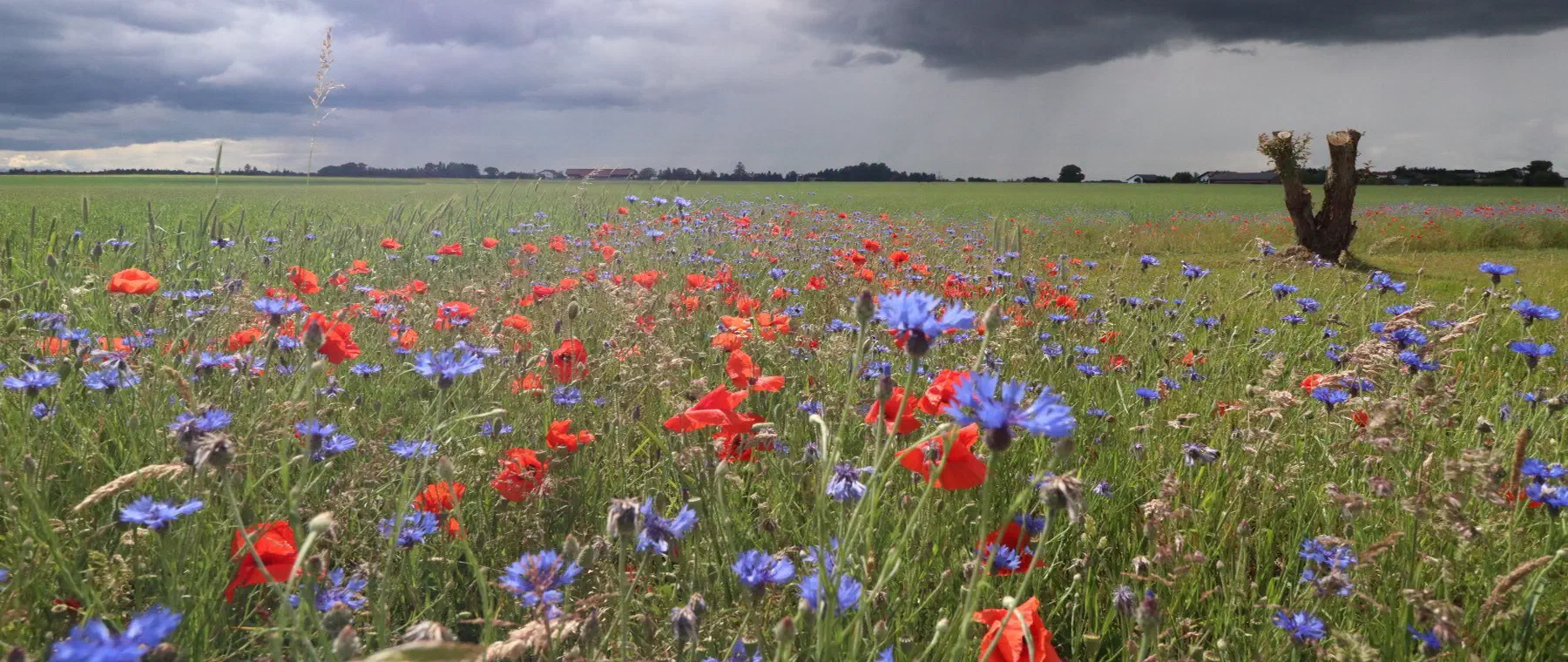
Creation of extensive margins, flowering strips and skylark plots in the cleared loess Börde. As advance CEF measures they secure breeding and feeding habitats for skylark, grey partridge and common hamster.
Stream restoration and fen
Removal of watercourse reinforcement on the Oker, Ilse and Bode, creation of riparian buffer strips and rewetting of fen areas in the Großes Bruch. This improves water retention and the habitat network at the same time.
Hedgerows and woodland edge design
Graded build-up of woodland edges and creation of hedgerows between the ridges. They connect the isolated woodland islands and create migration corridors for European wildcat and hazel dormouse.
Protected species in the Nördliches Harzvorland
European wildcat in the Elm and Lappwald
The continuous deciduous woodlands of the ridges lie within the range of the European wildcat. The strictly protected species under Annex IV of the FFH Directive needs undisturbed old-growth stands, root plates and brash piles as breeding places, as well as continuous woodland corridors.
About this species ›Hazel dormouse on woodland edges
Structurally rich woodland edges and hedgerows with fruit-bearing shrubs are hazel dormouse habitats. Where impacts affect woody stands, advance habitat enhancement, connection and nest tubes are the usual CEF measures.
About this species ›Bats in the limestone beech forest
Old beech stands with woodpecker holes and crevice roosts provide maternity roosts for Bechstein's bat and barbastelle. The loss of roost trees requires replacement roosts and the permanent securing of habitat trees.
About this species ›Skylark in the loess Börde
The large arable fields of the Harz foreland are skylark habitat, though with a continuing decline in numbers. Skylark plots, flowering strips and fallow strips are the typical advance measures where impacts occur.
About this species ›Your route to eco-points in D33
Contact and enquiry
Tell us your compensation requirement and the natural region. We check availability.
Offer and advice
A transparent offer covering measure types, scope and availability.
Coordination with authorities
Full coordination with the lower nature conservation authority. We handle everything.
Long-term monitoring
Permanent securing of the land, management and documentation across the contract term.
Eco-points in neighbouring natural regions
All about natural region D33
Request eco-points in natural region D33
We will promptly prepare a transparent offer with matching eco-points held in stock in the Nördliches Harzvorland.