Eco-points in natural region D32
Niedersächsische Börden
Eco-points and compensation in natural region D32 Niedersächsische Börden, the fertile loess belt in south-eastern Lower Saxony. greeNature develops and manages compensation sites true to the natural region under the NAGBNatSchG and the Lower Saxony biotope value procedure, nationwide and with knowledge of the regional authorities.
Natural region D32 at a glance
Natural region D32, the Niedersächsische Börden, stretches as a fertile loess belt through south-eastern Lower Saxony. Between the Weser-Aller-Flachland in the north and the Niedersächsisches Bergland in the south lies a gently undulating, widely open arable landscape. It includes well-known sub-areas such as the Hildesheimer Börde, the Calenberger Börde and the Braunschweiger Börde, grouped around the five-city cluster of Hannover, Braunschweig, Salzgitter, Peine and Hildesheim.
A cover of Ice Age loess up to two metres thick is a defining feature, from which some of the most fertile soils in Germany have developed, including deep chernozem soils and luvisols. The substrate of Triassic, Jurassic and Cretaceous rock is crossed by salt domes, which arch up individual ridges and hills. The balanced climate, with mild winters and moderate rainfall, has favoured arable farming for centuries.
Over wide stretches, sugar beet, winter wheat and potatoes shape the landscape. The proportion of woodland is low, near-natural features are rare, and designated nature reserves cover only a small part of the area. As a result, the remaining habitats, such as the Bockmerholz/Gaim oak-hornbeam woodland or the wetlands around the Salzgittersee and the Lengeder Teiche, bear a particular responsibility for species protection.
For impacts on nature and landscape, the impact mitigation regulation under §§ 13 to 15 BNatSchG applies, given specific form in Lower Saxony through the NAGBNatSchG. Assessment takes place through a biotope value procedure (the Städtetag model), and completed measures and eco-accounts are recorded in the state-wide compensation register. In the intensively used Börde landscape in particular, it is demanding to find suitable enhancement sites, which requires careful planning true to the natural region.
📍 Districts covered
🌿 Ecological features
- A loess cover up to two metres thick, with some of the most fertile soils in Germany (chernozem soils and luvisols).
- A national stronghold of the strictly protected common hamster in the Hildesheimer and Calenberger Börde.
- An intensively used, woodland-poor arable landscape with sugar beet, cereals and potatoes.
- A very low proportion of nature reserves and FFH sites, which gives each individual enhancement measure particular weight.
- Important breeding areas for open-land species such as the northern lapwing, grey partridge, common quail, corn bunting and skylark.
- The Bockmerholz/Gaim oak-hornbeam woodland as an FFH site, and the Salzgittersee and Lengeder Teiche as an EU bird protection area.
- A substrate of Triassic, Jurassic and Cretaceous rock, crossed by salt domes.
✅ greeNature in this region
greeNature is active nationwide and supports project developers and municipalities in Lower Saxony too through statutory nature-conservation compensation. We know the requirements of the NAGBNatSchG, the biotope value procedure applied in Lower Saxony, and the practice of the lower nature conservation authorities, which maintain the compensation register. In the intensively used Börde landscape, we secure suitable sites, plan enhancements typical of the natural region, implement them, and take on permanent management as well as documentation for official recognition. Where a need arises under species protection law under § 44 BNatSchG, for example for the common hamster or open-land birds, we develop advance CEF measures that continuously secure the ecological function for the affected species.
Typical measures in natural region D32
Common hamster protection and CEF measures
Creating hamster-friendly management strips with lucerne, cereals and standing harvest residues on the loess soils of the Börde. As advance CEF measures, they secure cover and food for the common hamster, strictly protected under § 44 BNatSchG.
Field margins and flowering areas
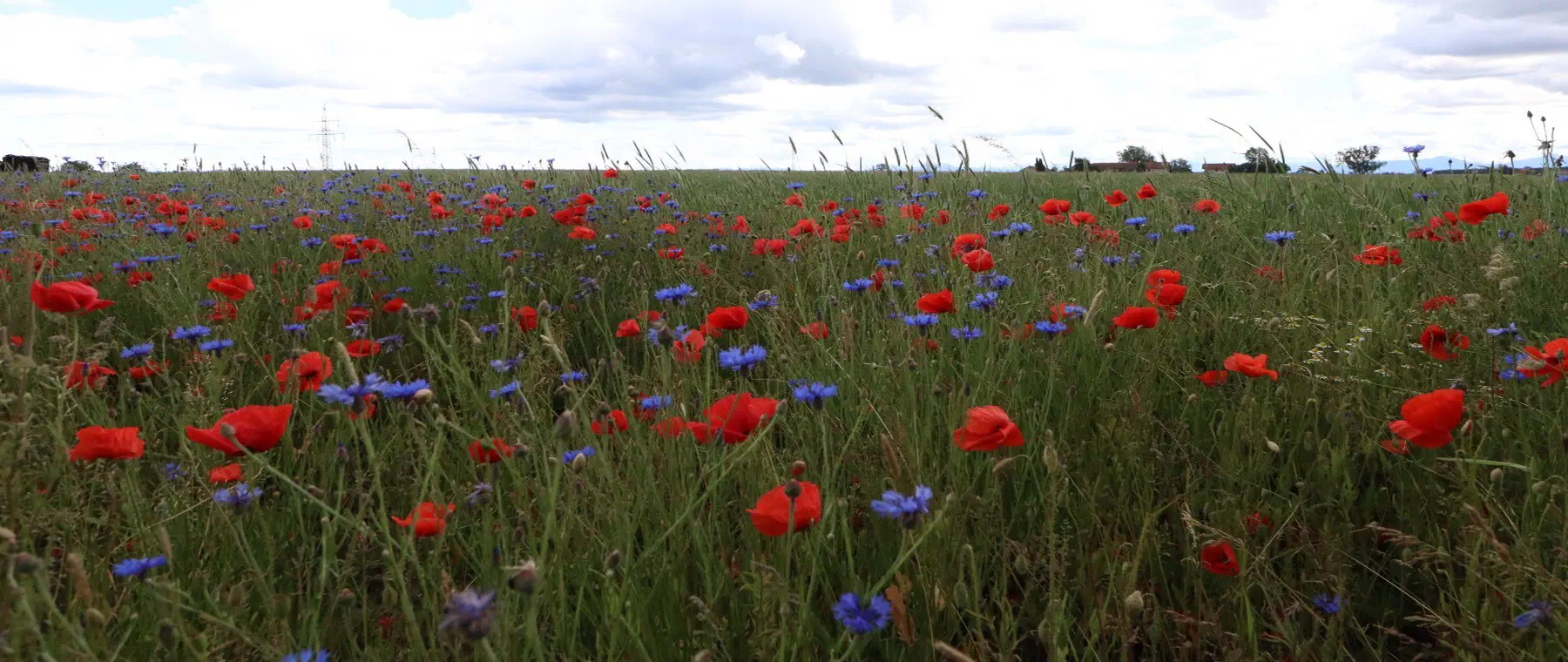
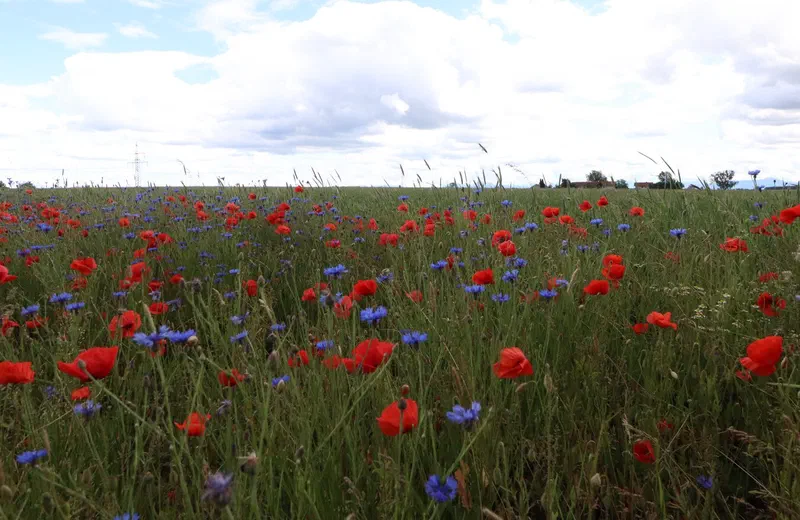
Extensive field margins, perennial flowering areas and skylark plots in the cleared farmland. They support the skylark, grey partridge, corn bunting and wild bees, and measurably enhance the intensively used farmland landscape.
Hedgerows, field copses and field margins
Creating new hedgerows, field copses and wide field margins as a habitat network. These features connect isolated habitats, provide cover and counteract the clearing of structure from the Börde landscape.
Small water bodies and shallow scrapes
Creating sunlit, fish-free small water bodies, shallow scrapes and flood hollows for amphibians and meadow birds. In the water-scarce farmland, they create valuable stepping stones and breeding sites.
Floodplain development and grassland extensification
Extensification of grassland and restoration of streams and rivers such as the Innerste, Fuhse and Oker. Riparian buffer strips, floodplain woodland fringes and wet meadows improve water retention and habitat diversity.
Broadleaf woodland and woodland-edge development
Development of site-appropriate oak-hornbeam and beech woodland and near-natural woodland edges, together with the retention of old and dead wood, for example around Bockmerholz/Gaim. This strengthens bats, cavity-nesting birds and the increasingly rare woodland islands.
Protected species in the Niedersächsische Börden
European hamster
The Börde region is one of the national strongholds of the European hamster. This strictly protected species (Annex IV of the FFH Directive) inhabits the deep loess soils and, in the case of impacts, regularly depends on advance CEF measures such as protective strips and adapted farming practices.
Skylark
A characteristic bird of the open arable landscape. Its numbers are declining owing to intensive land use. Skylark plots, flowering strips and extensively managed field margins are effective enhancements that can be credited as compensation.
About this species ›Northern lapwing
The northern lapwing breeds in damp hollows and on open arable land in the Börde. It benefits from shallow pools, flood hollows and extensively managed wet grassland, which are created through CEF and compensation measures.
About this species ›Grey partridge and corn bunting
Grey partridge, corn bunting, quail and yellow wagtail are typical breeding birds of the Börde landscape. They need field-margin structures, fallow land and buffer strips, which are deliberately restored in the cleared arable landscape.
Bats
Broadleaf woodland islands such as Bockmerholz/Gaim and old tree stands provide bats with roosts and hunting grounds. The retention of old and dead wood, together with connecting hedgerows and woody structures, secures their habitats.
About this species ›Great crested newt
The great crested newt (Annex IV of the FFH Directive) inhabits fish-free small water bodies in the woodland islands and the open farmland. Newly created, sunlit spawning waters benefit the species and can readily be implemented as a compensation measure.
About this species ›Your route to eco-points in D32
Contact and enquiry
Tell us your compensation requirement and the natural region. We check availability.
Offer and advice
A transparent offer covering measure types, scope and availability.
Coordination with authorities
Full coordination with the lower nature conservation authority. We handle everything.
Long-term monitoring
Permanent securing of the land, management and documentation across the contract term.
Eco-points in neighbouring natural regions
All about natural region D32
Request eco-points in natural region D32
We will promptly prepare a transparent offer with matching eco-points held in stock in the Niedersächsische Börden.