Eco-points in natural region D04
Mecklenburgische Seenplatte
Immediately available eco-points from officially recognised eco-accounts in natural region D04. greeNature solutions, your full-service partner for compensation in the Mecklenburgische Seenplatte around the Müritz.
Natural region D04 at a glance
Natural region D04, the Mecklenburgische Seenplatte, comprises the inland lake district of Mecklenburg around the Müritz and the Mecklenburg Great Lakes. It is a young moraine landscape that formed around 20,000 years ago during the Weichselian glaciation as the inland ice retreated.
Ground and terminal moraines, outwash plains and ice-age meltwater channels shape a relief exceptionally rich in water bodies. Between more than 1,000 lakes, countless kettle holes (small water bodies of the ground moraine) and extensive fens, near-natural mixed beech forests alternate with large pine plantations on nutrient-poor sands.
At the heart of the region lies the Müritz-Nationalpark, covering 322 km², Germany's largest inland national park. Its Serrahn section, an area of ancient beech forest, forms part of the UNESCO World Natural Heritage. The Müritz itself is the largest lake lying entirely within Germany, alongside the Kölpinsee, Fleesensee and Plauer See.
The silting-up zones, wet meadows and bogs are particularly valuable as habitat and as a resting and breeding area for cranes, white-tailed eagles and ospreys. This setting offers wide-ranging potential for ecologically effective compensation measures.
📍 Districts covered
🌿 Ecological features
- Müritz: at around 110 km², the largest lake lying entirely within Germany
- Müritz-Nationalpark: at 322 km², Germany's largest inland national park
- Serrahn in the Müritz-Nationalpark: UNESCO World Natural Heritage ancient beech forests
- The Mecklenburg Great Lakes chain of Müritz, Kölpinsee, Fleesensee and Plauer See
- More than 1,000 lakes as well as countless kettle holes as small water bodies of the ground moraine
- Extensive fens with high potential for rewetting
- An important resting and breeding area for cranes, white-tailed eagles and ospreys
✅ greeNature in this region
In the Mecklenburgische Seenplatte, greeNature develops and manages eco-account and compensation areas in accordance with the requirements of the state of Mecklenburg-Western Pomerania. We secure suitable sites, plan enhancements typical of the natural region such as bog rewetting, water body and bank restoration or forest conversion, and coordinate them with the districts' lower nature conservation authorities. Impact and compensation are assessed uniformly across the state according to the Hinweise zur Eingriffsregelung (HzE M-V), with recognition and booking of eco-points via an eco-account under the ÖkoKtoVO M-V. From site selection through implementation to permanent management and documentation, we support project developers, municipalities and companies so that compensation takes effect within the affected natural region wherever possible.
Typical measures in natural region D04
Bog rewetting
Rewetting drained fens in the lake and valley lowlands, a type of measure with high ecological value and great significance for the water balance and climate protection in the lake district.
Water body and bank restoration
Developing near-natural lakeshores and silting-up zones, establishing riparian buffer strips and restoring watercourses and small water bodies as habitat for amphibians, dragonflies and water birds.
Forest conversion
Converting non-native pine plantations into site-appropriate, climate-resilient mixed beech and oak woodland, secured long-term and with high structural and habitat value for native woodland fauna.
Grassland extensification
Extensifying wet grassland in the lowlands of the Great Lakes, converting intensively used land into species-rich wet meadows for meadow-breeding birds such as northern lapwing, snipe and crane.
Species protection CEF/FCS
Measures for white-tailed eagle, osprey and black stork (nest protection and quiet zones), bat roosts and amphibian waters, designed according to the Hinweise zur Eingriffsregelung M-V.
Structural enrichment of farmland
Creating hedgerows, field copses and kettle holes as stepping-stone habitats in the cleared agricultural landscape of the ground moraine, with flower strips and skylark plots for open-land species.
Protected species in the Mecklenburgische Seenplatte
White-tailed eagle & osprey
The great lakes and forests of the region are among the most important breeding areas for white-tailed eagle and osprey in Germany. The white-tailed eagle remains year-round, while the osprey hunts over the open water surfaces. Nest protection and undisturbed quiet zones are typical protective measures.
Crane & kingfisher
Bogs and shallow lakeshores are resting and breeding sites of European importance for the crane. The kingfisher breeds at clear waters and steep banks. CEF measures: shallow-water zones, shallow pools and near-natural eroding banks.
About this species ›Black stork
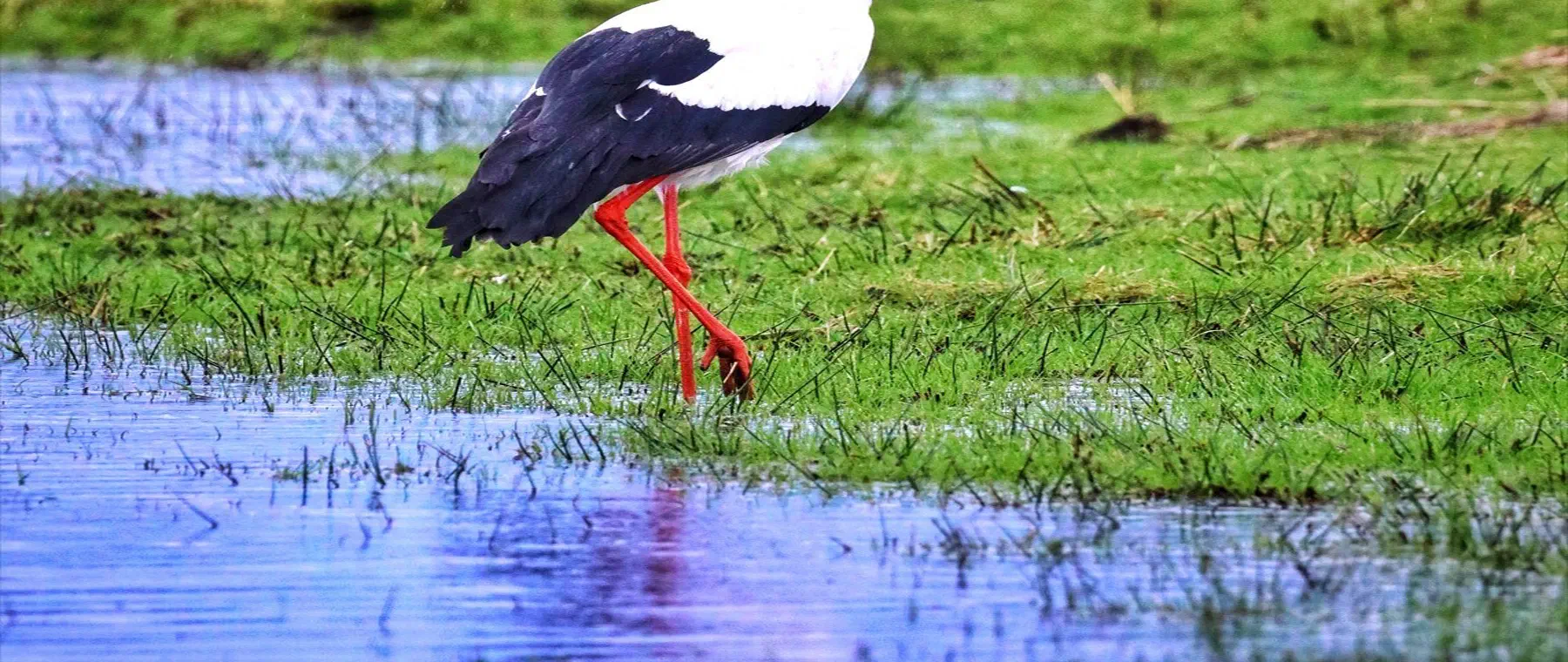
The large, undisturbed forest areas around the Müritz and Nossentiner Heide provide the black stork with breeding territory and foraging habitat at forest streams and wet meadows. Forest conversion and watercourse restoration strengthen its populations.
About this species ›Bats
Old beech forests, tree cavities and hunting grounds rich in water bodies host a species-rich bat fauna, including barbastelle bat and greater mouse-eared bat. Roost protection and securing foraging habitats are effective compensation measures.
About this species ›Amphibians in kettle holes and bogs
Kettle holes, bog waters and small water bodies of the ground moraine are habitat for fire-bellied toad, European tree frog and great crested newt. Creating and desilting small water bodies are among the classic species protection measures in the lake district.
About this species ›Meadow-breeding birds in wet grassland
Northern lapwing, snipe and meadow pipit use the wet meadows of the lake and river lowlands as breeding grounds. Grassland extensification, rewetting and flood hollows specifically improve their habitats.
About this species ›Your route to eco-points in D04
Contact and enquiry
Tell us your compensation requirement and the natural region. We check availability.
Offer and advice
A transparent offer covering measure types, scope and availability.
Coordination with authorities
Full coordination with the lower nature conservation authority. We handle everything.
Long-term monitoring
Permanent securing of the land, management and documentation across the contract term.
Eco-points in neighbouring natural regions
All about natural region D04
Request eco-points in natural region D04
We will promptly prepare a transparent offer with matching eco-points held in stock in the Mecklenburgische Seenplatte.