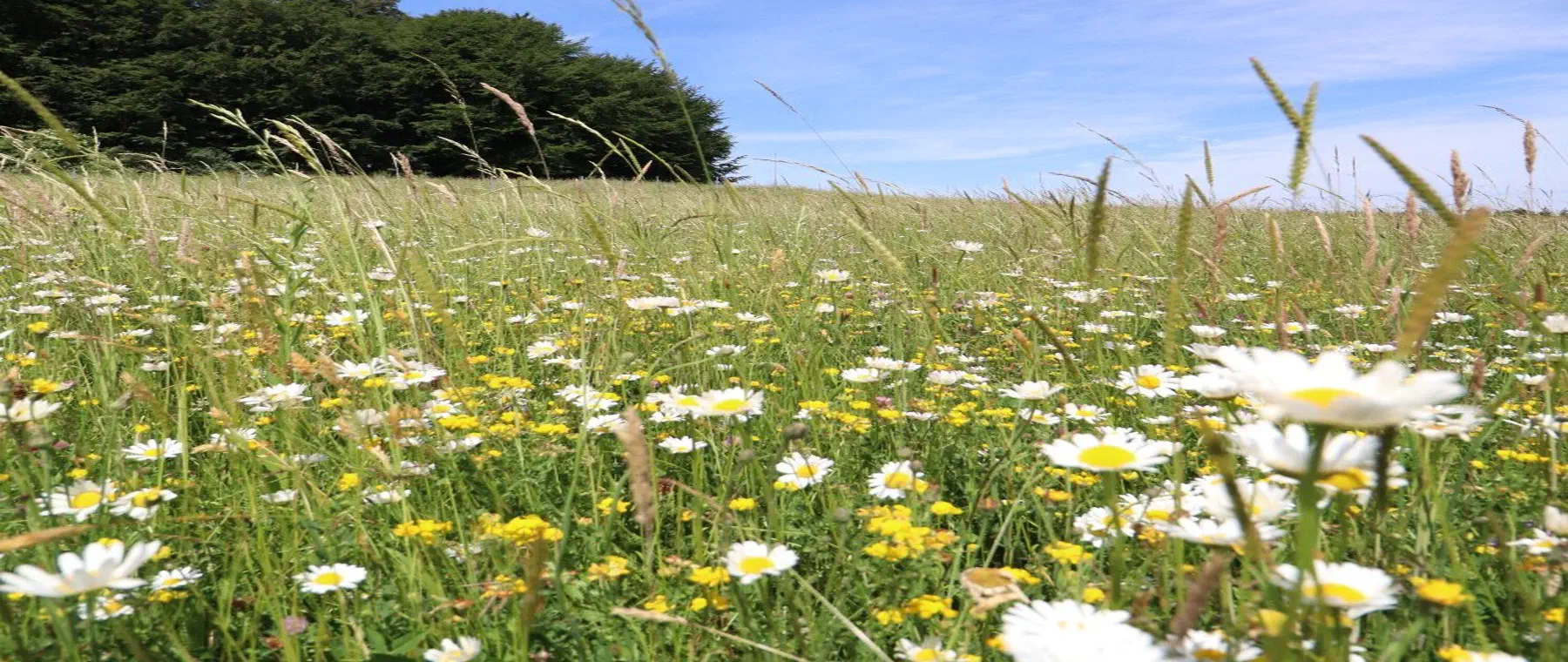
Eco-points and compensation areas
District of Schmalkalden-Meiningen
Eco-points and compensation areas in Schmalkalden-Meiningen district, assessed according to the Thuringian compensation model. greeNature is your nationwide full-service partner for compensation of impacts between Thuringian forest and Rhön.
The District of Schmalkalden-Meiningen at a glance
Schmalkalden-Meiningen district is located in south-western Thuringia and extends from the Rennsteig on the ridge of the Thuringian forest in the north to the High Rhön and Grabfeld in the south. Since Thuringia has no administrative regions, there is no district administration between district and federal state level. District seat and administrative centre is Meiningen.
In terms of natural regions, the district has shares in three BfN major regions. The forested north belongs to the Thuringian-Franconian central uplands (D48) with the Thuringian forest heights around Oberhof and Brotterode. The central and western district with the Salzungen-Meiningen Werra highlands and the Thuringian Rhön counts to the East Hessian highlands (D47), the far south extends to the Main Franconian plateaus (D56) in the Grabfeld.
Ecologically significant are the mountain meadows and mountain hay meadows of the Rhön, the chalk and basalt domes of the dome Rhön and the near-natural mountain mixed forests of the Thuringian forest. The characterising flowing water is the Werra with its tributaries and floodplains. Large parts of the district lie in the UNESCO biosphere reserve Rhön and the Thuringian forest Nature Park.
Economy combines small and medium-sized industry (tool, metal and vehicle manufacturing around Schmalkalden and Zella-Mehlis) with agriculture and forestry as well as strong tourism, such as the winter sports location Oberhof. Traffic, commercial and energy projects regularly trigger impacts, whose compensation in Thuringia must be provided according to the Thuringian compensation model on the basis of the impact mitigation regulation (§§ 13 to 15 BNatSchG), ThürNatG and the Thuringian Compensation Ordinance.
🗺️ Associated natural regions
Go to natural region D47 ›
Go to natural region D48 ›
Go to natural region D56 ›
📍 Selected municipalities
🌿 Ecological features
- UNESCO biosphere reserve Rhön, whose Thuringian section covers approximately 84,000 ha in the natural regions High Rhön and Front Rhön
- Thuringian forest Nature Park in the north-west of the district with the Rennsteig as a high ridge path
- Numerous FFH sites and a bird protection site, in the Rhön cared for by the Rhön Natura 2000 station with seat in Kaltensundheim
- Species-rich mountain meadows and mountain hay meadows (FFH habitat type) as habitat for whinchat, meadow pipit and black grouse
- Chalk and basalt domes of the dome Rhön with chalk grasslands and thermophilic species
- Werra and its side waters with floodplains, wet and wet grassland as habitat networking axis
✅ greeNature on the ground
greeNature operates nationwide and is familiar with the Thuringian compensation system. We work with the lower nature conservation authority of Schmalkalden-Meiningen district and the regional Natura 2000 stations, are familiar with assessment according to ThürNatG and the Thuringian Compensation Ordinance and the special features of the mountain meadow, forest and Werra landscapes in natural regions D48, D47 and D56. From requirement identification through land securing to implementation, management and monitoring, we accompany your project throughout.
Typical measures in the district of Schmalkalden-Meiningen
mountain meadows and mountain hay meadows
Restoration and extensive management of species-rich mountain and mountain hay meadows in the Rhön and Thuringian forest through adapted mowing, no fertilisation and grazing. Such measures achieve high enhancements in the Thuringian compensation model and secure FFH habitat types.
Restoration of Werra and streams
Dismantling of bank structures, creation of watercourse buffer strips and near-natural redesign of Werra and its tributaries. Newly created aue waters and damp depressions create habitat for amphibians, dragonflies and the kingfisher.
near-natural forest conversion
Conversion of structurally poor spruce forests of the Thuringian forest into site-appropriate mountain mixed forests with beech, sycamore, fir and ash. Mature and deadwood structures promote cavity-nesting birds, bats and the European wildcat.
orchards and hedgerows in the Werra valley
Creation and management of orchard stands, hedgerows and field copses on the sun-exposed slopes of the Werra highlands. These structures network habitats and upgrade the agricultural landscape for birds and insects.
chalk grasslands of the dome Rhön
Clearing and grazing of chalk and basalt domes to preserve thermophilic grasslands. They house rare orchids, butterflies and wild bees and are among the high-value compensation targets of the region.
species protection CEF and FCS
Advance compensation measures under § 44 BNatSchG, such as replacement quarters for bats in forest and buildings, habitat structures for hazel dormouse and replacement spawning waters for amphibians, coordinated to the respective project.
Protected species in the Southern Thuringia between Thuringian forest and Rhön
European wildcat in the Thuringian forest
The contiguous broadleaf and mountain mixed forests of the Thuringian forest are among the core habitats of the European wildcat (Annex IV FFH Directive). Forest conversion, deadwood enrichment and networking of forest areas are typical measures.
About this species ›black stork in forest valleys
The black stork breeds in undisturbed old-growth stands and hunts at near-natural streams and damp meadows. Watercourse restoration and the protection of undisturbed forest areas secure its breeding and food habitats.
About this species ›bats in forest and Rhön
Bechstein's bat, Barbastelle bat and greater mouse-eared bat use old forests, caves and buildings in the region. When tree felling or building demolition occurs, replacement quarters as CEF measures under § 44 BNatSchG are required.
About this species ›hazel dormouse in hedgerows and broadleaf forest
The strictly protected hazel dormouse inhabits structurally rich broadleaf forests, forest edges and hedge rows of the Werra highlands. Preservation and new creation of woody structures in spatial context secure its breeding sites.
About this species ›amphibians at springs and streams
Fire salamanders in the stream valleys of the Thuringian forest and yellow-bellied toads and common frogs in fluctuating damp depressions depend on clean small waters. New or restored spawning waters offset impacts.
About this species ›black grouse and meadow-breeding birds of the Rhön
The open mountain meadows and high moor remnants of the High Rhön are refuges for black grouse, whinchat and meadow pipit. Extensive grassland management and moor protection preserve this open, undisturbed landscape.
Which projects trigger a compensation obligation?
traffic and infrastructure
Expansion and maintenance of federal roads (B19, B62, B247), town bypasses and bridge works over Werra and streams regularly trigger compensation and replacement obligations. greeNature develops nature region-appropriate compensation areas for road authorities and municipalities.
wind energy and renewables
Wind energy projects in the vicinity of the Thuringian forest and ground-mounted photovoltaic systems require nature conservation compensation and frequently species protection measures (CEF and FCS) for bats and wind-sensitive bird species.
commerce and industry
Expansions and new settlements in tool, metal and vehicle manufacturing around Schmalkalden, Zella-Mehlis and Meiningen as well as new commercial areas create compensation requirements. Land owners can offer their properties as compensation areas.
tourism and winter sports Oberhof
Expansion of sports and tourism infrastructure at the winter sports location Oberhof in the sensitive mountain forest and meadow area requires carefully planned compensation and replacement measures in line with the biosphere reserve and FFH objectives.
From enquiry to monitoring
Contact and enquiry
Tell us your compensation requirement and the natural region. We check availability.
Offer and advice
A transparent offer covering measure types, scope and availability.
Coordination with authorities
Full coordination with the lower nature conservation authority. We handle everything.
Long-term monitoring
Permanent securing of the land, management and documentation across the contract term.
Eco-points in adjoining districts
All about eco-points
in the district of Schmalkalden-Meiningen
Request eco-points in the district of Schmalkalden-Meiningen
We will promptly prepare a transparent offer with matching eco-points held in stock in the district of Schmalkalden-Meiningen.