Eco-points and compensation areas
District of Saalfeld-Rudolstadt
Immediately available eco-points from authority-approved eco-accounts. greeNature is your full-service partner for compensation according to the Thuringian compensation model in the Thuringian slate mountains and upper Saale valley.
The District of Saalfeld-Rudolstadt at a glance
Saalfeld-Rudolstadt district is located in southern Thuringia and belongs to the East Thuringia planning region. Administrative seat and district seat is Saalfeld/Saale, second centre is Rudolstadt. The valley of the Saale, which runs through the district from south to north and connects the densely populated valley towns with the forest-rich heights of the Thuringian slate mountains, is characteristic.
Geologically, the district is divided into two areas. The larger, southern part belongs to the BfN natural region D48 (Thuringian-Franconian central uplands) with the slate and greywacke heights of the slate mountains, deeply incised stream valleys and rocky outcrops. The north around Rudolstadt counts to the edge plateaus of the Thuringian basin (D18) with Muschelkalk and Buntsandstein soils and thermophilic dry biotopes.
Ecologically, the district is of great significance. Approximately 400 square kilometres of the Thuringian slate mountains/Upper Saale Nature Park lie within the district, as well as 16 nature reserves and FFH sites in the Saale valley between Hohenwarte and Saalfeld and in the Schwarza valley. Species-rich mountain meadows, near-natural streams and extensive forests are habitat for black stork and European wildcat, which have re-established populations here.
Economically, the region is industrially characterised. Steel production in Unterwellenborn, medical technology, pharmaceuticals and the traditional glass and porcelain industry secure numerous jobs. Business expansion, traffic and energy projects regularly trigger impacts whose compensation must be provided according to the Thuringian compensation model (assessment according to ThürNatG and the Thuringian Compensation Ordinance).
🗺️ Associated natural regions
Go to natural region D18 ›
Go to natural region D48 ›
📍 Selected municipalities
🌿 Ecological features
- Thuringian slate mountains/Upper Saale Nature Park, approximately 400 km² within the district
- FFH site no. 154 Saale valley between Hohenwarte and Saalfeld
- FFH site no. 153 Schwarza valley from Goldisthal with tributaries, with NSG Schwarza valley
- 16 nature reserves, including species-rich mountain meadows such as NSG Wurmbergwiese
- Hohenwarte dam and reservoirs of the upper Saale (Saale cascade)
- Slate slopes, rocky outcrops and near-natural streams in the slate mountains
- Muschelkalk and Buntsandstein dry biotopes in the northern edge plateaus
✅ greeNature on the ground
greeNature operates nationwide and manages compensation projects in the Thuringian slate mountains and upper Saale valley. We are familiar with assessment according to the Thuringian compensation model, the requirements of the lower nature conservation authority in Rudolstadt and the natural region features of natural regions D48 and D18. From requirement analysis to acceptance, we take on the entire process.
Typical measures in the district of Saalfeld-Rudolstadt
Mountain meadows and mountain hay meadows
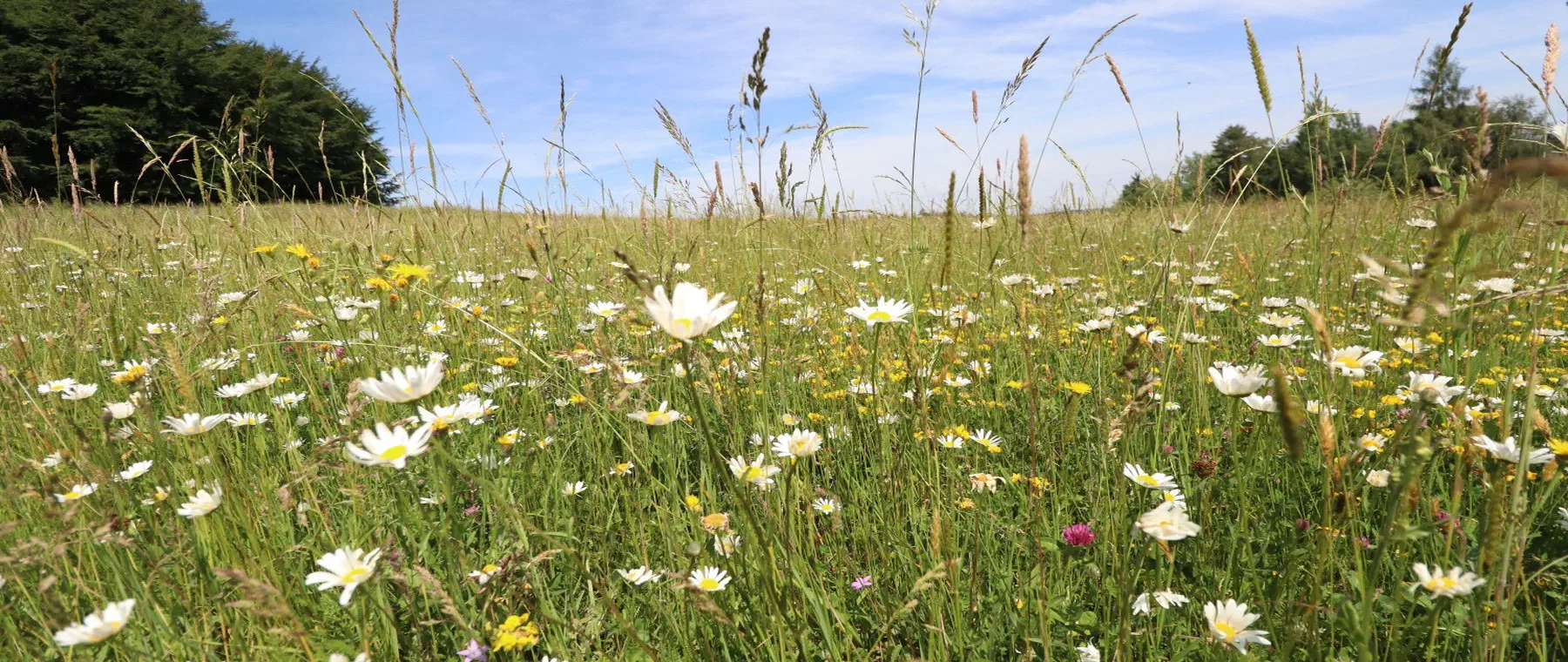
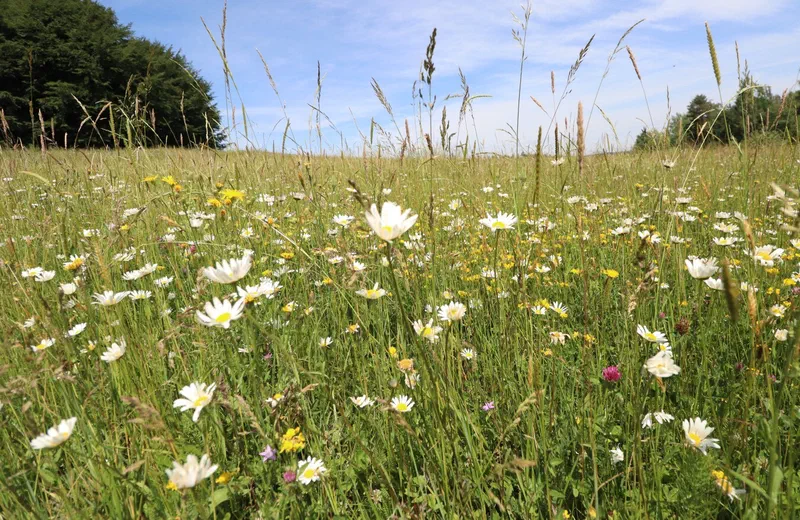
Preservation and development of species-rich mountain and damp meadows in the slate mountains through adapted mowing dates, no fertilisation and extensive grazing. Mountain hay meadows are among the protected FFH habitat types and are central to montane insect and plant diversity.
Flowing water and aue restoration
Dismantling of bank structures, connection of side channels and allowing natural development on Saale, Schwarza and Sormitz. This creates steep banks, gravel banks and riparian woodlands as habitat for kingfisher, fish and amphibians.
Near-natural forest conversion
Conversion of structurally poor spruce stands and rewilding of damaged areas into site-appropriate broadleaf and mixed forests of beech, fir, sycamore and oak and promotion of mature and deadwood. Such measures stabilise the forests and upgrade habitats of the slate mountain heights.
Dry biotopes and orchards
Management and new creation of lime grasslands, rocky slopes and orchard stands on the Muschelkalk and Buntsandstein plateaus in the north of the district. These thermophilic biotopes are home to specialised insects, reptiles and rare plants.
Species protection CEF and FCS
Advance replacement quarters for bats in buildings and forests, kingfisher steep banks on Saale and Schwarza, replacement spawning waters for amphibians and habitats for sand lizards, each as CEF or population-supporting FCS measures under § 44 and § 45 BNatSchG.
Hedgerows and habitat networking
Creation of hedgerows, field copses and forest edge structures in the agricultural landscape of valley areas and plateaus. These structures network habitats, create stepping-stone biotopes and support the migration of European wildcat between forest areas.
Protected species in the Thuringian slate mountains and upper Saale valley
black stork in forest valleys
The large contiguous forests and near-natural streams of the slate mountains offer the strictly protected black stork breeding and food habitats. When impacts occur in forest and water areas, disturbance protection, nest protection zones and securing of undisturbed feeding waters are required.
About this species ›European wildcat in forest areas
The European wildcat is documented in the Thuringian slate mountains, including in Schafbachtal. For the strictly protected species, unfragmented forests and networking woody structures are decisive. Habitat networking and forest edge design are typical measures in traffic and infrastructure projects.
About this species ›bats in forest and buildings
Numerous bat species use tree cavities, tunnels and roof spaces in the district. All species are strictly protected (Annex IV FFH Directive). When demolition, renovation or felling occurs, replacement quarters in spatial context as advance CEF measures are required.
About this species ›kingfisher on Saale and Schwarza
The near-natural riverbank sections of Saale, Schwarza and Sormitz provide steep banks as breeding sites. When impacts occur at watercourses, such as bridge or bank construction, steep bank modelling and bank restoration are proven CEF measures for the strictly protected kingfisher.
About this species ›amphibians in streams and ponds
Fire salamanders, yellow-bellied toads and common frogs inhabit the spring stream valleys, ponds and fluctuating damp depressions of the slate mountains. Creation and networking of spawning waters as well as protection of terrestrial habitats secure their breeding sites during construction projects.
About this species ›hazel dormouse in woody structures and forest edges
The strictly protected hazel dormouse inhabits structurally rich forest edges, hedgerows and shrub areas of the upland areas. In case of felling, sectional, technically accompanied removal of woody material and networking of replacement habitats are required.
About this species ›Which projects trigger a compensation obligation?
industry and commerce
Steel production in Unterwellenborn, medical technology and pharmaceuticals in the Rudolstadt area and glass and porcelain industry characterise the economy. Business expansions, new production facilities and commercial areas regularly create compensation requirements according to the Thuringian compensation model.
traffic and infrastructure
Expansion and renovation of federal and state roads, town bypasses, bridge works over the Saale and projects on the railway lines in the Saale valley trigger compensation and replacement obligations, often combined with species protection measures for European wildcat and bats.
energy and renewable facilities
Wind power on the heights of the slate mountains, ground-mounted photovoltaic systems and hydropower on the Saale cascade create compensation requirements and can trigger CEF and FCS measures for wind-sensitive species and aquatic species such as the kingfisher.
settlement and residential development
Residential and commercial land in Saalfeld, Rudolstadt and Bad Blankenburg lead to land sealing and require nature conservation compensation. Owners of suitable land can contribute their land to a land pool as land providers.
From enquiry to monitoring
Contact and enquiry
Tell us your compensation requirement and the natural region. We check availability.
Offer and advice
A transparent offer covering measure types, scope and availability.
Coordination with authorities
Full coordination with the lower nature conservation authority. We handle everything.
Long-term monitoring
Permanent securing of the land, management and documentation across the contract term.
Eco-points in adjoining districts
All about eco-points
in the district of Saalfeld-Rudolstadt
Request eco-points in the district of Saalfeld-Rudolstadt
We will promptly prepare a transparent offer with matching eco-points held in stock in the district of Saalfeld-Rudolstadt.