Eco-points and compensation areas
District of Gotha
Immediately available eco-points and compensation areas in the district of Gotha, assessed according to the Thuringian compensation model on the basis of the Thuringian Nature Conservation Act (ThürNatG) and the Thuringian Compensation Ordinance. greeNature is your nationwide full-service partner for compensation of impacts between the Thuringian basin and Thuringian forest.
The District of Gotha at a glance
The district of Gotha is located in western Thuringia and extends from the Großer Inselsberg (916 m) in the south to the Fahner heights in the north. The district seat is the former residence city Gotha. The district covers approximately 936 km² and about 135,800 inhabitants in 29 cities and municipalities. Thuringia is not divided into administrative regions, the district administration undertakes the duties of the lower nature conservation authority itself.
In terms of natural regions, the district is divided into two landscapes. The northern and central part belongs to the BfN natural region Thuringian basin and edge plateaus (D18), an open, fertile arable landscape with the Muschelkalk ridge of the Fahner heights and the lowlands of Nesse and Apfelstädt. The south lies in the Thuringian-Franconian central uplands (D48), the forested Thuringian forest with the Rennsteig on the ridge, montane beech forests, mountain meadows and near-natural upland streams.
Ecologically defining are extensive Natura 2000 areas. These include the FFH site Thuringian forest from Ruhla to Großer Inselsberg with montane beech and mixed forests, the Drei Gleichen with Muschelkalk dry grasslands and the Apfelstädtaue as a floodplain biotope. In the Thuringian forest lie the Schmalwasser and Ohra reservoirs in the catchment of the Apfelstädt. The contiguous forests are habitat for the European wildcat, the Fahner heights are a significant orchard and fruit-growing area.
Economically, the federal motorway 4 as an east-west axis, metal processing, mechanical engineering and automotive suppliers as well as logistics sites in the Neudietendorf and Nesse-Apfelstädt area at the junction of A4 and A71 define the district. Infrastructure, wind energy, ground-mounted photovoltaic systems, the planned expansion of pumped storage capacity at Schmalwasser and raw material extraction regularly trigger impacts. Compensation and replacement are assessed in Thuringia via the Thuringian assessment model according to ThürNatG and the Thuringian Compensation Ordinance in value units.
🗺️ Associated natural regions
Go to natural region D18 ›
Go to natural region D48 ›
📍 Selected municipalities
🌿 Ecological features
- The highest elevation is the Großer Inselsberg at 916 m in the Thuringian forest on the border with Wartburgkreis
- The Rennsteig runs along the ridge of the Thuringian forest and forms the southern district border in sections
- FFH site Thuringian forest from Ruhla to Großer Inselsberg with montane beech forests, mountain meadows and silicate cliffs
- Drei Gleichen with Muschelkalk dry grasslands as an FFH and bird protection site in the transition to Ilm district
- Fahner heights fruit-growing area, a Muschelkalk ridge with extensive orchards and apple plantations in the north of the district
- Schmalwasser and Ohra reservoirs in the Apfelstädt catchment and the Thuringian forest Nature Park
✅ greeNature on the ground
greeNature operates nationwide and manages compensation projects in the district of Gotha between the Thuringian basin and Thuringian forest. We are familiar with the lower nature conservation authority of the district of Gotha, the assessment of impact and compensation according to the Thuringian assessment model and the requirements of ThürNatG and the Thuringian Compensation Ordinance from practice. From land selection in the natural regions D18 and D48 to official recognition, we accompany your project fully.
Typical measures in the district of Gotha
Near-natural forest conversion
Conversion of structurally poor spruce forests to site-appropriate beech and upland mixed forests in the Thuringian forest and promotion of mature and deadwood. Such measures upgrade the habitats of European wildcat, black stork and forest-dependent bat species in the large forest areas of the district.
Mountain meadows and mountain hay meadows
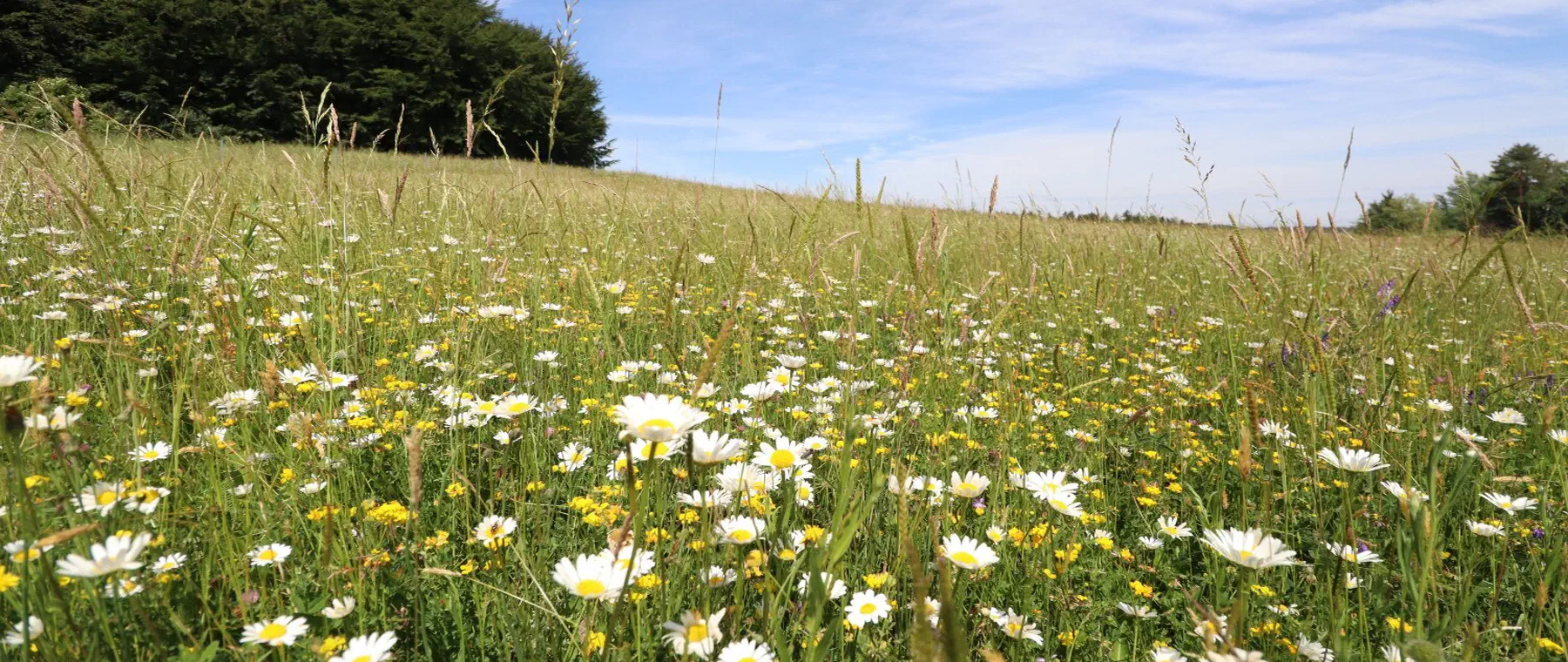
Restoration and adapted management of species-rich mountain and wet meadows along the Rennsteig through late mowing and extensive grazing. These open-land biotopes of the uplands are home to rare plants, meadow-breeding birds and diverse insect fauna.
Floodplain and flowing water restoration
Dismantling of bank structures, near-natural bank design and connection of side channels to Apfelstädt, Nesse and Hörsel. This creates steep banks, gravel banks and floodplain forest fringes as habitat for kingfisher, fish and amphibians in the valley lowlands of the Thuringian basin.
Orchards and hedgerows
Creation and rejuvenation of orchard meadows and hedge structures on the Fahner heights and chalk slopes of the district. As stepping-stone habitats, they network the open arable landscape and create habitat for hazel dormouse, little owl and wild bees.
Chalk grasslands and dry slopes
Management and restoration of species-rich semi-arid grasslands at the Drei Gleichen and Seeberg near Gotha through grazing and clearing. These warm-exposed slopes are habitat for sand lizards, orchids and thermophilic insects.
Species protection CEF and FCS
Securing of bat shelter sites in forests and tunnels, creation of sand lizard habitats on railway embankments and slopes, and measures for wildcat networking, tailored to §§ 44 and 45 BNatSchG and coordinated with the lower nature conservation authority.
Protected species in the Between Thuringian basin, Fahner heights and Thuringian forest
European wildcat
The contiguous forests of the Thuringian forest and their connection to the neighbouring Hainich are core habitats of the strictly protected wildcat. Near-natural forest conversion, forest edge development and securing of migration corridors are typical upgrades.
About this species ›bats in forest and tunnels
Montane beech forests, old tunnels and caves in the Thuringian forest provide greater mouse-eared bat, Bechstein's bat and other species hunting and shelter space. Shelter securing and retention of hunting habitats are important CEF measures.
About this species ›black stork
The black stork breeds in the minimally disturbed forests of the Thuringian forest and uses near-natural upland streams as food habitat. Quiet forest areas and restored flowing waters are central upgrades in terms of species protection.
About this species ›sand lizard on dry slopes
The Muschelkalk dry grasslands of the Drei Gleichen and Seeberg as well as railway embankments and slopes are habitat for the sand lizard, strictly protected under Annex IV of the FFH Directive. Clearing, stone heaps and sunny margins create suitable habitats.
About this species ›skylark in the Thuringian basin
The open arable landscapes of the Thuringian basin and Fahner heights are habitat for the skylark, grey partridge and other field birds. Flowering strips, fallows and extensively managed field margins counteract population declines.
About this species ›kingfisher on Apfelstädt and Nesse
Near-natural sections of the Apfelstädt, Nesse and Hörsel with steep banks and bank erosion provide the kingfisher with breeding sites. Restoration and river's own dynamic development create permanently suitable habitats in the valley floodplains.
About this species ›Which projects trigger a compensation obligation?
traffic and infrastructure
Federal motorway 4 crosses the district with five junction points from east to west, with the addition of town bypasses, federal and state roads as well as the Erfurt-Eisenach railway line. Expansion and maintenance of these transport routes trigger compensation and replacement obligations under the impact mitigation regulation. greeNature provides eco-points and compensation areas for this.
energy and grid expansion
The planned expansion of pumped storage capacity at Schmalwasser, wind energy projects, ground-mounted photovoltaic systems and high-voltage transmission lines create substantial compensation requirements. For cable routes and installations, CEF measures for bats and birds are frequently required.
commercial and industrial
Metal processing, mechanical engineering, automotive suppliers and logistics sites in the Neudietendorf and Nesse-Apfelstädt area at the junction of A4 and A71 require nature conservation compensation when expanding and settling. Owners of suitable land can benefit as providers.
raw material extraction
Limestone, gravel and natural stone extraction in the Thuringian basin and at the edge of the Thuringian forest impact soil and biotopes. Reclamation, development of replacement habitats and the creation of sunny raw soil sites are typical measures here.
From enquiry to monitoring
Contact and enquiry
Tell us your compensation requirement and the natural region. We check availability.
Offer and advice
A transparent offer covering measure types, scope and availability.
Coordination with authorities
Full coordination with the lower nature conservation authority. We handle everything.
Long-term monitoring
Permanent securing of the land, management and documentation across the contract term.
Eco-points in adjoining districts
All about eco-points
in the district of Gotha
Request eco-points in the district of Gotha
We will promptly prepare a transparent offer with matching eco-points held in stock in the district of Gotha.