Eco-points and compensation areas
District of Nordfriesland
Eco-points and compensation areas in Nordfriesland District, assessed according to the impact mitigation regulation and the Eco-Account Ordinance Schleswig-Holstein. greeNature is your full-service partner operating nationwide for compensation of impacts in marsh, wattenmeer coast and heathland, from needs determination to monitoring.
The District of Nordfriesland at a glance
Nordfriesland District is located in the far north-west of Schleswig-Holstein and with around 2,083 square kilometres is the state's largest district by area. District seat and administrative centre is Husum. In the west the district borders the North Sea, in the north Denmark, in the east Schleswig-Flensburg District and in the south, beyond the Eider, Dithmarschen. Since Schleswig-Holstein is not divided into administrative regions, the district administration is directly subordinate to the state.
In terms of natural regions, the district is divided into two major landscapes. Along the coast, on the Eiderstedt peninsula and on the islands extend the Schleswig-Holstein marshes and North Sea islands (BfN natural region D21) with fertile clay soils, dyked köges, salt marshes and the geest core islands Sylt, Amrum and Föhr. To the east adjoins the gently undulating Schleswig-Holstein Heathland (D22) with outwash plains, knicks, inland dunes and small peatlands.
Ecologically characteristic is the Schleswig-Holstein Wattenmeer National Park, which is simultaneously part of the UNESCO World Natural Heritage Wattenmeer and encompasses large coastal areas of the district as a Natura 2000 site. Additionally, the halligen, large-scale nature protection köges such as Beltringharder Koog and numerous wading bird areas in marsh grassland. This protected area landscape decisively determines where impacts are permissible and how compensation is to be nature-region-appropriate.
Economically, Nordfriesland is shaped by tourism (Sylt, Amrum, Föhr, Eiderstedt and the halligen), an agriculture predominantly focused on grassland and dairy farming, and wind energy. The district ranks among Germany's onshore wind-strongest regions and is a central area for network expansion, coastal protection and community wind parks. Such projects regularly trigger impacts whose compensation in Schleswig-Holstein is accounted for according to §§ 13 to 15 BNatSchG in conjunction with the State Nature Conservation Act (LNatSchG SH) and via eco-account according to the Eco-Account Ordinance.
🗺️ Associated natural regions
Go to natural region D21 ›
Go to natural region D22 ›
📍 Selected municipalities
🌿 Ecological features
- Schleswig-Holstein Wattenmeer National Park and UNESCO World Natural Heritage Wattenmeer, largest protected area landscape on the west coast
- Geest core islands Sylt, Amrum and Föhr with dunes, heaths and cliffs as well as the halligen as worldwide special landscape form
- Beltringharder Koog, one of Schleswig-Holstein's largest coastal nature conservation areas, with salt water lagoon and wading bird land
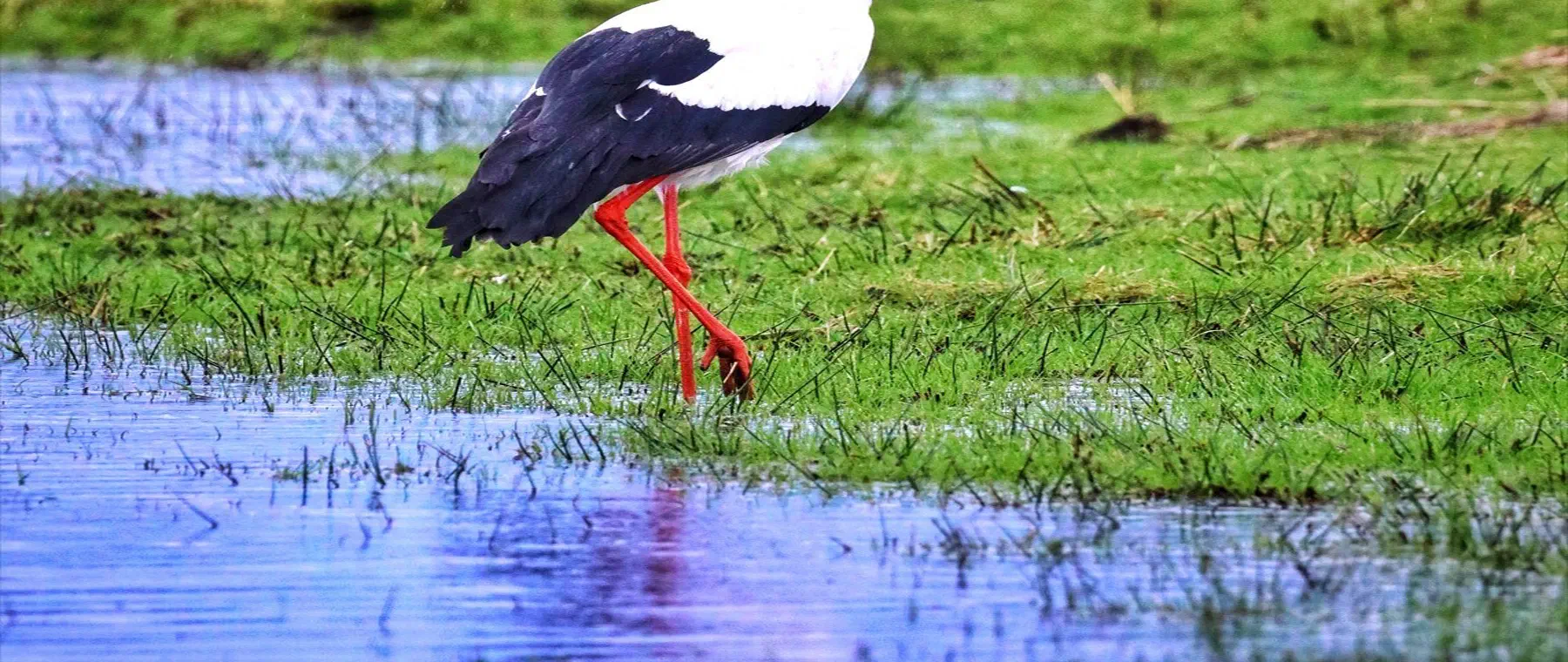
- Extensive marsh grassland as internationally important breeding and staging areas for wading and coastal birds and arctic geese
- Nordfriesland Heathland with knicks, inland dunes and heathland remnants (such as Bordelumer and Langenhorner Heath)
- One of Germany's onshore wind-strongest districts with numerous community wind parks and network expansion projects
✅ greeNature on the ground
greeNature operates nationwide and is familiar with Schleswig-Holstein's compensation law. We work with the lower nature conservation authority of Nordfriesland District (Environmental Department) and know the impact mitigation regulation according to §§ 13 to 15 BNatSchG in conjunction with the State Nature Conservation Act, the eco-account according to the Eco-Account Ordinance and the characteristics of marsh-, wattenmeer- and heathland-shaped landscapes in natural regions D21 and D22. Because compensation should work nature-region-appropriately where possible, we focus on marsh-typical measures such as wading bird protection, re-wetting and grassland extensification as well as knick and heathland management on the heathland. Where species protection requirements exist under § 44 BNatSchG, we conceive precautionary CEF measures that continuously secure ecological function for affected species. From needs determination through land securing to implementation, management and monitoring, we accompany your project from a single source.
Typical measures in the district of Nordfriesland
Wading bird protection in marsh grassland
Extensive grazing, raised water levels, late mowing and creation of puddles secure breeding places of northern lapwing, black-tailed godwit and redshank in the marsh. Such measures can be implemented as production-integrated compensation or as precautionary CEF measures.
Re-wetting and ditch restoration
Raising water levels and near-natural design of marsh ditches, drainage channels and small water bodies creates wet habitats and significantly enhances previously heavily drained land. In lowlands of the heathland, small peatlands can additionally be restored.
Grassland extensification
Conversion of intensively used marsh arable land to extensively used, late-mowed permanent grassland strengthens meadow-breeding birds and ground-breeding birds and simultaneously reduces nutrient leaching to water bodies. Adapted mowing dates and cessation of fertilisation increase nature conservation value.
Knick creation and management
Hedgerows (knicks) characteristic of Schleswig-Holstein Heathland are newly created, supplemented and properly coppiced. They network habitats, act as stepping-stone biotopes and enhance the cleared arable landscape.
Dune and heathland management
Scrub clearance, extensive grazing and maintaining open sand areas preserve dune and heathland habitats on the geest cores of Sylt, Amrum and Föhr as well as on Nordfriesland Heathland and secure their specialised species.
Species protection CEF and FCS
Precautionary compensation measures under § 44 BNatSchG, such as alternative bat roosts, alternative habitats for amphibians and reptiles and meadow-breeding bird land, coordinated with respective project and favourable conservation status (FCS) requirements.
Protected species in the Nordfriesland between wattenmeer, marsh and heathland
Meadow-breeding birds in marsh grassland
Northern lapwing, black-tailed godwit and redshank breed on open, wet meadows and pastures of the marsh. They benefit from high water levels, puddles and late mowing, which can be well implemented as CEF and compensation measures.
About this species ›Skylark in marsh and heathland
Skylark nests in open landscape of grassland and arable land. Lark windows, flower strips and extensive arable margin strips improve its breeding success and are proven species protection measures under § 44 BNatSchG.
About this species ›Amphibians in small water bodies and peatlands
Pool frog, grass frog and natterjack toad inhabit marsh ditches, small water bodies and fluctuating wet depressions. New or restored, sunny and fish-free breeding water bodies in spatial context secure breeding sites during impacts.
About this species ›Sand lizard on heathland and dunes
The strictly protected sand lizard (FFH Annex IV) inhabits warm-dry margins, inland dunes and heathland edges of the heathland and islands. During impacts, alternative habitats with sunny and hiding structures as CEF measures are required.
About this species ›Bats in knicks and buildings
Old tree stocks, knicks and buildings provide roosts for strictly protected bat species (FFH Annex IV). For demolition or tree felling, alternative roosts as precautionary CEF measures under § 44 BNatSchG are required.
About this species ›Staging and guest birds of the köges
Wattenmeer and adjacent köges and salt marshes are internationally important staging and overwintering areas for arctic geese and wading birds. Extensively used grassland and undisturbed resting areas secure these populations.
Which projects trigger a compensation obligation?
Wind energy and network expansion
Nordfriesland ranks among Germany's wind power-strongest districts. Expansion of community wind parks and associated power lines on the west coast create compensation requirements and frequently require species protection assessments and FCS measures for wind-sensitive species.
Coastal and flood protection
Dike reinforcements, climate dikes and adjustments to drainage along the marsh coast impact grassland, foreland and water bodies. Nature conservation compensation can be efficiently covered via stockpiled eco-points from the eco-account.
Road and transport infrastructure
Expansion of federal road B5, bypasses, cycle and footpath construction and railway and bridge structures regularly trigger compensation and replacement obligations that can be covered via nature-region-appropriate eco-points.
Settlement, commerce and tourism
Residential, commercial and accommodation land develop in Husum, Niebüll, on Sylt and in tourism sites. Associated impacts on nature and landscape can be efficiently and legally securely compensated via stockpiled compensation land.
From enquiry to monitoring
Contact and enquiry
Tell us your compensation requirement and the natural region. We check availability.
Offer and advice
A transparent offer covering measure types, scope and availability.
Coordination with authorities
Full coordination with the lower nature conservation authority. We handle everything.
Long-term monitoring
Permanent securing of the land, management and documentation across the contract term.
Eco-points in adjoining districts
All about eco-points
in the district of Nordfriesland
Request eco-points in the district of Nordfriesland
We will promptly prepare a transparent offer with matching eco-points held in stock in the district of Nordfriesland.