Eco-points and compensation areas
District of Sächsische Schweiz-Osterzgebirge
Saxon Switzerland-Osterzgebirge District extends from the Elbe valley near Pirna via the Elbe sandstone mountains to the ridge elevations of the Osterzgebirge at the Czech border. If you build here, you compensate according to the Saxon Eco-Account Ordinance. greeNature undertakes accounting, land provision and implementation, nationwide and with knowledge of Saxon procedures.
The District of Sächsische Schweiz-Osterzgebirge at a glance
Saxon Switzerland-Osterzgebirge District is located in the south-east of Saxony and extends from the Elbe valley near Pirna via the Elbe sandstone mountains to the ridge elevations of the Osterzgebirge at the Czech border. This elevation and landscape diversity also characterises the nature conservation balance of impacts according to §§ 13 to 15 BNatSchG.
For compensation of impacts, the Saxon Eco-Account Ordinance (SächsÖKoVO) applies in Saxony, together with the guidance recommendation for assessing and accounting for impacts. The creditable value of a measure results as the difference between the initial status and the enhanced target status of a site, expressed in eco-points.
In addition to the impact mitigation regulation, the specific species protection under § 44 BNatSchG must be observed. In structurally rich forests, on mountain meadows and at flowing waters, strictly protected species occur, for which precautionary compensation measures (CEF) and conservation of favourable conservation status (FCS) may be required.
greeNature accompanies project developers and landowners nationwide and brings knowledge of Saxon procedures, from land selection through accounting to permanent implementation and securing.
🗺️ Associated natural regions
Go to natural region D16 ›
Go to natural region D19 ›
📍 Selected municipalities
🌿 Ecological features
- With the Saxon Switzerland National Park, the only rock national park in Germany is located within the district. It is simultaneously designated as an FFH site and as a European bird protection site (SPA).
- Around 59 per cent of the district area is under landscape protection, distributed among 16 landscape protection areas.
- The district includes 35 FFH sites with over 200 square kilometres and nine European bird protection sites, predominantly in forests.
- The mountain meadows of the Osterzgebirge rank among the most species-rich grassland stocks in Saxony and are an important starting point for enhancement measures.
- The lower Osterzgebirge and the side valleys of the Elbe (Müglitz, Seidewitz, Gottleuba and Bahre) form a concentration point for the highly endangered Schreiber's bat.
- Following the floods of 2002 and 2013, flood protection and infrastructure at Müglitz and Gottleuba triggered substantial compensation requirements.
✅ greeNature on the ground
greeNature develops and manages compensation land in Saxon Switzerland-Osterzgebirge District and coordinates measures with the lower nature conservation authority at the District Office. We assess initial and target status according to the Saxon Eco-Account Ordinance and the guidance recommendation, secure land permanently and document implementation. This gives project developers a reliable record for the permit authority without themselves having to search for and manage land.
Typical measures in the district of Sächsische Schweiz-Osterzgebirge
Mountain meadows and extensive grassland
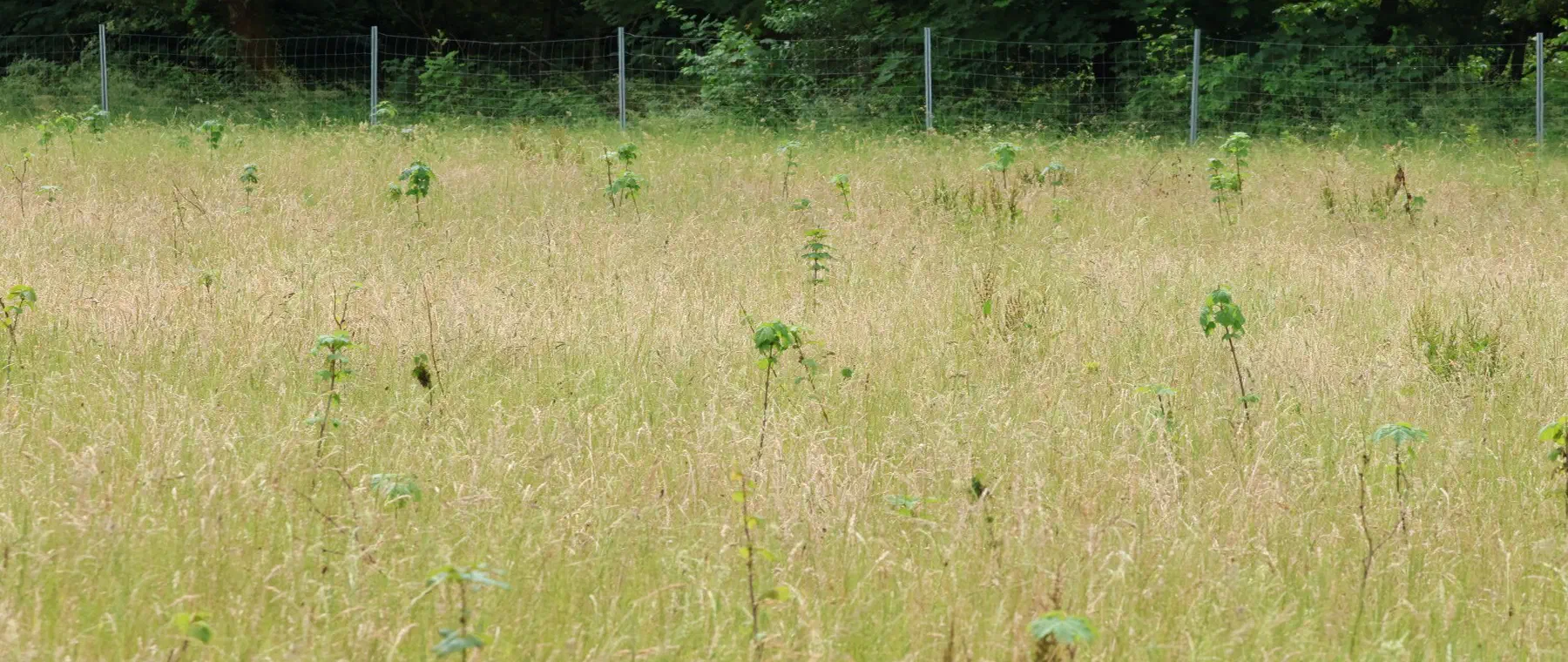
Restoration and extensive management of species-rich mountain and valley meadows in the Osterzgebirge, for instance through adapted mowing, de-acidification and cessation of fertilisation. Such measures ecologically enhance grassland and create eco-points under the guidance recommendation.
Flowing water and floodplains
Restoration of streams and rivers such as Müglitz, Seidewitz or Gottleuba, with riparian strips, bank freeing and site-appropriate vegetation. This improves continuity and habitat and also serves flood protection.
Near-natural forest conversion
Conversion of structurally poor spruce plantations to site-appropriate deciduous and mixed forests with beech, fir and sycamore. Forest conversion increases biotope quality and stand climate stability in the Erzgebirge.
Orchard and hedgerow
Creation and management of orchards and field hedges in open cultural landscapes. They network habitats, promote insects and birds and can be well combined with agricultural use.
Species protection and roosts (CEF)
Precautionary measures for strictly protected species under § 44 BNatSchG, for instance securing and creation of bat roosts for Schreiber's bat or nesting boxes. This maintains the conservation status of local populations.
Peatland and wet biotopes
Re-wetting of wet and peatland sites in the ridge elevations of the Osterzgebirge and creation of small water bodies for amphibians. Wet habitats store water and carbon and house rare species.
Protected species in the Elbe sandstone mountains and Osterzgebirge
Schreiber's bat
One of Germany's rarest bat species with a concentration point in the Elbe valleys and lower Osterzgebirge. It is strictly protected and dependent on undisturbed summer and winter roosts.
About this species ›Black stork
The shy black stork nests in quiet, old forests and uses near-natural streams as feeding waters. It is recorded in European bird protection sites in the Osterzgebirge.
About this species ›Fire salamander
Saxon Switzerland is a distribution centre for the fire salamander. The species lives on cool, clean forest streams and is considered highly endangered in Saxony.
About this species ›Kingfisher
The kingfisher inhabits near-natural flowing waters with steep bank abrasions along the Elbe and tributaries. Restored banks improve its breeding and feeding opportunities.
About this species ›Sand lizard
The sand lizard uses sunny, structurally rich margins, slopes and stone rows. During impacts, relocations and creation of alternative habitats are frequently required.
About this species ›Hazel dormouse
The nocturnal hazel dormouse lives in structurally rich deciduous forests, at forest edges and in hedgerows with good berry supply. It is strictly protected and sensitive to fragmentation of its habitats.
About this species ›Which projects trigger a compensation obligation?
Flood protection and transport
Following the 2002 and 2013 floods, extensive protection and road construction measures were implemented along Müglitz and Gottleuba, triggering nature conservation compensation requirements.
Commerce and industry in the Elbe valley
Commercial and industrial land in the Elbe valley around Pirna, Heidenau and Freital leads to land sealing with corresponding compensation requirements.
Housing construction in the Dresden hinterland
In the easily accessible hinterland of Dresden, such as in Freital, Bannewitz and Kreischa, residential and settlement areas are being developed, requiring impacts on nature and landscape.
Network and pipeline expansion
Expansion of electricity, transport and supply lines crosses forests and open land and requires compensation and replacement measures.
From enquiry to monitoring
Contact and enquiry
Tell us your compensation requirement and the natural region. We check availability.
Offer and advice
A transparent offer covering measure types, scope and availability.
Coordination with authorities
Full coordination with the lower nature conservation authority. We handle everything.
Long-term monitoring
Permanent securing of the land, management and documentation across the contract term.
Eco-points in adjoining districts
All about eco-points
in the district of Sächsische Schweiz-Osterzgebirge
Request eco-points in the district of Sächsische Schweiz-Osterzgebirge
We will promptly prepare a transparent offer with matching eco-points held in stock in the district of Sächsische Schweiz-Osterzgebirge.