Eco-points and compensation areas
District of Harz
Immediately available eco-points from authority-recognised eco-accounts. greeNature is your full-service partner for compensation according to Saxony-Anhalt's eco-account regulation (ÖkoKVO LSA) between High Harz and Harz foreland.
The District of Harz at a glance
Harz District lies in western Saxony-Anhalt and, with around 2,105 km², is the largest district in the state by area. Administrative centre is the district seat Halberstadt. The district is divided into 13 uniform municipalities and the Vorharz municipal association, together 20 municipalities. Saxony-Anhalt has no administrative regions, the highest state authority for nature conservation is the State Administration Office.
Geographically, the district extends from the High Harz with the Brocken (1,141 m) via the wooded Lower Harz to the open, loess-influenced northern Harz foreland. The mountain areas are characterised by spruce and beech forests, peat bogs and mountain meadows; deeply incised river valleys such as the Bodetal at Thale as well as Selke, Holtemme and Ilse run through the mountain region. In the foreland, fertile arable soils, dry grassland and distinctive rock ridges such as Devil's Wall near Blankenburg characterise the landscape.
Ecologically, the district is of outstanding importance. Share in the cross-border Harz National Park, extensive Natura 2000 and bird protection areas of the High Harz as well as numerous nature conservation areas secure habitats for European wildcat, black stork, bats and rich mountain flora. For impacts, the impact mitigation regulation of §§ 13 to 15 BNatSchG applies; assessment of impacts and compensation takes place in Saxony-Anhalt in eco-points according to the Saxony-Anhalt eco-account regulation (ÖkoKVO LSA) and the state's assessment model.
Compensation needs arise from tourism and residential development in the world heritage and half-timbered towns of Quedlinburg, Wernigerode and Halberstadt, from raw material extraction in the Harz, from transport projects such as expansion of B6n and B81, and from wind energy and photovoltaic in the Harz foreland. greeNature develops and manages natural region-appropriate compensation land according to ÖkoKVO LSA, from assessment to recognition by the lower nature conservation authority.
🗺️ Associated natural regions
Go to natural region D20 ›
📍 Selected municipalities
🌿 Ecological features
- Share in Harz National Park with the Brocken (1,141 m), cross-border with Lower Saxony
- Harz/Saxony-Anhalt Nature Park with mountain forests, peat bogs and mountain meadows
- High Harz Natura 2000 and bird protection areas with spruce forests and high peat bogs
- Bodetal at Thale, deeply incised rocky valley with thermophilic slope forests
- Devil's Wall between Blankenburg and Weddersleben, distinctive sandstone rock ridge
- Selketal in Lower Harz, near-natural river with floodplain forest and mountain meadows
- Dry grassland and sand-grey hair grass sites in Harz foreland near Quedlinburg
✅ greeNature on the ground
greeNature operates nationwide and knows the administrative structures in Saxony-Anhalt, from the lower nature conservation authority (Untere Naturschutzbehörde) of Landkreis Harz in Halberstadt to the Landesverwaltungsamt. We base assessment and accounting on the Ökokonto-Verordnung Saxony-Anhalt (ÖkoKVO LSA) and the NatSchG LSA, expressing impact and compensation in eco-points. In natural regions D20 and D33 we secure suitable land, plan region-typical upgrades such as forest conversion, mountain meadow management and watercourse restoration, implement them and take on management, monitoring and documentation for official recognition. Where species protection requirements arise under § 44 BNatSchG, for example for the European wildcat, black stork or bats, we develop advance CEF measures that continuously secure the ecological function for the affected species.
Typical measures in the district of Harz
Forest conversion and protective forest development
Conversion of structurally poor spruce stands into site-appropriate mountain and mixed beech forests of beech, sycamore maple, fir and oak, promoting old and dead wood. Such measures stabilise the Harz forests weakened by drought and bark beetle and permanently enhance forest habitats.
Mountain meadow extensification
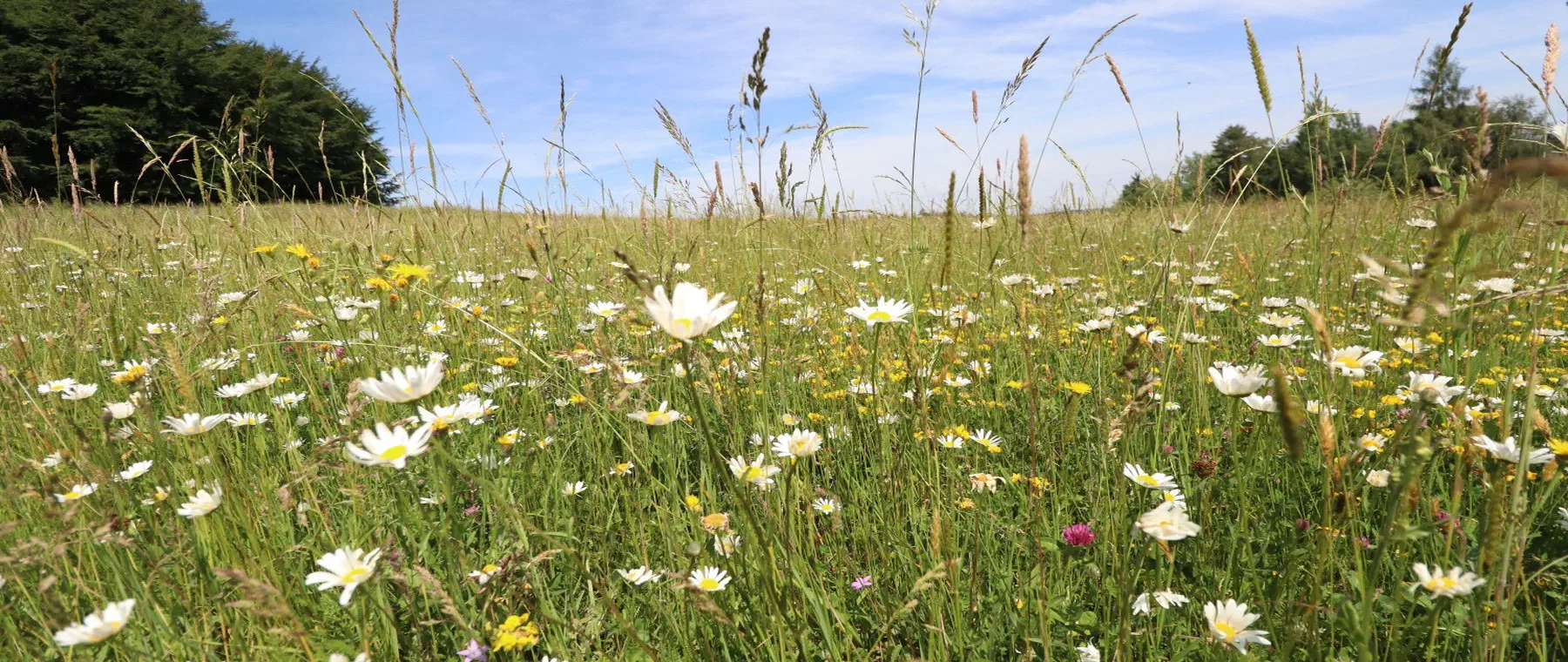
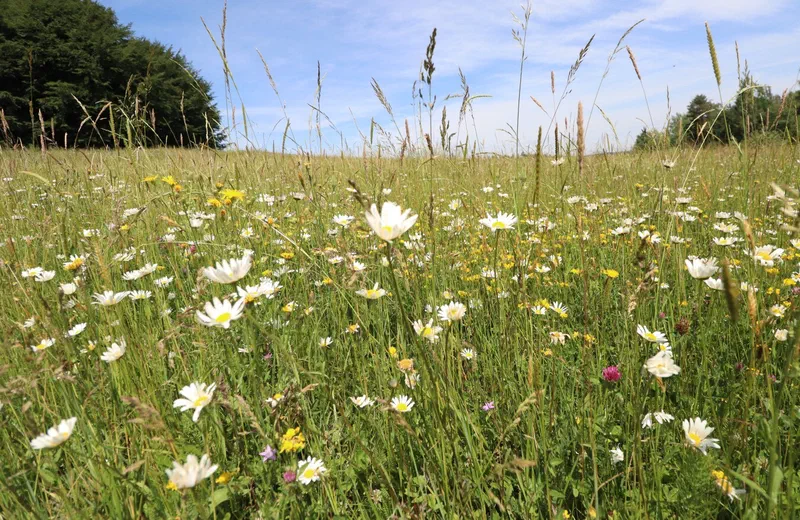
Conservation and development of species-rich mountain and wet meadows through adapted mowing dates, no fertiliser use and extensive grazing. The mountain hay meadows of the Harz are among the protected FFH habitat types and are central to insect and plant diversity.
Bog and spring restoration
Rewetting of drained raised bogs and spring areas in the Hochharz by raising the water table and removing drainage ditches. These measures secure bog-typical habitats, bind carbon and stabilise the water balance of the upland areas.
Watercourse restoration
Restoration of connectivity and near-natural bank structures on the Bode, Selke, Holtemme and Ilse, reconnection of side channels and development of riparian forest. This creates spawning and breeding habitats for fish, kingfisher and amphibians along the Harz rivers.
Species protection: CEF and FCS
Bat roosts in buildings, adits and caves, kingfisher nesting banks on the rivers, replacement habitats for the sand lizard on railway embankments and dry stone walls, each as an advance CEF measure or population-supporting FCS measure under § 44 and § 45 BNatSchG.
Dry grassland, traditional orchards and habitat network
Management and creation of dry grassland, hedgerows, field copses and traditional orchards in the northern Harz foreland. These structures connect habitats, create stepping-stone habitats and enhance the intensively farmed arable landscape.
Protected species in the Harz and northern Harz foreland
European wildcat in the Harz forests
The Harz is one of the most important occurrence areas of the strictly protected European wildcat (Annex IV of the FFH Directive). It needs structurally rich, low-disturbance deciduous and mixed forests with old and dead wood. Forest connectivity and the preservation of cover structures are proven FCS measures.
About this species ›Black stork in quiet forest valleys
The black stork breeds in undisturbed old-growth stands and uses near-natural streams and damp woodland meadows of the Harz as a feeding area. In the event of impacts, nest protection, buffer zones and watercourse enhancement secure the habitats of this strictly protected species.
About this species ›Bats in adits and caves
The greater mouse-eared bat, barbastelle and other species use the numerous mine adits, caves and roof spaces of the Harz as winter and summer roosts. All species are strictly protected, and replacement roosts are required as a CEF measure in the event of demolition and refurbishment.
About this species ›Kingfisher on the Harz rivers
The near-natural sections of the Bode, Selke, Holtemme and Ilse offer steep banks as nesting sites. In the event of impacts on watercourses, such as bridge or bank construction, the modelling of steep banks and bank restoration are typical CEF measures for the strictly protected kingfisher.
About this species ›Amphibians in mountain streams and ponds
Fire salamander, common frog and common toad inhabit the cool mountain streams, forest ponds and seasonally damp hollows of the Harz. Replacement spawning waters and land habitats in spatial context secure their breeding sites in construction and infrastructure projects.
About this species ›Sand lizard on dry sites
The sand lizard (Annex IV of the FFH Directive) inhabits railway embankments, slopes, dry stone walls and dry grassland in the Harz foreland. In the event of impacts, advance replacement habitats with basking spots, hiding structures and egg-laying sites must be created as a CEF measure.
About this species ›Which projects trigger a compensation obligation?
Transport and infrastructure
The expansion of federal roads such as the B6n and B81, town bypasses and works on railway lines and the Harzer Schmalspurbahn narrow-gauge railway trigger impacts, for which compensation must be provided under the Ökokonto-Verordnung Saxony-Anhalt. greeNature provides suitable eco-points and land for this.
Renewable energy
Wind energy and repowering projects as well as ground-mounted photovoltaic installations are concentrated in the open northern Harz foreland. They require compensation under nature conservation law and frequently CEF and FCS measures under species protection law for open-land and raptor species.
Mineral extraction
Limestone and hard-rock quarrying in the Rübeland area as well as other quarries in the Harz significantly impact nature and landscape. Restoration, subsequent use and area-based compensation are central components of compensation planning here.
Settlement, commerce and tourism
Residential and commercial development in Halberstadt, Wernigerode and Quedlinburg, as well as tourism projects in the World Heritage and national park regions, generate a need for compensation. Owners of land in the foreland and upland areas can offer it as compensation area.
From enquiry to monitoring
Contact and enquiry
Tell us your compensation requirement and the natural region. We check availability.
Offer and advice
A transparent offer covering measure types, scope and availability.
Coordination with authorities
Full coordination with the lower nature conservation authority. We handle everything.
Long-term monitoring
Permanent securing of the land, management and documentation across the contract term.
Eco-points in adjoining districts
All about eco-points
in the district of Harz
Request eco-points in the district of Harz
We will promptly prepare a transparent offer with matching eco-points held in stock in the district of Harz.