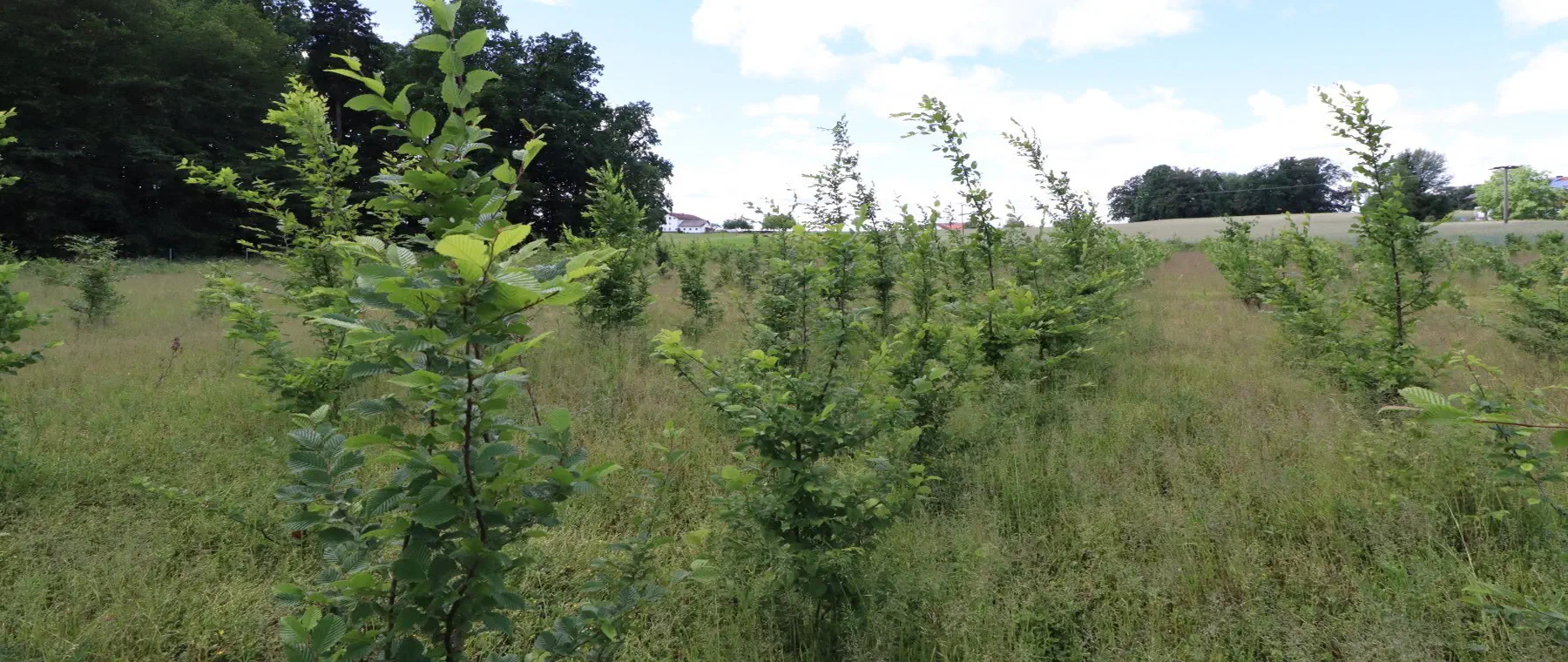
Eco-points and compensation areas
District of Südwestpfalz
Eco-points and compensation areas in the Südwestpfalz district, assessed under the Rhineland-Palatinate Landeskompensationsverordnung (LKompVO). greeNature develops and manages compensation areas between the Pfälzerwald, Wasgau and Westricher Hochfläche, and supports project developers from the assessment through to recognition by the nature conservation authority.
The District of Südwestpfalz at a glance
The Südwestpfalz district is the south-westernmost district in Rhineland-Palatinate and borders France (Alsace and Lorraine) directly to the south and west, as well as the Saarland. Around 89,000 people live across roughly 954 km² in seven collective municipalities with 84 local municipalities. The district surrounds the independent cities of Pirmasens and Zweibrücken. The seat of the district administration is Pirmasens, which does not itself belong to the district. An administrative region has not existed in Rhineland-Palatinate since 2000.
In landscape terms, the district is divided into two natural regions. The east and centre belong to the Pfälzerwald (natural region D50), the largest contiguous forest area in Germany on red sandstone. Its southern part, the Wasgau with the Dahner Felsenland, is famous for free-standing sandstone rocks, wooded conical hills and broad box valleys. The west belongs to the Westricher Hochfläche in the Saar-Nahe-Berg- und Hügelland (natural region D52), an open shell-limestone landscape with the Sickinger Höhe and the Zweibrücker Westrich, shaped by arable farming, grassland and a high proportion of fruit trees.
Ecologically, the district is of outstanding importance. Large parts lie within the Biosphärenreservat Pfälzerwald, the German part of the cross-border UNESCO Biosphärenreservat Pfälzerwald-Nordvogesen. The Biosphärenreservat Pfälzerwald FFH site (6812-301) and the special protection area of the same name are among the largest Natura 2000 areas in the state. The sandstone rock habitats of the Wasgau are home to the peregrine falcon and rare ferns, while the extensive beech and beech-oak forests provide habitat for the European wildcat, black stork and numerous bat species.
The economy is strongly rural in character and regarded as structurally weak. Besides forestry, the legacy of the shoe industry around Pirmasens and Hauenstein, sandstone quarrying and tourism in the Wasgau, it is chiefly transport projects, the reuse of former military and conversion sites, and renewable energy that trigger impacts. Their compensation is governed by the Rhineland-Palatinate Landeskompensationsverordnung (LKompVO), which determines the compensation requirement using a habitat valuation procedure.
🗺️ Associated natural regions
Go to natural region D51 ›
📍 Selected municipalities
🌿 Ecological features
- Biosphärenreservat Pfälzerwald, the German part of the cross-border UNESCO Biosphärenreservat Pfälzerwald-Nordvogesen
- Biosphärenreservat Pfälzerwald FFH site (6812-301), one of the largest Natura 2000 areas in Rhineland-Palatinate
- Pfälzerwald special protection area, breeding ground for, among others, the black woodpecker, peregrine falcon and European nightjar
- Dahner Felsenland in the Wasgau with sandstone rock habitats, home to the peregrine falcon and filmy fern
- Near-natural upland streams such as the Wieslauter, Rodalb and Schwarzbach with accompanying remnants of floodplain woodland
- Westricher Hochfläche with traditional orchards, shell-limestone dry habitats and structurally rich open land
✅ greeNature on the ground
greeNature works nationwide and develops eco-account and compensation areas in the Südwestpfalz district that suit the character of the Pfälzerwald, Wasgau and Westricher Hochfläche. We secure suitable land, plan the upgrading under the Landeskompensationsverordnung (LKompVO), and coordinate the measures with the lower nature conservation authority of the Südwestpfalz district administration as well as with landowners, forestry operations and municipalities. From the assessment in the habitat valuation procedure through implementation to permanent management, monitoring and documentation for recognition, project developers receive compensation from a single source. Where there is a need under species protection law pursuant to § 44 BNatSchG, we design advance CEF measures that consistently secure the ecological function for the affected species.
Typical measures in the district of Südwestpfalz
Watercourse restoration
Restoring continuous, structurally rich stream courses along the Wieslauter, Rodalb and Schwarzbach, developing riparian woodland and floodplain forest as habitat for brown trout, bullhead and kingfisher.
Woodland conversion and natural forest development
Converting non-natural coniferous plantations into site-appropriate beech and beech-oak forests, securing old and dead wood for woodpeckers, bats and deadwood-dwelling beetles in the Pfälzerwald.
Rock habitat and open land management in the Wasgau
Careful clearing of sandstone rocks and management of heat-loving margins, timed to the breeding season of the peregrine falcon, for the benefit of reptiles and rock-bound species.
Traditional orchards and nutrient-poor meadows on the Westricher Hochfläche
Creating and managing traditional orchards and species-rich grassland on shell limestone, habitat for the red-backed shrike, wryneck, wild bees and heat-loving insects.
Species protection CEF and FCS
Bat roosts, improving the habitat network for the European wildcat, connecting hedgerows for the hazel dormouse and creating small water bodies for amphibians, tailored to the LKompVO and § 44 BNatSchG.
Desealing of conversion sites
Dismantling and desealing former military and commercial sites, converting them into structurally rich habitats and succession areas as a high-value upgrade in the habitat valuation procedure.
Protected species in the Pfälzerwald, Wasgau and Westricher Hochfläche
European wildcat
The Pfälzerwald is among the most important wildcat habitats in Germany. The species needs deadwood-rich, undisturbed forests and a continuous habitat network between the forest areas, which compensation measures can specifically strengthen.
About this species ›Bats
Bechstein's bat, barbastelle and other species use the old beech forests and traditional orchards as hunting and roosting habitat. Preserving cavity trees and winter roosts is a common objective of CEF measures.
About this species ›Black stork
The black stork breeds in the low-disturbance, watercourse-rich forest areas of the Pfälzerwald. Near-natural streams with a good food supply and undisturbed nest sites are essential for the species.
About this species ›Peregrine falcon
The free-standing sandstone rocks of the Wasgau provide traditional breeding sites for the peregrine falcon. Rock management and the management of recreational use during the breeding season secure breeding success at the rock habitats.
Hazel dormouse
The hazel dormouse inhabits structurally rich forest edges, hedgerows and scrub of the Westricher Hochfläche. Preserving and newly creating connected woody structures are typical measures for its protection.
About this species ›Amphibians
The yellow-bellied toad and common midwife toad find suitable spawning habitats in water-filled quarries, wheel ruts and small water bodies. Creating sun-exposed ponds is an effective compensation measure.
About this species ›Which projects trigger a compensation obligation?
B10 expansion and transport infrastructure
The four-lane expansion of the B10 between Pirmasens and Landau runs, in sections such as Hinterweidenthal to Hauenstein, through the Biosphärenreservat Pfälzerwald. Such projects trigger a considerable compensation and species protection requirement, as do town bypasses and the expansion of subordinate roads.
Conversion and commerce
The reuse of former US military sites as well as the development of commercial and industrial areas around Pirmasens and in the Zweibrücken area require compensation under nature conservation law, but through desealing also offer potential for high-value compensation areas.
Renewable energy
Wind energy on the Westricher Hochfläche outside the core zones of the biosphere reserve, as well as ground-mounted photovoltaic installations on suitable sites, lead to impacts that entail compensation and, in many cases, CEF measures for bats and birds of prey.
Mineral extraction and forestry
Sandstone quarries and forestry projects in the Pfälzerwald generate impacts, the compensation for which can be provided through near-natural woodland conversion and watercourse and open-land upgrading in the habitat valuation procedure.
From enquiry to monitoring
Contact and enquiry
Tell us your compensation requirement and the natural region. We check availability.
Offer and advice
A transparent offer covering measure types, scope and availability.
Coordination with authorities
Full coordination with the lower nature conservation authority. We handle everything.
Long-term monitoring
Permanent securing of the land, management and documentation across the contract term.
Eco-points in adjoining districts
All about eco-points
in the district of Südwestpfalz
Request eco-points in the district of Südwestpfalz
We will promptly prepare a transparent offer with matching eco-points held in stock in the district of Südwestpfalz.