Eco-points and compensation areas
District of Rhein-Hunsrück-Kreis
Eco-points and compensation areas in Rhein-Hunsrück-Kreis, assessed according to the Landeskompensationsverordnung (LKompVO) of Rheinland-Pfalz. greeNature develops and manages naturally appropriate compensation between Hunsrück uplands and Upper Middle Rhine valley, from land securing through lasting management, operating nationwide and familiar with local authorities.
The District of Rhein-Hunsrück-Kreis at a glance
Rhein-Hunsrück-Kreis lies in south-west Rheinland-Pfalz and includes the central and eastern Hunsrück uplands and the left-bank portion of the Upper Middle Rhine valley. The district seat and administrative headquarters is Simmern in the Hunsrück. On around 991 square kilometres about 107,000 people live in 137 municipalities, which are distributed across four administrative associations and the independent city Boppard. Rheinland-Pfalz is not divided into administrative regions.
Geographically the district extends from the forested upland ridges and clearings of the Hunsrück uplands to the steep slate slopes above the Rhine at St. Goar and Oberwesel. Geologically, the Devonian bedrock of slate, greywacke and Taunusquartz characterises the subsoil, from which predominantly shallow, acid soils have developed. The highest elevation is the Simmerkopf at 653 metres. Numerous streams such as Baybach and Ehrbach have cut themselves deeply into the upland in narrow valleys.
Ecologically significant are the Soonwald in the south of the district as a large contiguous forest area, the Upper Middle Rhine valley as a UNESCO World Heritage site with its warmth-toned rocky and dry slopes and the hanging wet woods, small-scale acid slope moorlands in the cool-damp ridge areas. Large forest areas and watercourses are as FFH and bird protection areas part of the European protected area network Natura 2000. The forests harbour, among others, European wildcats, black storks and several strictly protected bat species.
Economically, the district is shaped by the Frankfurt-Hahn airport with its business and logistics environment, intensive use of wind energy on the upland ridges and agriculture and forestry. Wind farms, expansion of transport routes and power lines and business and settlement development regularly trigger impacts on nature and landscape. For their compensation, the Landeskompensationsverordnung (LKompVO) based on §§ 13 to 15 BNatSchG applies in Rheinland-Pfalz, supplemented by species protection under § 44 BNatSchG.
🗺️ Associated natural regions
Go to natural region D42 ›
Go to natural region D44 ›
📍 Selected municipalities
🌿 Ecological features
- Upper Middle Rhine valley as UNESCO World Heritage site with the slate slopes at St. Goar and Oberwesel
- Soonwald in the south of the district, large contiguous forest area in the Naturpark Soonwald-Nahe
- Hanging wet woods, acid slope moorlands in the cool-damp ridge areas of the Hunsrück
- Naturally intact narrow valleys such as Baybachtal and Ehrbachklamm with upland streams
- Forested Hunsrück uplands with open clearings and mountain meadows
- FFH and bird protection areas as part of the European Natura 2000 network
✅ greeNature on the ground
greeNature works nationwide and is familiar with compensation law in Rheinland-Pfalz. For Rhein-Hunsrück-Kreis we develop eco-account and compensation areas that match natural regions D42 Hunsrück and D44 Middle Rhine area. We secure suitable land, plan enhancement according to the Landeskompensationsverordnung, manage recognised measures in the national compensation register (KSP) and coordinate them with the lower nature conservation authority in Simmern and with landowners, forestry enterprises and municipalities. From conception through implementation to lasting management, monitoring and documentation, project developers receive compensation from a single source. Where species protection requirements apply under § 44 BNatSchG, we design advanced CEF measures that permanently secure ecological function for affected species.
Typical measures in the district of Rhein-Hunsrück-Kreis
Natural forest conversion
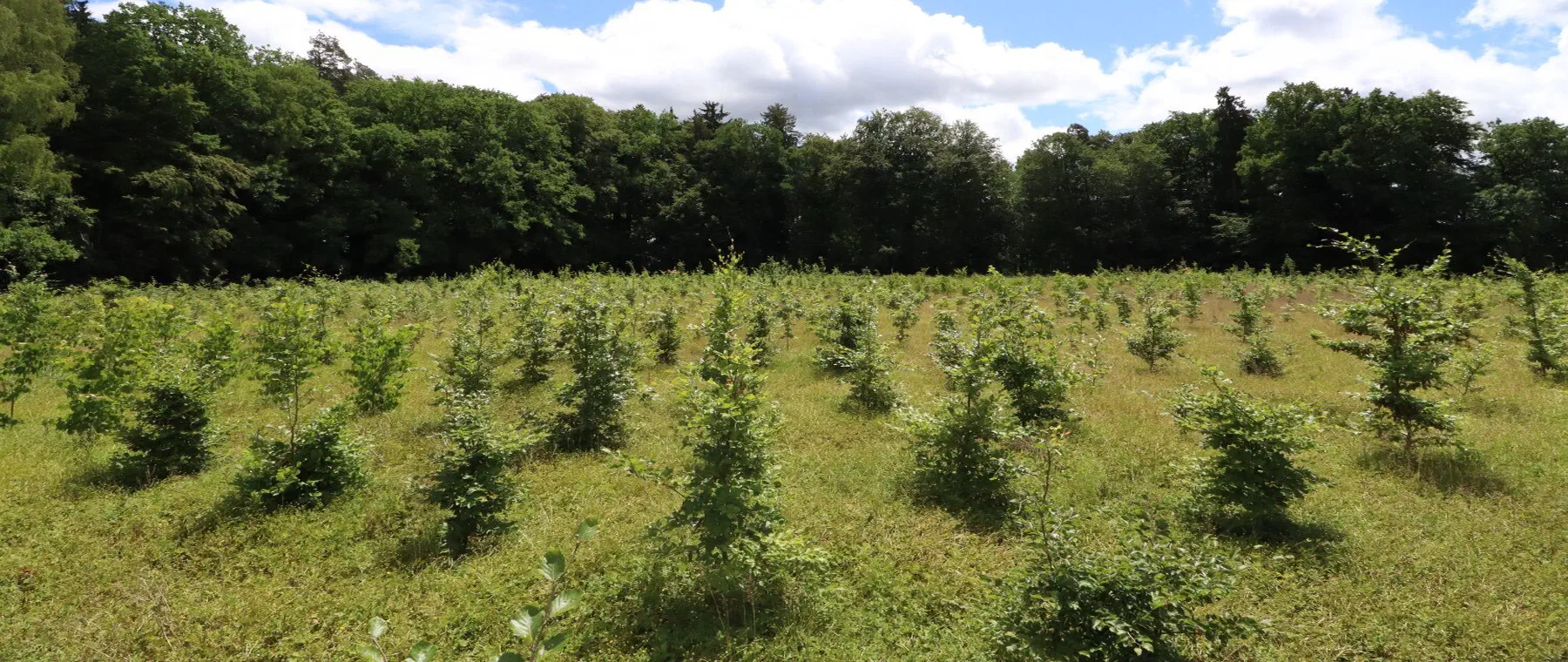
Conversion of structurally sparse spruce plantations to site-appropriate beech and oak mixed forests with high old and dead wood content. Such stands enhance the extensive forest areas of the Hunsrück and secure habitats for European wildcat, black woodpecker and bats.
Rewetting of hanging wet woods
Raising of water levels and removal of drainage ditches in acid slope moorlands of the ridge areas. Hanging wet woods rank among the region's rarest habitats; their rewetting sequesters carbon and creates habitats for wetland-typical species.
Restoration of upland streams
Removal of structures, connection of floodplains and allowing natural development at streams like Baybach, Ehrbach and Simmerbach. This creates steep banks, gravel beds and woody margins as habitat for kingfishers, brook lampreys and fish.
Extensification of mountain meadows and bristle grass meadows
Preservation and development of species-rich mountain and wet meadows and acidic bristle grass meadows through adapted mowing, forgoing fertilisation and extensive grazing. These open-land habitats are central to the insect and plant diversity of the uplands.
Dry slopes and vineyard fallows in Middle Rhine valley
Management and open-keeping of warmth-toned slate slopes, semi-arid grasslands and abandoned vineyards above the Rhine. Clearing, extensive grazing and preservation of dry stone walls promote warmth-loving reptiles, birds and insects.
Species protection with CEF and FCS measures
Advanced compensation measures for strictly protected species under § 44 BNatSchG, such as bat roosts, kingfisher steep banks and replacement habitats for sand lizards on slopes and railway embankments. They secure ecological function continuously and preserve favourable conservation status (FCS).
Protected species in the Hunsrück uplands and Upper Middle Rhine valley
European wildcat in Soonwald and Hunsrück
The forests of Soonwald and Hunsrück rank among the significant retreat areas of the European wildcat in Germany. The shy species (Appendix IV Habitats Directive) requires large, low-disturbance broadleaf forests with dead wood and structurally diverse margins. Forest conversion and habitat networks secure its habitats and migration corridors.
About this species ›Black stork in quiet forest valleys
The black stork breeds disturbance-sensitively in quiet, stream-traversed forest areas of the Hunsrück. It depends on undisturbed territories and naturally intact watercourses as foraging habitat. For projects near forest, such as wind farms, species protection assessment of this species is regularly required.
About this species ›Bats in forests and buildings
Numerous bat species are documented in the district, including Bechstein's bat and greater mouse-eared bat. Ancient broadleaf forests, caves, tunnels and buildings serve as roost; old and dead wood-rich stands as hunting grounds. For demolition, refurbishment or removal, replacement roosts are required as a CEF measure.
About this species ›Hazel dormouse in hedgerows and forest margins
The strictly protected hazel dormouse inhabits structurally diverse forest margins, hedgerows and shrublands of the Hunsrück uplands. For removal, section-by-section, professionally supervised vegetation removal and networking of replacement habitats are required.
About this species ›Skylark on the clearings
On the open clearings of the Hunsrück uplands, the skylark breeds on the ground. It suffers from dense, uniform field stands. Skylark windows, flower margins and extensive field margin strips improve its breeding success and are suitable as production-integrated compensation.
About this species ›Kingfisher at Hunsrück streams
At naturally intact upland streams such as Baybach and Ehrbach, the kingfisher finds steep banks as breeding sites and fish-rich waterbodies as foraging habitat. For impacts at watercourses, steep-wall modelling and riverbank restoration are typical CEF measures.
About this species ›Which projects trigger a compensation obligation?
Wind energy on the upland ridges
Rhein-Hunsrück-Kreis ranks among the pioneers of wind energy and intensively uses its upland ridges. Construction, repowering and grid connection of wind farms trigger impacts under impact mitigation regulation and species protection requirements for wind-sensitive species such as red kites, black storks and bats.
Frankfurt-Hahn airport, business and logistics
Frankfurt-Hahn airport with its business and logistics environment in the west of the district is an important economic site. Expansion and settlement projects lead to land sealing and require nature conservation compensation under impact mitigation regulation.
Transport, infrastructure and grid expansion
Expansion of federal and state roads, bypasses, bridge structures and power lines for wind power transport generate compensation and replacement requirements. Impacts on forest and watercourses can additionally trigger CEF measures for woodland and water-dependent species.
Settlement and business
Residential and business areas in Simmern, Boppard, Kastellaun and other cities and open-area photovoltaic systems require nature conservation compensation. Owners of agricultural and forestry land can contribute as land providers for eco-accounts.
From enquiry to monitoring
Contact and enquiry
Tell us your compensation requirement and the natural region. We check availability.
Offer and advice
A transparent offer covering measure types, scope and availability.
Coordination with authorities
Full coordination with the lower nature conservation authority. We handle everything.
Long-term monitoring
Permanent securing of the land, management and documentation across the contract term.
Eco-points in adjoining districts
All about eco-points
in the district of Rhein-Hunsrück-Kreis
Request eco-points in the district of Rhein-Hunsrück-Kreis
We will promptly prepare a transparent offer with matching eco-points held in stock in the district of Rhein-Hunsrück-Kreis.