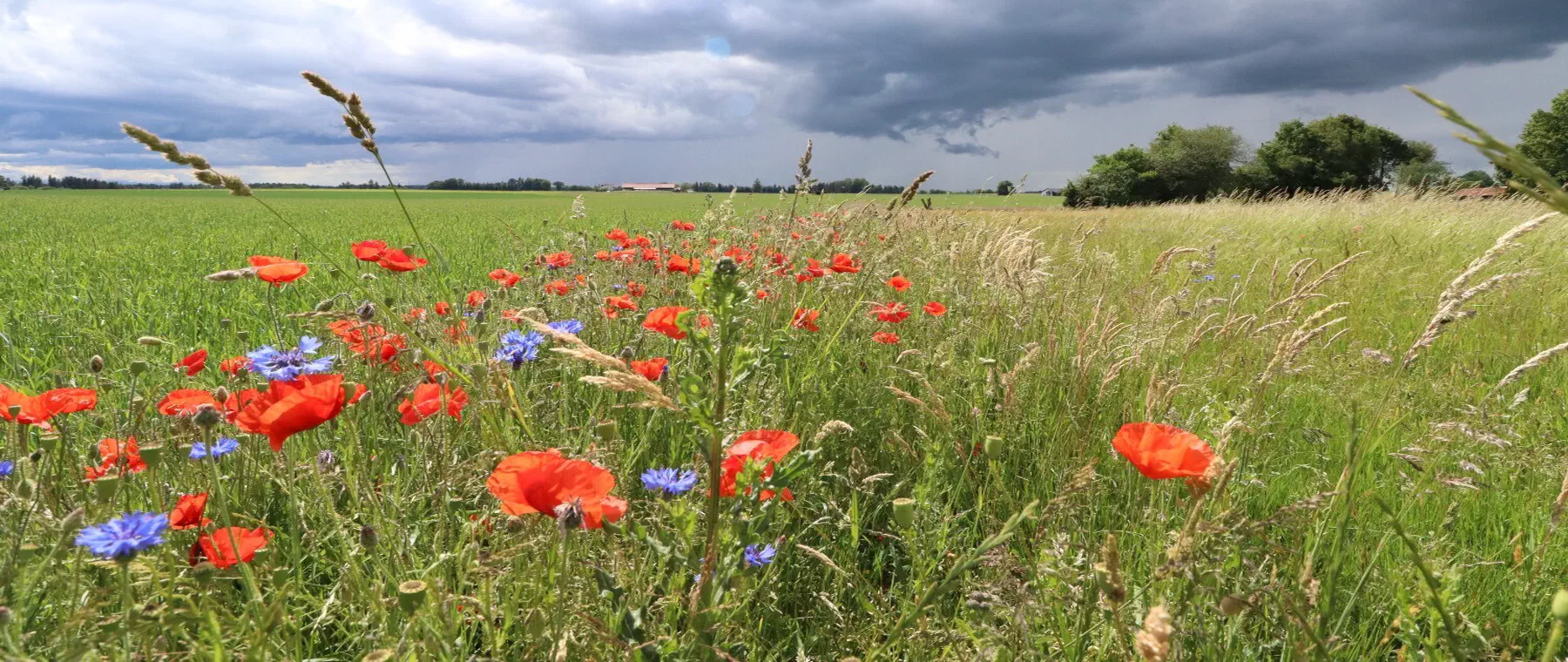
Eco-points and compensation areas
District of Mainz-Bingen
Immediately available eco-points from officially recognised eco-accounts. greeNature solutions, your nationwide full-service partner for nature conservation compensation according to the Landeskompensationsverordnung Rheinland-Pfalz (LKompVO) in Rheinhessen and at the Island Rhine.
The District of Mainz-Bingen at a glance
Mainz-Bingen district lies in the north of Rheinhessen and is bounded in the east and north by the Rhine. The seat of the district administration is Ingelheim am Rhein. Rheinland-Pfalz is not divided into administrative regions; the state intermediate authority is the Aufsichts- und Dienstleistungsdirektion (ADD).
Naturally, the Rheinhessian table land and rolling hills (BfN natural region D53) characterise the district, an open, loess-covered rolling landscape with one of Germany's warmest and driest climates (in places under 500 mm annual precipitation). In the west, the Binger Forest, a forested spur of the Hunsrück (natural region D42), extends into the district.
Ecologically significant is the Island Rhine between Bingen and Mainz with its floodplains, oxbow arms and gravel islands. The Rhine floodplain is an internationally significant resting and wintering area for water and wading birds; in winter regularly over 10,000 water birds are present here.
Economically, viticulture (Rheinhessen is Germany's largest wine-growing area), pharmaceutical industry in Ingelheim and proximity to the Rhine-Main conurbation shape the district. Vineyard land consolidation, business and settlement development and infrastructure projects regularly trigger compensation requirements according to LKompVO.
🗺️ Associated natural regions
Go to natural region D53 ›
Go to natural region D42 ›
Go to natural region D44 ›
📍 Selected municipalities
🌿 Ecological features
- Island Rhine between Bingen and Mainz with the nature conservation areas Fulder floodplain-Ilmen floodplain, Hadera floodplain-Königsklinger floodplain and sandbar
- FFH and EU bird protection area Rhine floodplain Mainz-Bingen (5914-303), also Ramsar wetland of international importance
- FFH area Binger Forest (6012-301), large beech forest with maternity roosts of Bechstein's bats and black woodpecker and middle spotted woodpecker
- Rheinhessian rolling landscape with loess, chalk calcareous grassland and warmth-loving vineyard habitats
- Mouth of the Nahe into the Rhine at Bingen, transition to Saar-Nahe mountain and rolling landscape
- Pronounced vineyard cultural landscape with dry stone walls and vine slopes as habitat for sand lizards and wild bees
✅ greeNature on the ground
greeNature solutions operates nationwide and manages compensation projects in Rheinland-Pfalz based on the Landeskompensationsverordnung (LKompVO). We know the habitat value procedure of the state, provision through recognised eco-accounts and coordination with the lower nature conservation authority of the Kreisverwaltung Mainz-Bingen from project practice.
Typical measures in the district of Mainz-Bingen
Dry stone walls & vine slopes
Securing and creating dry stone walls, sunlit slopes and vineyard fallows in the Rheinhessian rolling landscape, habitat for sand lizards, wild bees and warmth-loving insects.
Rhine floodplain restoration
Connection of oxbow arms, development of floodplain forest and gravel islands at the Island Rhine, spawning and breeding habitats for fish, amphibians and wading birds.
Field enhancement
Skylark windows, multi-year flower margins and extensive field margin strips in the depleted vine land and arable land, CEF measures for skylark and grey partridge.
Traditional orchards & chalk calcareous grassland
Creation and management of traditional orchard meadows and grazing of chalk calcareous grasslands on the slopes of the Rheinhessian rolling landscape, species-rich habitats in warm-dry location.
Forest conversion in the Binger Forest
Development of old and dead wood, natural beech forest conversion and roost protection for Bechstein's bat in the Binger Forest (FFH area 6012-301).
Watercourse & riverbank margins
Removal of riverbank structures and creation of water margins at Nahe, Selz and smaller streams, habitat networks and habitat for kingfisher and amphibians.
Protected species in the Rheinhessen and Island Rhine
Sand lizard in the vineyards
The sunlit dry stone walls, vine slopes and railway embankments of Rheinhessen are ideal habitats for the strictly protected sand lizard (Appendix IV Habitats Directive). Frequently targeted species in vineyard land consolidation and construction projects, typical CEF measures are stone rows, stone clearance heaps and habitat networks.
About this species ›Skylark in the arable land
The skylark breeds in the open arable and vine land, whose populations decline through intensified use. Skylark windows and multi-year flower margins are proven compensation measures in the Rheinhessian rolling landscape.
About this species ›Wading and water birds at Island Rhine
The Rhine floodplain Mainz-Bingen is internationally significant for resting and wintering water birds, over 10,000 individuals in winter. Northern lapwings, ducks and wading birds use floodplains and wet meadows; extensification and rewetting are typical measures.
About this species ›Bechstein's bat in Binger Forest
The ancient beech stands of Binger Forest harbour Bechstein's bat maternity roosts (Appendix II and IV Habitats Directive). Roost protection, old and dead wood development and preservation of cavity trees secure breeding success.
About this species ›Amphibians of Rhine floodplains
Great crested newt, natterjack toad and tree frog live in floodplain waterbodies and extraction ponds. Newly created, sunlit small waterbodies are effective CEF measures for amphibians where impacts affect Rhine floodplains.
About this species ›Kingfisher at Rhine and Nahe
Naturally intact steep banks at Rhine, Nahe and Selz provide the kingfisher with breeding sites. Riverbank collapse zones, steep walls and structurally diverse water margins are typical enhancement measures within habitat networks.
About this species ›Which projects trigger a compensation obligation?
Viticulture & vineyard land consolidation
Rheinhessen is Germany's largest wine-growing area. Vineyard land consolidation, path construction and reordering of vineyard areas affect dry stone walls, slopes and small structures and trigger compensation obligations under LKompVO.
Industry & business
The pharmaceutical site Ingelheim and business and logistics areas along the Rhine and motorways regularly generate substantial compensation and replacement requirements through land sealing.
Settlement development in Rhine-Main surroundings
As a growing part of the Rhine-Main conurbation, Ingelheim, Nieder-Olm, Bodenheim and further municipalities designate residential and business areas requiring nature conservation compensation. Land owners can benefit here as providers of compensation areas.
Renewable energies
Open-area photovoltaic systems on marginal-yield sites and wind energy in the transition to the Hunsrück trigger impact mitigation regulation and species protection assessments under § 44 BNatSchG.
From enquiry to monitoring
Contact and enquiry
Tell us your compensation requirement and the natural region. We check availability.
Offer and advice
A transparent offer covering measure types, scope and availability.
Coordination with authorities
Full coordination with the lower nature conservation authority. We handle everything.
Long-term monitoring
Permanent securing of the land, management and documentation across the contract term.
Eco-points in adjoining districts
All about eco-points
in the district of Mainz-Bingen
Request eco-points in the district of Mainz-Bingen
We will promptly prepare a transparent offer with matching eco-points held in stock in the district of Mainz-Bingen.