Eco-points and compensation areas
District of Birkenfeld
Compensation areas and eco-account credits in Birkenfeld district, assessed according to the Landeskompensationsverordnung Rheinland-Pfalz (LKompVO). greeNature solutions is your nationwide full-service partner for nature conservation compensation between Hunsrück and Nahe.
The District of Birkenfeld at a glance
Birkenfeld district lies in the west of Rheinland-Pfalz on the border with the Saarland. Rheinland-Pfalz has not had administrative regions since 2000; the district reports directly to the state level. The administrative seat is the eponymous district seat Birkenfeld, the largest city is the independent gem city Idar-Oberstein in the Nahe valley.
Naturally, the district is divided into two halves. The north belongs to the BfN natural region D42 (Hunsrück) with the forested uplands of Hochwald and Idarwald and the Erbeskopf (816 m), the highest elevation in Rheinland-Pfalz. The south with the Nahe valley around Idar-Oberstein and the Baumholderer land counts as the natural region D52 (Saar-Nahe mountain and rolling landscape).
Ecologically characteristic are extensive beech and mixed forests, spring-fed slope moorlands (hanging wet woods) and naturally intact watercourses. Large parts of the district lie in the Nationalpark Hunsrück-Hochwald (since 2015) and in the Naturpark Saar-Hunsrück. With the FFH area Hochwald and the open calcareous grasslands of the Truppenübungsplatz Baumholder there are valuable habitats for demanding species.
Compensation requirements arise primarily from the expansion of wind energy in the Hunsrück, from transport and settlement projects as well as raw material extraction in hard stone quarries around Idar-Oberstein. Compensation and replacement in Rheinland-Pfalz follow §§ 13 to 15 BNatSchG and the Landeskompensationsverordnung (LKompVO).
🗺️ Associated natural regions
Go to natural region D52 ›
Go to natural region D42 ›
📍 Selected municipalities
🌿 Ecological features
- Nationalpark Hunsrück-Hochwald (since 2015), beech forests, hanging wet woods and block fields
- Erbeskopf (816 m), highest mountain in Rheinland-Pfalz
- FFH area Hochwald (DE 6208-302), cross-border with Trier-Saarburg and Bernkastel-Wittlich
- Naturpark Saar-Hunsrück, extensive naturally intact forest landscape
- Truppenübungsplatz Baumholder, extensive open-land, moorland and calcareous grassland habitats
- Nahe and tributaries such as Traun and Idarbach, naturally intact watercourses with fish stocks
✅ greeNature on the ground
greeNature solutions operates nationwide and supports project developers, municipalities and landowners also in Rheinland-Pfalz. For Birkenfeld district we know the requirements of the Landeskompensationsverordnung (LKompVO), the coordination with the lower nature conservation authority at the Kreisverwaltung and the natural region peculiarities between Hunsrück and Nahe. From land securing through measure planning to lasting management and monitoring you receive compensation from a single source.
Typical measures in the district of Birkenfeld
Wetland and wet forest restoration
Rewetting of hanging moorlands and spring moorlands in the High and Idarwald, development of site-appropriate alder wet forests and naturally intact beech forests. Such measures secure rare wet habitats and yield high enhancement value.
Open-land management and calcareous grassland
Extensive grazing and scrub removal of bristle grass meadows, moorlands and calcareous grasslands on Nahe slopes and in the vicinity of Baumholder. Management preserves species-rich open-land habitats that would otherwise become overgrown with scrub.
Watercourse restoration
Removal of riverbank structures, creation of water margins and promotion of natural riverbank structures on the Nahe, Traun and Idarbach. Naturally intact streams improve habitat network connectivity and create habitat for kingfishers and dippers.
Traditional orchards
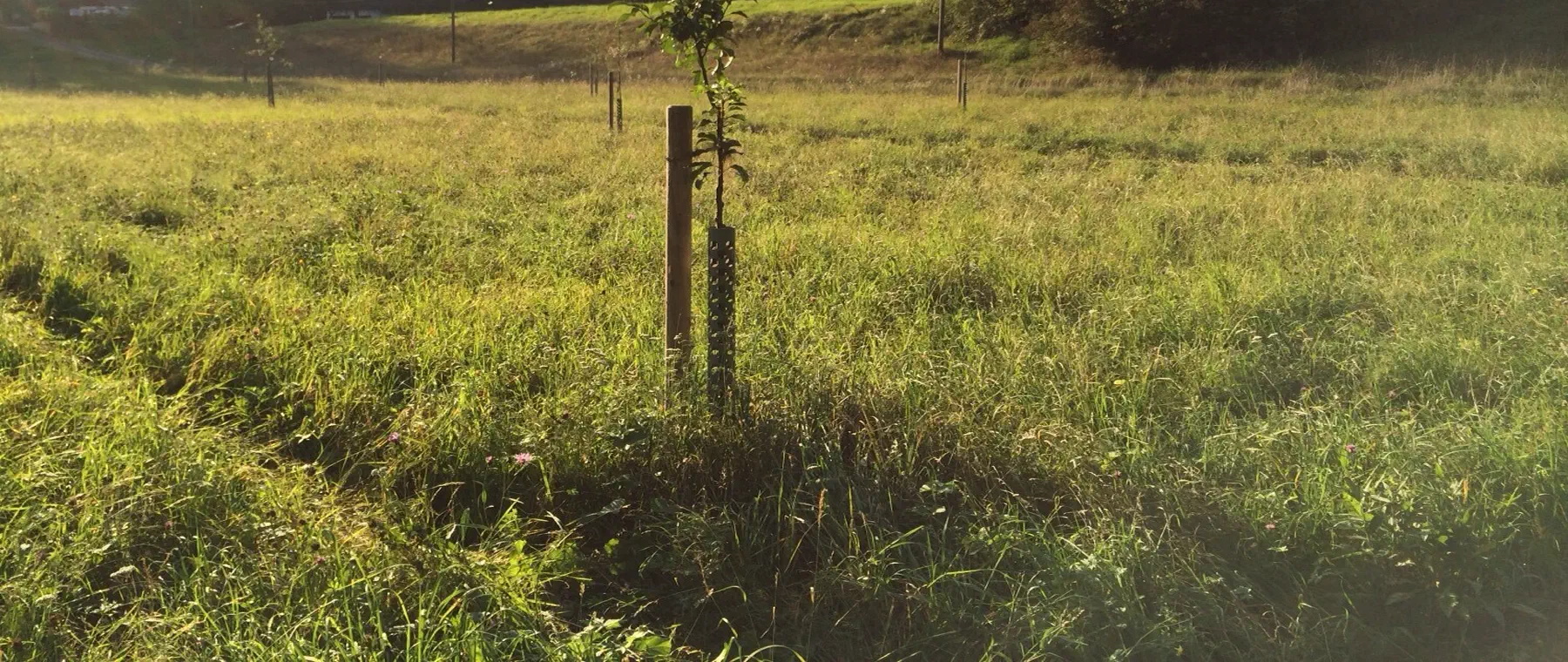
Creation and reactivation of traditional orchard stands on the warmth-benefiting slopes of the Nahe and Hunsrück, habitat for little owls, cavity-dwelling bats and numerous wild bee species.
Species protection CEF and FCS
Tailored measures for European wildcats (forest networks and crossing aids), bat roosts in old wood, reptile habitats for sand lizards on railway embankments and quarry edges according to the provisions of § 44 BNatSchG.
Hedgerows and habitat network
Creation of hedgerows, field copses and stepping-stone habitats in structurally impoverished arable land to network forest areas of the Hunsrück with the open-land habitats of the Nahe.
Protected species in the National park land between Hunsrück and Nahe
European wildcat
The large contiguous forests of the Nationalpark Hunsrück-Hochwald rank among the core areas of the European wildcat. Typical measures are the networking of forest habitats and crossing aids at transport routes.
About this species ›Black stork
The disturbance-sensitive black stork breeds in the extensive, quiet Hunsrück forests and searches for food at naturally intact forest streams. Wind power projects regularly trigger FCS measures here.
About this species ›Bats in old-wood forests
Bechstein's bats, barbastelle bats and greater mouse-eared bats use the ancient broadleaf forests as roost and hunting ground. Preservation of cavity trees and artificial roosts are proven compensation measures.
About this species ›Kingfisher at the Nahe
The Nahe and its tributaries provide the kingfisher with steep banks for breeding and fish-rich sections for foraging. Stream restorations and modelled riverbank collapse zones create suitable habitats.
About this species ›Hazel dormouse
The hazel dormouse inhabits structurally diverse and berry-rich forest edges, shrublands and hedgerows. For vegetation removal, preservation of networked structures and the creation of new hedgerows are required.
About this species ›Sand lizard
The calcareous grasslands and moorlands of the Truppenübungsplatz Baumholder and railway embankments and quarry edges are habitat for the sand lizard. It is a frequently targeted species in infrastructure and resource projects.
About this species ›Which projects trigger a compensation obligation?
Wind energy in the Hunsrück
The Hunsrück ranks among the windy upland areas and is intensively used for wind energy. Construction and repowering of wind farms trigger impact compensation and FCS measures for black storks, red kites and bats.
Transport infrastructure
Expansion and refurbishment of federal and state roads such as B41 and B269, bypasses and bridge structures generate compensation obligations under §§ 13 to 15 BNatSchG.
Raw material extraction
Hard rocks such as diabase and melaphyr are extracted in quarries around Idar-Oberstein. Expansions and new mining fields require compensation and replacement measures, frequently associated with reptile protection.
Settlement and business development
New residential and business areas in Idar-Oberstein, Birkenfeld and Baumholder lead to land sealing and thus nature conservation compensation requirements that landowners can utilise as suppliers.
From enquiry to monitoring
Contact and enquiry
Tell us your compensation requirement and the natural region. We check availability.
Offer and advice
A transparent offer covering measure types, scope and availability.
Coordination with authorities
Full coordination with the lower nature conservation authority. We handle everything.
Long-term monitoring
Permanent securing of the land, management and documentation across the contract term.
Eco-points in adjoining districts
All about eco-points
in the district of Birkenfeld
Request eco-points in the district of Birkenfeld
We will promptly prepare a transparent offer with matching eco-points held in stock in the district of Birkenfeld.