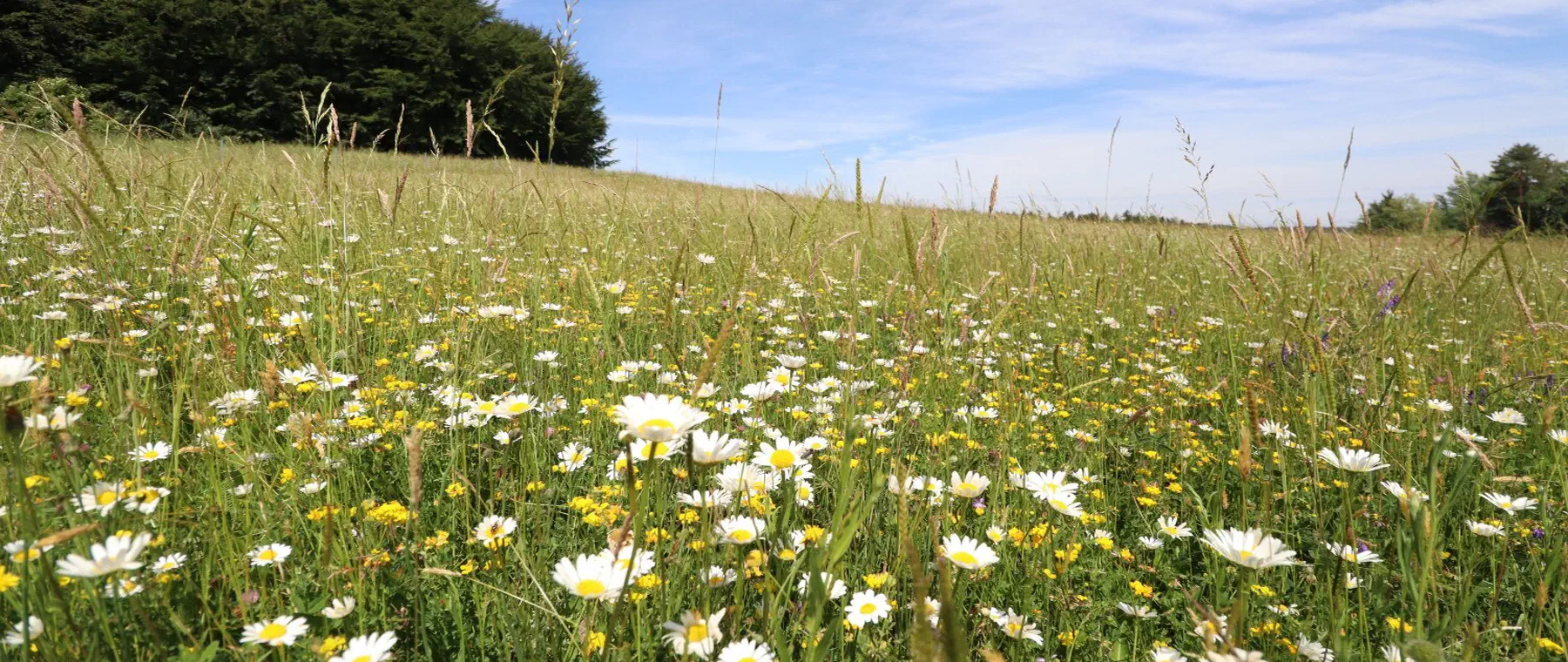
Eco-points and compensation areas
District of Bernkastel-Wittlich
Eco-points and compensation areas for Bernkastel-Wittlich district, professionally developed and coordinated with the responsible nature conservation authority according to the Landeskompensationsverordnung Rheinland-Pfalz (LKompVO). greeNature solutions supports project developers nationwide from impact assessment through to lasting safeguarding of measures.
The District of Bernkastel-Wittlich at a glance
Bernkastel-Wittlich district lies in the west of Rheinland-Pfalz and at roughly 1,168 square kilometres is the second-largest district in the state. Within it three landscapes meet, the volcanically shaped Eifel in the north, the deeply incised Mosel valley in the centre and the forest-rich uplands of the Hunsrück in the south. The district seat is Wittlich.
In the natural region classification of the BfN, the district belongs to three major landscapes: the Hunsrück (D42), the Mosel valley (D43) and the Eifel (D45). This diversity ranges from the sun-exposed slate slopes of the Middle Mosel across the forested domes of the Mosel Eifel to the cool heights of the Hunsrück with the Erbeskopf, the highest elevation in Rheinland-Pfalz at 816 metres.
Ecologically significant are the steep slopes and dry stone walls of Mosel vineyards, the naturally intact tributary valleys of the Mosel, the Kondelwald as an old and dead wood-rich beech and oak forest of the Mosel Eifel, and extensive forest areas of the Hunsrück in the vicinity of the Naturpark Saar-Hunsrück. Numerous areas are secured as FFH and bird protection areas of the Natura 2000 network.
Economically, the viticulture on the Middle Mosel (heartland of Riesling cultivation), agriculture and forestry, tourism and trade and industrial sites shape the district. Transport corridors such as the A1, A60 and B50neu with the Hochmosel viaduct trigger compensation requirements under §§ 13 to 15 BNatSchG just as much as the expansion of wind energy on the uplands of the Hunsrück and Eifel.
🗺️ Associated natural regions
Go to natural region D42 ›
Go to natural region D45 ›
Go to natural region D43 ›
📍 Selected municipalities
🌿 Ecological features
- Middle Mosel steep slopes with dry stone walls and vineyard fallows, habitat for warmth-loving species
- Kondelwald, old and dead wood-rich beech and oak-hornbeam forest of the Mosel Eifel
- Naturally intact Mosel tributary valleys (including the Ueßbach) as part of the Natura 2000 network
- Erbeskopf (816 m), highest elevation of the Hunsrück and Rheinland-Pfalz
- Parts of the Naturpark Saar-Hunsrück with extensive forests and valley streams
- Volcanically shaped landscape elements of the Eifel in the north of the district
- FFH areas along the Mosel slopes and tributary valleys with bat and butterfly habitats
✅ greeNature on the ground
greeNature solutions operates nationwide and works in Bernkastel-Wittlich district according to the Landeskompensationsverordnung Rheinland-Pfalz (LKompVO). We know the requirements of the lower nature conservation authority at the Kreisverwaltung Bernkastel-Wittlich, the Rheinland-Pfalz eco-account and the natural region peculiarities of Mosel, Eifel and Hunsrück. From impact assessment through land securing to monitoring we undertake the complete process.
Typical measures in the district of Bernkastel-Wittlich
Vineyard fallows and dry stone walls
Development and management of abandoned steep slopes with open slate surfaces, stone clearance rows and dry stone walls. These structures are valuable habitat for sand lizards, wall lizards and warmth-loving insects and are well suited as compensation in the Mosel slope areas.
Forest conversion with old and dead wood
Development of structurally diverse, site-appropriate broadleaf mixed forests and creation of old and dead wood islands, for instance in the vicinity of the Kondelwald. Cavity trees and habitat structures secure habitats for bats, black storks and European wildcats.
Stream and floodplain restoration
Removal of culverted sections, development of naturally intact riverbank structures and creation of floodplain forest margins on Mosel tributary valleys. The measures promote kingfishers, amphibians and watercourse connectivity.
Grassland extensification in the Hunsrück
Conversion of intensively managed land into species-rich hay and grazing meadows on the uplands of the Hunsrück, with adapted mowing regimes in favour of meadow-breeding birds, butterflies and flower-visiting insects.
Traditional orchards and calcareous grassland
Creation and refurbishment of traditional orchard stands and management of sparse, flower-rich margins and semi-arid grassland on sunny slopes as stepping-stone and foraging habitats within habitat networks.
Hedgerows and habitat network
Creation of hedgerows, field copses and margins for linking forest, open land and valley areas. Such structures connect partial habitats of hazel dormouse, red-backed shrike and numerous insect species.
Protected species in the Middle Mosel, Eifel and Hunsrück
European wildcat
The contiguous forests of Hunsrück and Eifel rank among the significant retreat areas of the strictly protected European wildcat. Structurally diverse broadleaf forests, wind-felled areas and networked woodland are decisive for the species and stand in focus of species protection measures.
About this species ›Black stork
In the low-disturbance, water-rich forest areas of the district, the black stork breeds. It uses naturally intact valley streams as foraging habitat, which is why quiet nest surroundings and intact watercourses are particularly important to consider in projects.
About this species ›Sand lizard in Mosel slopes
Dry stone walls, vineyard fallows and sunlit slopes of the Middle Mosel provide the sand lizard with ideal living conditions. Where impacts affect slope areas, it counts among species regularly to be examined, for which advanced compensation measures (CEF) are set.
About this species ›Bats in the Kondelwald
Old and dead wood-rich forests such as the Kondelwald and Mosel tributary valleys provide bats with roosts and hunting grounds. Cavity trees, old tunnels and bunker facilities are important summer and winter roosts that must be secured in projects.
About this species ›Kingfisher
At the Mosel and its naturally intact tributaries, the kingfisher breeds in steep banks. Restored riverbank sections, collapse zones and intact fish populations secure its habitat and are typical building blocks of water-related compensation.
About this species ›Amphibians of valley streams
Fire salamanders, yellow-bellied toads and further amphibians inhabit the spring-head valley streams of Eifel and Hunsrück. Newly created small waterbodies and restoration of watercourses are among the effective measures for this species group.
About this species ›Which projects trigger a compensation obligation?
Transport and infrastructure
The transport corridors A1, A60 and the B50neu with the Hochmosel viaduct and bypasses and expansion of secondary road networks trigger compensation and replacement obligations under §§ 13 to 15 BNatSchG. greeNature solutions develops legally sound compensation concepts according to LKompVO.
Wind energy on Hunsrück and Eifel
Expansion of wind energy on the uplands of Hunsrück and Eifel regularly requires, beyond impact compensation, species protection measures, for instance for bats, black storks and red kites. FCS and CEF measures safeguard the affected populations and habitats.
Trade and industrial areas
Designation and expansion of trade and industrial areas, among others in the Wittlich area, lead to land sealing with corresponding compensation requirements. greeNature solutions provides compensation areas and undertakes full authority coordination.
Viticulture and land consolidation
Steep slope rehabilitation and land consolidation in the Mosel vineyards affect sensitive habitats at dry stone walls and slopes. Nature conservation professionally supervised measures combine viticultural use with preservation of sand lizards and warmth-loving species.
From enquiry to monitoring
Contact and enquiry
Tell us your compensation requirement and the natural region. We check availability.
Offer and advice
A transparent offer covering measure types, scope and availability.
Coordination with authorities
Full coordination with the lower nature conservation authority. We handle everything.
Long-term monitoring
Permanent securing of the land, management and documentation across the contract term.
Eco-points in adjoining districts
All about eco-points
in the district of Bernkastel-Wittlich
Request eco-points in the district of Bernkastel-Wittlich
We will promptly prepare a transparent offer with matching eco-points held in stock in the district of Bernkastel-Wittlich.