Eco-points and compensation areas
District of Heinsberg
Immediately available eco-points from officially recognised eco-accounts. greeNature supports your compensation in Kreis Heinsberg as full-service partner, from assessment under the Ökokonto-Verordnung NRW through liaison with the lower nature conservation authority.
The District of Heinsberg at a glance
Kreis Heinsberg lies in the far west of North Rhine-Westphalia in the Cologne administrative region and borders the Dutch province of Limburg over a long stretch. The district seat is Heinsberg, characterised by the Rur, which runs through the district area from south-east to north-west. Naturally, the district divides into the Selfkant in the west, the Schwalm-Nette plateau in the north-east, plus the Erkelenzer Börde and Baaler Riedelland in the south-east.
The entire district belongs to the BfN major landscape D35 (Lower Rhine Lowland and Cologne Bay). Over wide areas, Ice Age terraces of sand and gravel have produced heaths, dunes and pine forests. The south-east carries fertile loess soils of the Erkelenzer Börde, whilst the valleys of the Rur, Wurm and Schwalm form damp lowlands.
Ecologically significant are the Teverener Heide with its dune, heath, bog and water complex, the transnational bird protection site Schwalm-Nette plateau with border forest and Meinweg, and the Rur floodplains. The north has a share in the Maas-Schwalm-Nette nature reserve, directly adjoining the Dutch national park De Meinweg. Overall, five FFH sites are designated.
Economically, the district is heavily shaped by the Rhineland Mining Area. The Garzweiler opencast mine extends into Erkelenz town, and the structural change following coal phase-out brings extensive reclamation, restoration and commercial projects. Combined with transport expansion, settlement development and renewable energies, compensation requirements regularly arise, to be addressed under the State Nature Conservation Act NRW and the Ökokonto-Verordnung NRW.
🗺️ Associated natural regions
Go to natural region D35 ›
📍 Selected municipalities
🌿 Ecological features
- Teverener Heide, FFH site with dune, heath, bog and water complex in the south of the district
- Bird protection site Schwalm-Nette plateau with border forest and Meinweg, transnational across more than 7,000 hectares
- Maas-Schwalm-Nette nature reserve, adjoining the Dutch national park De Meinweg
- Rur floodplains as near-natural watercourse and floodplain landscape across the district area
- Helpensteiner Bachtal and Rothenbach, near-natural stream system with alder and ash forests
- Erkelenzer Börde with fertile loess soils as a habitat for field birds
- Garzweiler post-mining landscape at the eastern district edge as an area for large-scale reclamation
✅ greeNature on the ground
greeNature operates nationwide and implements compensation in Kreis Heinsberg consistently according to the State Nature Conservation Act NRW and the Ökokonto-Verordnung NRW. We understand the numerical assessment procedure with biotope values, the requirements of the lower nature conservation authority in Heinsberg and the special circumstances in the Rhineland Mining Area and in the border region to the Netherlands.
Typical measures in the district of Heinsberg
Watercourse and floodplain restoration
Removal of bank reinforcement, reconnection of oxbows and promotion of natural dynamics on the Rur, Wurm and Schwalm. This creates steep banks, shingle banks and floodplain woodland as habitat for kingfisher, fish and amphibians.
Heath and sand-grassland management
Scrub removal, sheep grazing and turving on the terrace sands around the Teverener Heide. These measures preserve open heaths, sand-grasslands and small waterbodies as protected habitat types.
Arable extensification and field bird protection
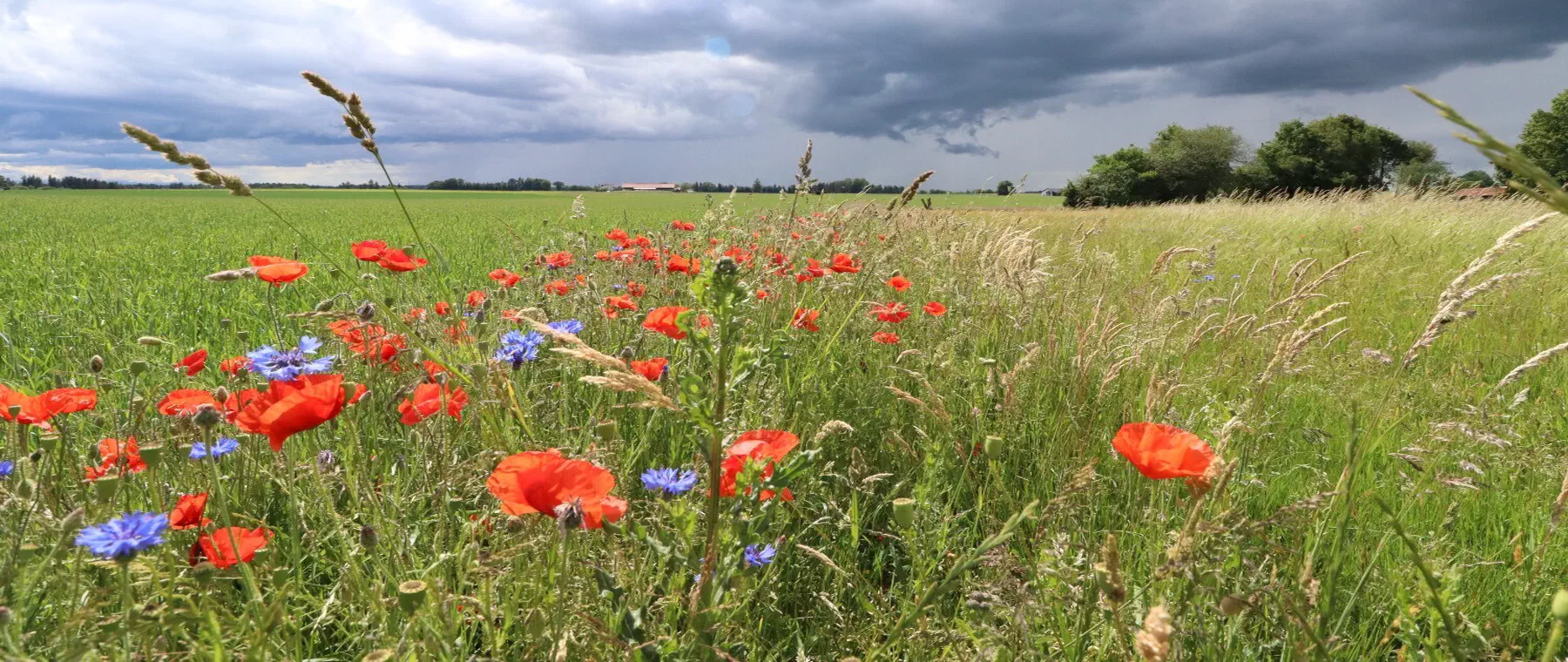
Creation of flower strips, skylark windows and extensively managed arable margins in the Erkelenzer Börde. These structures support northern lapwing and skylark populations in open farmland.
Forest development and new afforestation
Conversion of structurally poor pine plantations to site-appropriate broadleaf and mixed forests plus creation of forest on suitable land. Dead and fallen timber plus woodland edges further enhance habitats.
Species protection CEF and FCS
Bat roosts on buildings and in forests, replacement habitats for sand lizard on slopes and embankments, steep faces for kingfisher and breeding ponds for amphibians, each as advance compensation and safeguarding measures (CEF) or population-supporting measures (FCS) under § 44 and § 45 BNatSchG.
Hedgerows, field copses and habitat network
Creation of hedgerows, tree rows and field copses in the intensively farmed plain and at the mine edge. These structures network habitats, create stepping-stone biotopes and connect valley floodplains with forest areas.
Protected species in the Rurland, Selfkant and Schwalm-Nette
Northern lapwing in the plain
The northern lapwing breeds on open arable land and in wet depressions of the Erkelenzer Börde. As a field bird of farmland, it benefits from field-bird islands, extensive arable margins and rewetted depressions established as compensation measures.
About this species ›Skylark on open fields
The skylark inhabits the wide arable tracts of the district. Skylark windows, flower strips and a more open field layout improve its breeding and feeding habitats and are proven elements of open-land compensation.
About this species ›Sand lizard on sandy soils
On terrace sands, railway embankments and slopes, the strictly protected sand lizard (Annex IV FFH Directive) finds suitable habitats. In cases of impact, replacement habitats with sunny spots and shelter structures are typical CEF measures.
About this species ›Kingfisher on Rur and Schwalm
Near-natural bank sections with steep faces offer the kingfisher breeding sites. In cases of watercourse impact, steep-face modelling and bank restoration are proven measures for the strictly protected species.
About this species ›Bats in forest and settlement
Numerous bat species use forests, watercourses and buildings in the district as hunting and roost habitats. All species are strictly protected; replacement roosts are required as CEF measures during demolition and renovation.
About this species ›Amphibians in heathland and floodplain
Great crested newt, natterjack toad and other amphibians inhabit small waterbodies in the Teverener Heide and pools and depressions in valley floodplains. Creation and networking of fish-free breeding ponds secure their breeding sites in building projects.
About this species ›Which projects trigger a compensation obligation?
Brown coal and structural change in the Rhineland Mining Area
The Garzweiler opencast mine extends into Erkelenz town. Reclamation, restoration of the post-mining landscape and new commercial land in the course of coal phase-out trigger extensive compensation and replacement obligations, which greeNature supports as land partner.
Infrastructure and transport
Expansion and gap-closures in the motorway and federal road network, town bypasses, bridge structures on Rur and Wurm plus rail projects create impacts on nature and landscape whose compensation must be provided under LNatSchG NRW.
Commerce, logistics and settlement
New commercial and logistics sites, residential areas in Heinsberg, Erkelenz, Hückelhoven and Geilenkirchen towns plus land recycling in structural change require statutory nature-conservation compensation and create demand for recognised eco-points.
Renewable energies
Wind installations on plain land, free-field photovoltaic systems and reuse of opencast pit edges require statutory nature-conservation compensation plus species protection CEF and FCS measures for field birds and bats.
From enquiry to monitoring
Contact and enquiry
Tell us your compensation requirement and the natural region. We check availability.
Offer and advice
A transparent offer covering measure types, scope and availability.
Coordination with authorities
Full coordination with the lower nature conservation authority. We handle everything.
Long-term monitoring
Permanent securing of the land, management and documentation across the contract term.
Eco-points in adjoining districts
All about eco-points
in the district of Heinsberg
Request eco-points in the district of Heinsberg
We will promptly prepare a transparent offer with matching eco-points held in stock in the district of Heinsberg.