Eco-points and compensation areas
District of Euskirchen
eco-points und compensation areas im district Euskirchen, aus anerkannten eco-accountmaßnahmen nach der eco-account-Verordnung North Rhine-Westphalia. greeNature entwickelt und betreut naturraumtreue compensationsflächen zwischen Zülpicher Börde und Nordeifel, von der assessment bis zur dauerhaften management, bundesweit tätig und mit Kenntnis der regionalen Behörden.
The District of Euskirchen at a glance
Der district Euskirchen liegt im Süden von North Rhine-Westphalia und gehört zum administrative region Köln. Er spannt sich vom fruchtbaren Ackerland der Zülpicher Börde im Norden über die Mechernicher Voreifel bis in die bewaldeten Höhenzüge der Nordeifel im Süden und Westen. Diese Spannweite macht ihn naturräumlich zu einem der vielfältigsten districte des Landes.
Naturräumlich hat der district Anteil an zwei BfN-Haupteinheiten. Der Norden zählt zur Niederrheinischen Bucht (D35) mit ihren Lössböden und der weithin offenen Bördelandschaft, der größere Teil im Süden und Westen gehört zur Eifel (D45) mit Kalkeifel, Münstereifeler Wald und den Tälern von Erft, Urft und Olef. Für die Zuordnung einer compensation ist der natural region des impacts maßgeblich.
Ökologisch prägend ist der Anteil am Nationalpark Eifel im Raum Schleiden sowie ein dichtes Netz aus FFH- und Vogelschutzgebieten. Die artenreichen Kalkmagerrasen und Wacholderheiden der Kalkeifel, naturnahe Buchenwälder und die Bachtäler zählen zu den wertvollsten Lebensräumen. Die Eifelwälder sind zudem ein Verbreitungsschwerpunkt der Europäischen European wildcat.
Erheblichen compensation requirement erzeugen der Wiederaufbau nach dem Hochwasser vom Juli 2021, das Erft, Urft und Ortslagen wie Bad Münstereifel schwer getroffen hat, dazu Straßen- und Infrastrukturvorhaben, die Windenergie in der Nordeifel sowie Rohstoffgewinnung, Gewerbe und Siedlungsentwicklung im Raum Euskirchen und Weilerswist.
🗺️ Associated natural regions
Go to natural region D45 ›
Go to natural region D35 ›
📍 Selected municipalities
🌿 Ecological features
- Anteil am Nationalpark Eifel im Raum Schleiden, dem einzigen Nationalpark North Rhine-Westphalias, mit naturnahen Buchenwäldern und dem Urftsee
- Kalkeifel mit artenreichen Kalkmagerrasen, Wacholderheiden und Orchideenvorkommen, überwiegend als Natura-2000-Gebiete gesichert
- Europäische European wildcat als Charakterart der zusammenhängenden Eifelwälder mit landesweit bedeutendem Bestand und habitat network
- Zülpicher Börde im Norden, eine der ertragreichsten Lössackerlandschaften mit Restvorkommen von Feldvögeln
- FFH-Gebiete in den Bachtälern und um Bad Münstereifel (Eschweiler Tal und Kalkkuppen) mit Kalkbuchenwäldern und Halbtrockenrasen
- Historic mining at Mechernich (Bleiberg) with tunnels that today serve as important winter quarters for bats
- Far-reaching impacts of the July 2021 flood on watercourses, floodplains and settlements on the Erft and Urft
✅ greeNature on the ground
greeNature operates nationwide and guides project developers and municipalities in Kreis Euskirchen through statutory nature-conservation compensation. We understand the impact mitigation regulation under §§ 13 to 15 BNatSchG, its implementation in the State Nature Conservation Act of North Rhine-Westphalia (LNatSchG NRW) and the numerical assessment procedure by which biotopes are assessed using value points. For the district, spanning from the Zülpicher Börde to the Nordeifel, we secure suitable land, plan natural-region-appropriate enhancements from the management of calcareous grasslands through restoration of stream valleys to near-natural forest conversion, implement them and undertake permanent management and documentation for recognition by the lower nature conservation authority (Untere Naturschutzbehörde). Measures and eco-points are recorded under the Ökokonto-Verordnung NRW and listed in the compensation register. Where species protection requirements exist under § 44 BNatSchG, for example for bats, European wildcats or amphibians, we develop advance compensation and safeguarding measures (CEF) that ensure the ecological function of affected habitats on a permanent basis.
Typical measures in the district of Euskirchen
Calcareous grasslands and juniper heaths
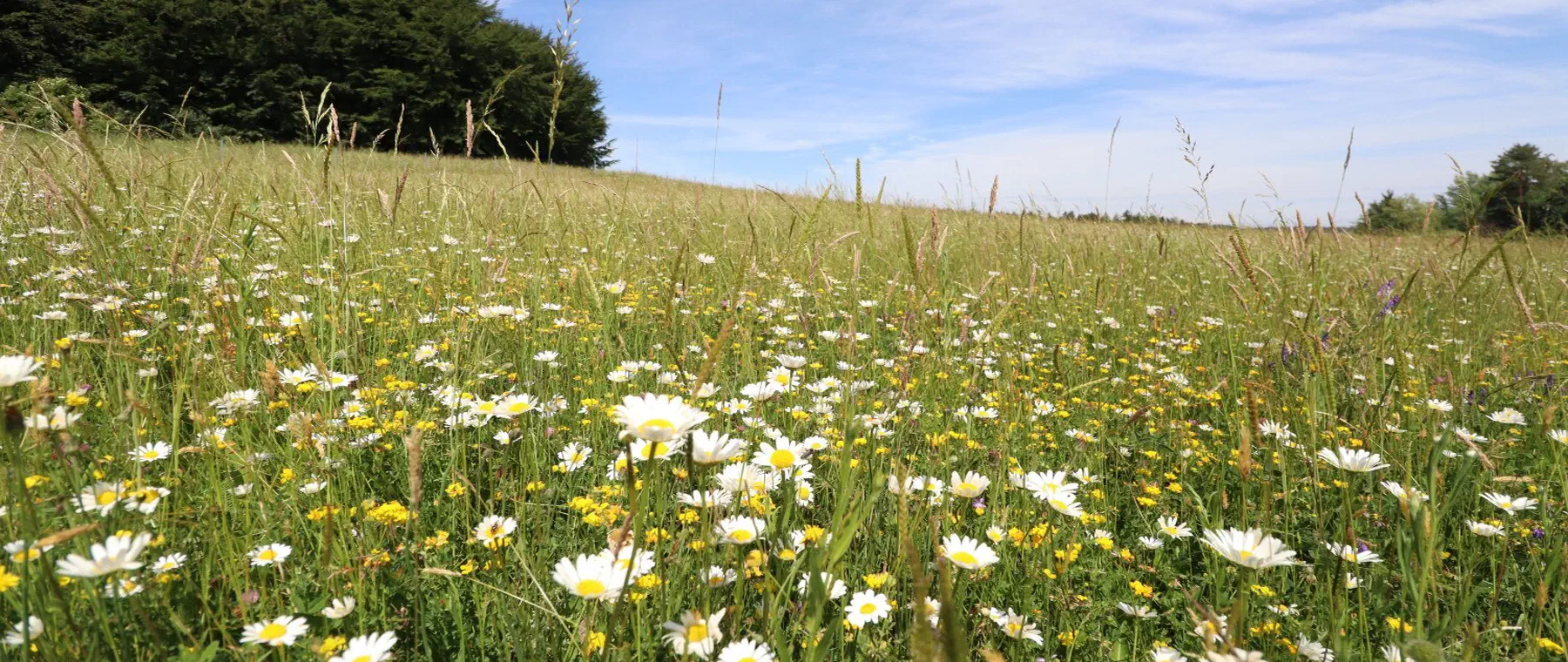
Scrub clearance, restoration and permanent management of the species-rich semi-arid and calcareous grasslands of the Kalkeifel, mostly through grazing by sheep and goats. These habitats support numerous orchids, wild bees and butterflies and rank among the highest-value enhancement areas in the region.
Watercourse and floodplain restoration
Deculverting and removal of bank reinforcement, creation of riparian buffer strips and reconnection of floodplains to the Erft, Urft, Olef and their tributaries. Following the 2021 flood, near-natural watercourse development combines here with precautionary water retention in the landscape.
Near-natural forest conversion and habitat network
Conversion of structurally poor coniferous plantations to site-appropriate broadleaf and mixed forests, plus development of woodland edges and stepping-stone habitats. In the Eifel forests, these measures strengthen the habitat network and migration corridors for the European wildcat.
Grassland extensification
Conversion of intensively managed meadows and pastures into species-rich extensively managed grassland in the stream valleys of the Eifel, with late mowing and reduced fertilisation. This creates habitats for meadow-breeding birds, insects and food sources for the surrounding forests.
Hedgerows and traditional orchards in the plain
New planting of hedgerows, field copses, broad field margins and traditional orchard stands in the intensively farmed Zülpicher Börde. These structures connect isolated habitats and provide field birds and small mammals with shelter and food.
Species protection CEF and FCS
Tailored measures under § 44 BNatSchG, such as securing and enhancing bat roosts in the tunnels near Mechernich, sand lizard habitats on railway and quarry sites, and breeding ponds for amphibians and great crested newts in the Kalkeifel.
Protected species in the Nordeifel und Zülpicher Börde
European wildcat
The Eifel forests rank among Germany's most significant ranges for the strictly protected wildcat (Annex IV FFH Directive). It requires large, low-disturbance forests with dead wood and connecting hedgerow structures, which is why forest conversion and habitat networking are typical compensation approaches.
About this species ›Black stork
The elusive black stork breeds in the extensive, tranquil forest areas of the Eifel and hunts for food in near-natural streams and wetland areas. It benefits from watercourse restoration and the preservation of disturbance-free forest zones.
About this species ›Bats of the Kalkeifel
Caves, rock faces and the old mining tunnels near Mechernich are important summer and winter roosts, including for the greater mouse-eared bat. In cases of impact on buildings, forests or tunnels, CEF measures such as replacement roosts secure the function of habitats.
About this species ›Hazel dormouse
The hazel dormouse inhabits structure-rich and berry-rich woodland edges, hedgerows and understory vegetation in the Eifel. As a strictly protected species under Annex IV of the FFH Directive, it must be regularly considered in cases of hedgerow clearance and is promoted through networking and habitat creation.
About this species ›Amphibians and great crested newt
Great crested newts, yellow-bellied toads and other amphibians inhabit the small and still waters of the Kalkeifel. Newly created, sunny breeding ponds and chains of small ponds are proven enhancement and CEF measures for these species.
About this species ›Field birds of the plain
Skylarks and northern lapwings breed in the open Zülpicher Börde but have declined sharply due to intensive arable farming. Flowering strips, fallow strips, skylark windows and extensively managed arable land create breeding and feeding habitats.
About this species ›Which projects trigger a compensation obligation?
Reconstruction following the 2021 flood
Reconstruction of watercourses, bridges, roads and settlements on the Erft and Urft following the July 2021 flood is one of the largest tasks in the district. It combines infrastructure measures with near-natural watercourse development and regularly triggers compensation and replacement obligations.
Road and infrastructure projects
Expansion and new construction of roads in the Eifel, including the long-planned A1 motorway gap-closure, plus town bypasses and utility routes create compensation requirements. Natural-region-appropriate compensation land is often found in the wooded and water-rich areas.
Wind energy in the Nordeifel
Wind parks are being established and expanded on the heights of the Nordeifel, for example in Blankenheim, Dahlem and Hellenthal. Beyond impact compensation, they trigger species protection requirements for bats and wind-sensitive bird species, which may require FCS measures.
Raw material extraction, commerce and settlement
Limestone and graywacke quarrying in the Eifel, sand extraction, plus commercial, logistics and residential development in the Euskirchen and Weilerswist area require statutory nature-conservation compensation. Landowners can participate here as providers of compensation land.
From enquiry to monitoring
Contact and enquiry
Tell us your compensation requirement and the natural region. We check availability.
Offer and advice
A transparent offer covering measure types, scope and availability.
Coordination with authorities
Full coordination with the lower nature conservation authority. We handle everything.
Long-term monitoring
Permanent securing of the land, management and documentation across the contract term.
Eco-points in adjoining districts
All about eco-points
in the district of Euskirchen
Request eco-points in the district of Euskirchen
We will promptly prepare a transparent offer with matching eco-points held in stock in the district of Euskirchen.