Eco-points and compensation areas
District of Nienburg/Weser
Eco-points and naturally appropriate compensation areas in Nienburg/Weser District on the Middle Weser. greeNature develops, secures and manages compensation areas according to the impact mitigation regulation and Lower Saxony nature conservation law (NAGBNatSchG), from assessment in the biotope value method to permanent management.
The District of Nienburg/Weser at a glance
Nienburg/Weser District lies in central Lower Saxony in the Middle Weser region and belongs overwhelmingly to the BfN natural region D31 (Weser-Aller lowlands). The Weser runs through the district from south to north and shapes with its floodplain, oxbows and adjacent lowlands the landscape character. Administrative regions have not existed in Lower Saxony since 2004. The intermediate level is now performed by the Office for Regional Development.
Geologically, the district is shaped by glacially formed valley sands, river terraces and geest plateaux. Over wide arable and grassland areas rise gentle geest ridges such as the Rehburg Hills, while the west with extensive bogs opens towards the natural region D30 (Ems-Hunte geest and Dümmer geest lowlands).
Ecologically significant are the Weser floodplain with its moist meadows, the Uchter Moor as the district's largest nature reserve (approximately 3,263 hectares) and the Meerbruch meadows near Rehburg-Loccum belonging to the Steinhuder Meer. Uchter Moor is part of the Diepholz bog lowlands, an internationally significant staging area for cranes.
The economy combines strong agriculture (among other things the widely known asparagus cultivation) with paper and glass production, chemical industry, food production, logistics and renewable energies. Commerce, infrastructure and energy projects regularly trigger compensation requirements under §§ 13 to 15 BNatSchG in the district.
🗺️ Associated natural regions
Go to natural region D30 ›
📍 Selected municipalities
🌿 Ecological features
- Weser floodplain of Middle Weser with moist grassland, oxbows and riparian forest remnants
- Uchter Moor, largest nature reserve of the district (approximately 3,263 hectares), part of Diepholz bog lowlands
- Meerbruch meadows near Rehburg-Loccum, share in the FFH and EU bird protection area Steinhuder Meer
- Diepholz bog lowlands as internationally significant staging area for cranes
- Rehburg Hills as forested geest ridge above the lowland
- Transition from the Weser-Aller plain (D31) to the bogs of Dümmer geest lowlands (D30) to the west
✅ greeNature on the ground
greeNature operates nationally and is familiar with nature conservation law of the federal states. In Lower Saxony, we orient compensation at the impact mitigation regulation under §§ 13 to 15 BNatSchG in conjunction with NAGBNatSchG and assess impact and compensation using the biotope value method according to NLWKN guidance materials. Upgrades can be stockpiled through an eco-account under § 16 BNatSchG and as eco-points assigned to later impacts. For Nienburg/Weser District, we secure appropriate areas in the Weser floodplain, on the geest and in lowland areas, coordinate measures with the lower nature conservation authority, maintenance associations and landowners and undertake planning, implementation, management and monitoring from a single source. Where species protection requirements exist under § 44 BNatSchG, we conceive early CEF measures that continuously secure ecological function for affected species.
Typical measures in the district of Nienburg/Weser
Moist grassland and meadow bird protection
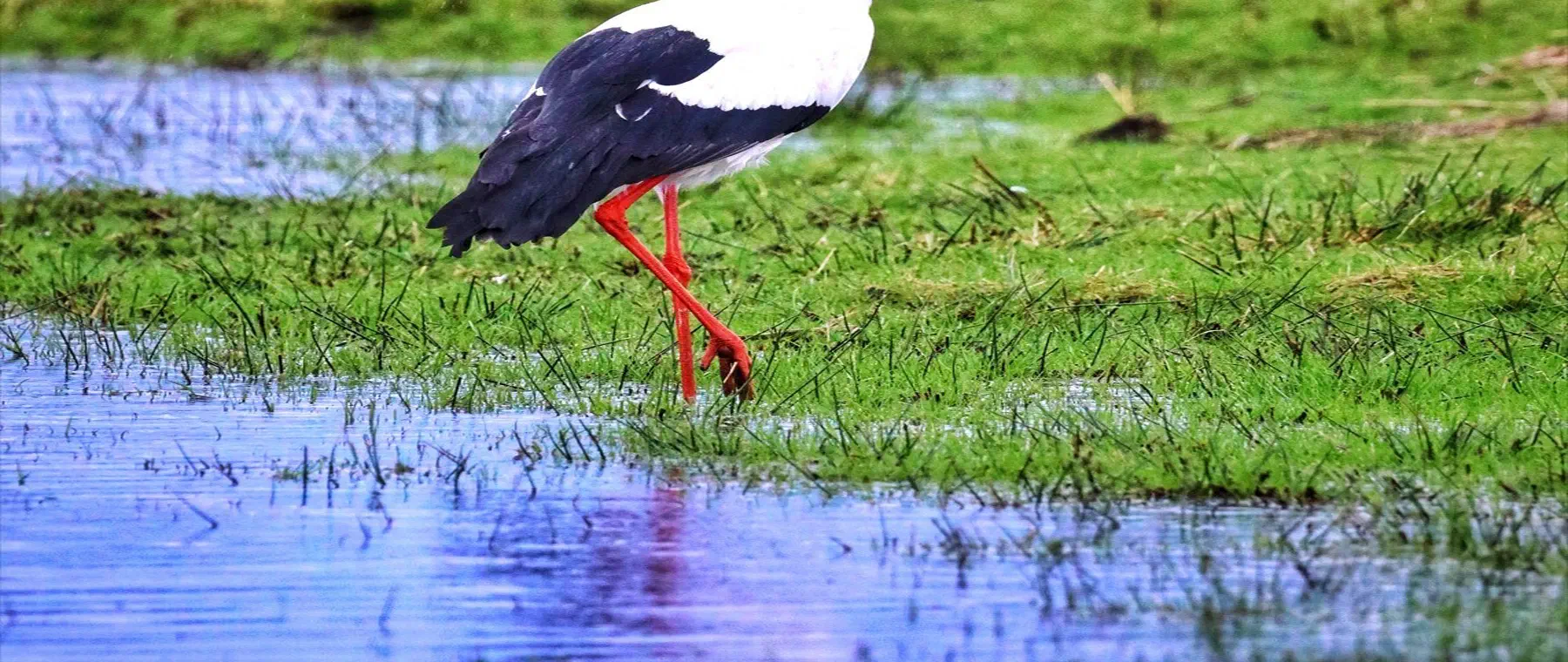
Rewetting and extensification of grassland in the Weser floodplain and lowlands, with adapted cutting dates, shallow pools and nesting site protection. This creates breeding and feeding areas for northern lapwings, black-tailed godwits and other meadow birds and lasting compensation value.
Bog restoration
Rewetting of drained peat bog areas around Uchter Moor through damming and removal of drainage. This strengthens peat-forming vegetation, sequesters carbon and preserves habitat for bog-typical species in the Dümmer geest lowlands.
Upgrade Weser floodplain and waterbodies
Connection of oxbows, flattening of steep banks and creation of floodplain waters on the Middle Weser. Natural bank structures promote fish, amphibians and riparian species and sustainably upgrade waterbody habitat.
Arable extensification
Conversion of intensively used arable land into extensively managed areas with skylark plots, flower and fallow strips. On the geest and valley sand soils of the district, such measures act as early compensation for field birds and insects.
Species protection CEF and FCS
Bespoke measures under § 44 BNatSchG, such as kingfisher steep banks on the Weser, replacement roosts for bats, sunny spawning waters for amphibians and sand structures for sand lizards on slopes and railway embankments.
Hedgerows and copses
Creation of hedgerows, copses and tree rows in open fields. These structures network habitats as stepping stones, serve bats and birds as lead lines and upgrade agricultural landscape on the geest.
Protected species in the Middle Weser and Weser-Aller lowlands
Northern lapwing and meadow birds
Moist grasslands of the Weser floodplain and Meerbruch meadows are breeding and staging areas for northern lapwings, black-tailed godwits and snipe. Their breeding sites are protected under § 44 BNatSchG. Grassland extensification, shallow pools and nesting site protection secure ecological function as CEF measures.
About this species ›Skylark
As a ground-nesting bird of open fields, the skylark is widespread on the arable and grassland of the district and regularly considered in specialist species protection assessment. Skylark plots and flower strips act as early compensation measures.
About this species ›Crane and bog species
Uchter Moor as part of Diepholz bog lowlands is an internationally significant staging area for cranes. Rewetting and keeping open maintains bog habitat and supports further specialised wetland species.
Bats
Native bat species are strictly protected and secured via Annex IV of the Habitats Directive. Riparian forests, alleys, hedgerows and old buildings in the district serve as hunting area, lead structure and roost. Replacement roosts and preservation of lead lines maintain function.
About this species ›Kingfisher
The kingfisher breeds on the Weser and its tributaries in natural steep banks. Creation and management of riverbank erosion and steep walls provides suitable breeding sites and serves as nature conservation specialist upgrade along flowing waterbodies.
About this species ›Amphibians and great crested newt
Small waterbodies, oxbows and bog margins host amphibians such as great crested newt protected under Annex II and IV of the Habitats Directive. Creation of sunny, fish-free spawning waters in networking supports populations as a CEF measure.
About this species ›Which projects trigger a compensation obligation?
Industry and commerce
Paper and glass production, chemical industry, food production and logistics characterise the economic location. Business expansions and new commercial areas create compensation requirements, which greeNature covers with naturally appropriate compensation areas and complete authority coordination.
Infrastructure and transport
Expansion of federal and state roads, bypass routes, Weser bridges plus measures on railway lines and Middle Weser waterways trigger compensation and replacement obligations under the impact mitigation regulation.
Energy and grid expansion
Wind energy and utility-scale photovoltaic installations, natural gas extraction installations plus grid expansion require nature conservation compensation and, where species are affected, CEF or FCS measures.
Settlement development
Residential and commercial areas in Nienburg/Weser and surrounding municipalities require compensation measures. Owners of arable and grassland in the Weser floodplain can offer their areas as compensation areas.
From enquiry to monitoring
Contact and enquiry
Tell us your compensation requirement and the natural region. We check availability.
Offer and advice
A transparent offer covering measure types, scope and availability.
Coordination with authorities
Full coordination with the lower nature conservation authority. We handle everything.
Long-term monitoring
Permanent securing of the land, management and documentation across the contract term.
Eco-points in adjoining districts
All about eco-points
in the district of Nienburg/Weser
Request eco-points in the district of Nienburg/Weser
We will promptly prepare a transparent offer with matching eco-points held in stock in the district of Nienburg/Weser.