Eco-points and compensation areas
District of Vogelsbergkreis
Eco-points and compensation areas in Vogelsbergkreis, assessed under the Hessian compensation ordinance. greeNature is your full-service partner for compensation in the Vogelsberg volcanic massif and east Hessian Bergland.
The District of Vogelsbergkreis at a glance
Vogelsbergkreis lies in central Hesse and belongs to the administrative region Giessen. The Vogelsberg, the largest contiguous basalt massif in central Europe, is the dominant feature, with its highest elevation being Taufstein at 773 metres. At around 1,459 km², the district is among Hesse's largest by area and sparsely populated.
Geologically, the landscape is shaped by Tertiary volcanism. Over basalt and weathered volcanic soils lie extensive beech forests, mountain meadows and structured open land with hedgerows, stone walls and spring flushes. The Vogelsberg acts as the region's water store, with sources including Nidda, Schwalm, Ohm, Lauter and Nidder.
Ecologically, the EU bird protection site Vogelsberg (DE 5421-401) is particularly significant, at around 63,600 hectares the largest Natura 2000 site in Hesse. It was designated partly due to strong populations of red kite and black stork. The FFH site Hoher Vogelsberg (DE 5421-302) with its mountain meadows and near-natural beech forests also contributes.
Economically, agriculture and forestry, wind energy and basalt mining characterise the region. Wind farms in the forested uplands, active quarries, bypasses and commercial development regularly create compensation requirements. Assessment is in eco-points under the Hessian compensation ordinance (KV).
🗺️ Associated natural regions
Go to natural region D47 ›
Go to natural region D46 ›
📍 Selected municipalities
🌿 Ecological features
- EU bird protection site Vogelsberg (DE 5421-401), around 63,600 ha, the largest Natura 2000 site in Hesse
- FFH site Hoher Vogelsberg (DE 5421-302), around 3,845 ha, mountain meadows and near-natural beech forests
- Largest contiguous basalt massif in central Europe, highest point Taufstein 773 m
- One of Europe's highest red kite densities and significant black stork populations
- Vogelsberg lakes as a regionally significant stopover for water and migratory birds
- Spring-rich uplands as the source of Nidda, Schwalm, Ohm, Lauter and Nidder
✅ greeNature on the ground
greeNature operates nationwide and is familiar with the Hessian compensation ordinance, habitat value method and assessment in eco-points. We know the requirements of the lower nature conservation authority of Vogelsbergkreis and the nature conservation specialties of the Vogelsberg, from mountain meadows to red kite and black stork habitats in the large bird protection site.
Typical measures in the district of Vogelsbergkreis
Mountain meadows and grassland
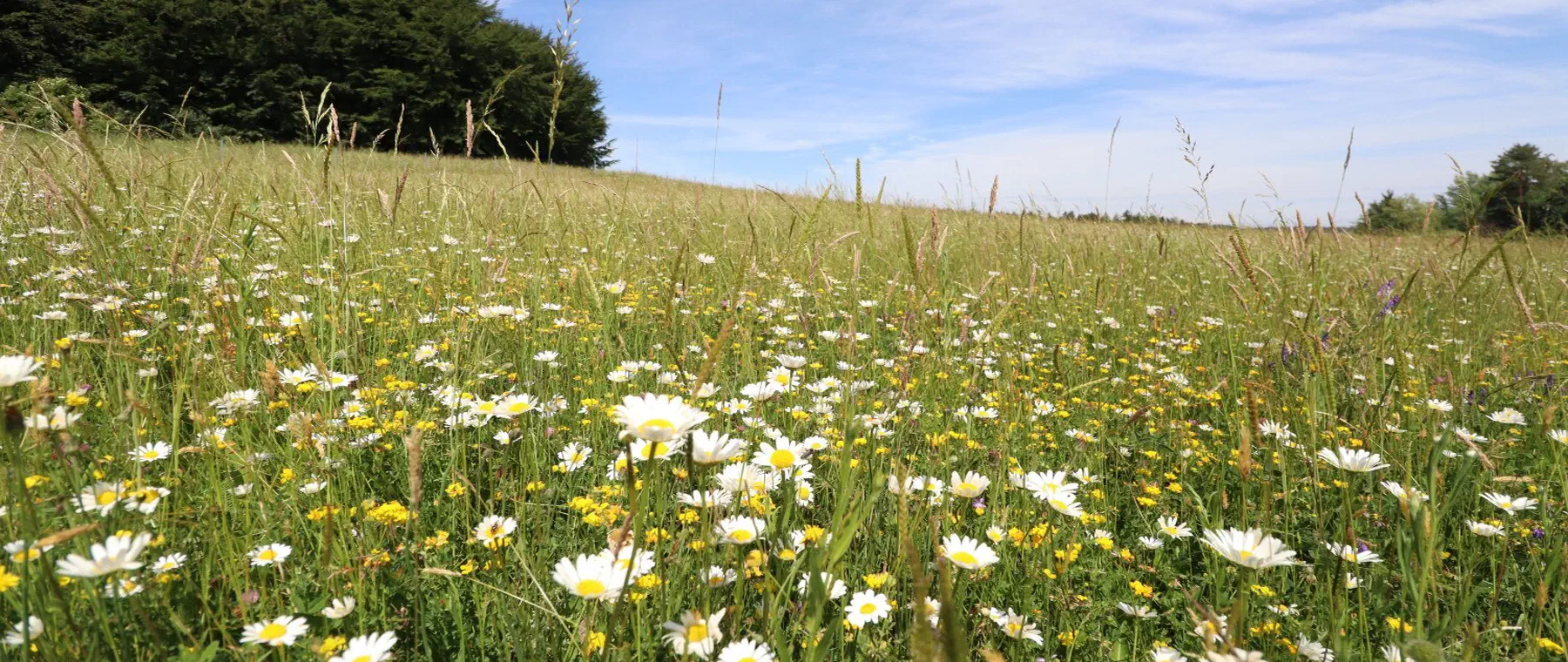
Extensification and restoration of species-rich mountain and wet meadows on volcanic soils, based on the FFH habitat type mountain meadows. Habitat for meadow-breeding birds, butterflies and wild bees in Hoher Vogelsberg.
Forest conversion and beech forest
Development of structured, near-natural beech and broadleaf forests with deadwood and veteran tree components. Habitat improvement for Bechstein's bat, Barbastelle, black woodpecker and wildcat.
Flowing water restoration
Removal of bank defences and establishment of near-natural banks on the upper reaches of Nidda, Schwalm, Ohm and Lauter. Creation of spawning habitats and breeding sites for kingfisher.
Springs and wet heathland
Restoration of spring flushes, small water bodies and wet heathland in the spring-rich uplands. Upgrade of amphibian breeding waters, including for great crested newt.
Traditional orchards and hedgerows
Establishment and management of traditional orchard stands, hedgerows and stone walls in structured open land. Stepping-stone habitats and habitat networks between forest edges and grassland.
Species protection CEF and FCS
Measures for red kite and black stork around wind energy and infrastructure projects, bat roosts and sand lizard habitats, coordinated under Section 44 BNatSchG and the Hessian KV.
Protected species in the Vogelsberg volcanic massif and east Hessian Bergland
Red kite
The Vogelsberg holds one of Europe's highest red kite densities. Open, structured grassland is central hunting habitat. FCS measures to secure conservation status are often required for wind energy projects.
Black stork
Extensive, undisturbed forests with stream valleys provide the black stork with breeding and feeding habitats. The Vogelsberg bird protection site was designated partly for this species.
About this species ›Wildcat
The Vogelsberg is among Hesse's core areas for the European wildcat. Near-natural forests, deadwood and uncut forest complexes are essential for habitat network connectivity.
About this species ›Bats
Bechstein's bat and Barbastelle use the old beech forests as roosts and hunting areas. Roost trees, winter quarters and habitat networking are typical compensation targets.
About this species ›Amphibians
Fire salamander, great crested newt and other amphibians inhabit spring flushes, small water bodies and Vogelsberg lakes. Creation and upgrade of breeding waters are proven measures.
About this species ›Kingfisher
The kingfisher breeds in steep banks of near-natural upper reaches of Lauter, Schwalm and Nidda. Restored watercourse sections and bank collapses create new breeding opportunities.
About this species ›Which projects trigger a compensation obligation?
Wind energy
The forested Vogelsberg is one of Hesse's most important wind energy locations. New construction and repowering of wind farms regularly trigger compensation and replacement obligations, especially FCS measures for red kite and black stork.
Basalt and raw material extraction
The Vogelsberg is a major basalt deposit. Expansion and new development of quarries require nature conservation compensation and later site reclamation.
Infrastructure and transport
Expansion of federal and state roads, bypasses and bridge works create compensation requirements under Sections 13 to 15 BNatSchG, assessed in eco-points under the Hessian KV.
Settlement and commerce
Residential and commercial areas in Lauterbach, Alsfeld and larger municipalities create impacts requiring compensation. Land owners can offer their properties as compensation areas.
From enquiry to monitoring
Contact and enquiry
Tell us your compensation requirement and the natural region. We check availability.
Offer and advice
A transparent offer covering measure types, scope and availability.
Coordination with authorities
Full coordination with the lower nature conservation authority. We handle everything.
Long-term monitoring
Permanent securing of the land, management and documentation across the contract term.
Eco-points in adjoining districts
All about eco-points
in the district of Vogelsbergkreis
Request eco-points in the district of Vogelsbergkreis
We will promptly prepare a transparent offer with matching eco-points held in stock in the district of Vogelsbergkreis.