Eco-points and compensation areas
District of Marburg-Biedenkopf
Immediately available eco-points from officially recognised eco-accounts. greeNature is your full-service partner for compensation under the Hessian compensation ordinance (KV) in Marburg Lahntal and Gladenbach Bergland.
The District of Marburg-Biedenkopf at a glance
Marburg-Biedenkopf district lies in central Hesse and belongs to the administrative region Giessen. The district seat and major centre is the university city of Marburg. Around 1,262 km² is home to approximately 243,000 people in 22 towns and municipalities. The district lies at the transition between three central upland landscapes and is traversed by the Lahn and its tributaries.
Naturally, the district is divided into three major units. The east belongs to the West Hessian Bergland (BfN natural region D46) with the Marburg-Giessen Lahntal, Burgwald, Upper Hessian Threshold and Amöneburg Basin. The western half is occupied by the montane Gladenbach Bergland, which naturally falls within the Westerwald (D39). The far north-west around Sackpfeife (674 m) extends into the Rothaar Mountains and thus into the Southern Bergland (D38).
Ecologically significant are the near-natural floodplains of the Lahn, Ohm, Wetschaft and Salzböde, the extensive Burgwald as one of the largest contiguous forest areas in Hesse, and the species-rich mountain and wet meadows of Gladenbach Bergland. The distinctive basalt cone of the Amöneburg and several FFH and bird protection sites contribute to high habitat diversity.
Economically, the university and life sciences sector in Marburg, the Ferrero plant in Stadtallendorf, and tool manufacturing and medium-sized businesses in the west characterise the district. Infrastructure and commercial projects, residential development and wind energy regularly create impacts requiring compensation under the Hessian compensation ordinance (KV) in eco-points.
🗺️ Associated natural regions
Go to natural region D46 ›
Go to natural region D39 ›
Go to natural region D38 ›
📍 Selected municipalities
🌿 Ecological features
- Marburg-Giessen Lahntal with near-natural Lahn floodplain as a flowing water and floodplain habitat
- Burgwald, one of the largest contiguous forest areas in Hesse
- Amöneburg Basin with the basalt cone of Amöneburg (365 m)
- Gladenbach Bergland with species-rich mountain meadows and bristle grass grassland (FFH habitat types)
- Rothaar Mountains around Sackpfeife (674 m), highest elevation in the district
- Near-natural streams such as Ohm, Wetschaft and Salzböde with structured valley floodplains
- Several FFH and bird protection sites significant for wildcat and black stork
✅ greeNature on the ground
greeNature operates nationwide and is familiar with Hessian compensation law. We assess impacts and measures under the Hessian compensation ordinance (KV) in the eco-points system, know the requirements of the lower nature conservation authority in Marburg and reliably assign projects to natural regions D46, D39 and D38. From needs analysis through land provision to administrative coordination and monitoring, we undertake the entire process.
Typical measures in the district of Marburg-Biedenkopf
Floodplain restoration on the Lahn
Removal of bank defences, reconnection of oxbows and development of self-regulating watercourse sections on the Lahn, Ohm and Wetschaft. This creates steep banks, gravel bars and riparian woodland as habitat for kingfisher, fish and amphibians.
Grassland extensification of mountain and wet meadows
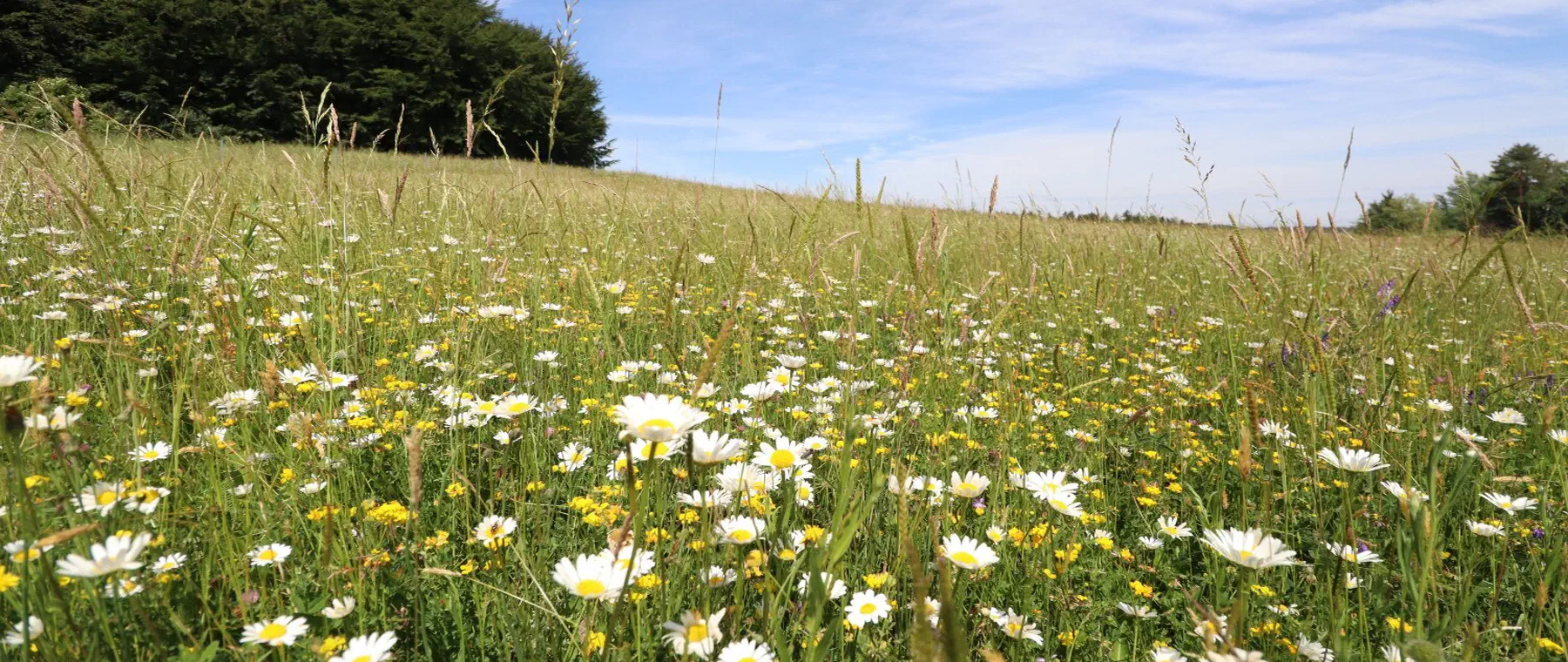
Maintenance and development of species-rich mountain meadows and wet grassland in Gladenbach Bergland through adapted cutting times, fertiliser avoidance and extensive grazing. These meadows are protected FFH habitat types.
Forest conversion with deadwood and veteran trees
Conversion of low-structure stands in Burgwald and Lahn Hills to native broadleaf forests and promotion of deadwood and veteran trees. Such measures upgrade habitats for wildcat, bats and black stork.
Hedgerows, traditional orchards and habitat networks
Establishment of hedgerows, copses and traditional orchard stands in Amöneburg Basin and open countryside. These structures link habitats and create stepping-stone habitats for farmland birds and insects.
Species protection CEF and FCS
Bat roosts in buildings and forests, replacement breeding sites for yellow-bellied toads and habitat structures for sand lizards on railway embankments and slopes, each as pre-implemented CEF or population-supporting FCS measure under Section 44 BNatSchG.
Flowing water restoration
Release and structural enrichment of small streams such as Salzböde and Wohra, establishment of buffer strips and passage for fish and invertebrates. These measures combine flood prevention with ecological upgrade.
Protected species in the Marburg Lahntal and Gladenbach Bergland
Wildcat in Burgwald and Lahn Hills
The strictly protected European wildcat (Annex IV FFH Directive) inhabits the large, structured forests of the district. Deadwood, uncut forest areas and forest edge structures are essential for its survival and typical targets of compensation measures.
About this species ›Black stork in large forest areas
The black stork breeds in quiet, old-growth forests and uses near-natural streams and floodplains for foraging. Forest disturbance reduction, retention of nest trees and restoration of forest streams are effective protective measures.
About this species ›Bats in forests and bunkers
Bechstein's bat, large mouse-eared bat and other species use beech forests and underground structures in the district as roosts. All species are strictly protected, replacement roosts as CEF measures are required for demolition, renovation and felling.
About this species ›Hazel dormouse in woodlands and forest edges
The strictly protected hazel dormouse inhabits structured forest edges, hedgerows and scrub. For felling, section-by-section, professionally supervised removal and networking of replacement habitats are required.
About this species ›Amphibians in pools and forest roads
Yellow-bellied toad, fire salamander and grass frog inhabit small water bodies, seepage forest streams and alternating-wet depressions of the mountains. Newly created, fish-free breeding waters in spatial connection secure their breeding sites during construction.
About this species ›Kingfisher on Lahn and tributary streams
Near-natural bank sections with steep banks provide kingfisher breeding sites. For impacts on water bodies, steep bank modelling and bank restoration are proven CEF measures for the strictly protected species.
About this species ›Which projects trigger a compensation obligation?
Road and transport infrastructure
Bypass roads along Federal Roads B 62, B 252 and B 453, and road and bridge construction on the Lahntal trigger compensation and replacement obligations under Sections 13 to 15 BNatSchG, to be met in eco-points under the Hessian KV.
Industry and commerce
Extensions to the Ferrero plant in Stadtallendorf, the life sciences site in Marburg and commercial area expansions in district centres regularly create compensation requirements for land sealing and vegetation loss.
Wind energy and renewable energies
Wind energy projects in the higher elevations of Gladenbach Bergland and Rothaar Mountains, and photovoltaic ground installations require nature conservation compensation and species protection FCS measures, especially for wind-sensitive species.
Settlement and residential development
Residential construction and infill projects in the university city of Marburg and surrounding municipalities require compensation measures. Owners of suitable land can bring these in as eco-account or compensation areas.
From enquiry to monitoring
Contact and enquiry
Tell us your compensation requirement and the natural region. We check availability.
Offer and advice
A transparent offer covering measure types, scope and availability.
Coordination with authorities
Full coordination with the lower nature conservation authority. We handle everything.
Long-term monitoring
Permanent securing of the land, management and documentation across the contract term.
Eco-points in adjoining districts
All about eco-points
in the district of Marburg-Biedenkopf
Request eco-points in the district of Marburg-Biedenkopf
We will promptly prepare a transparent offer with matching eco-points held in stock in the district of Marburg-Biedenkopf.