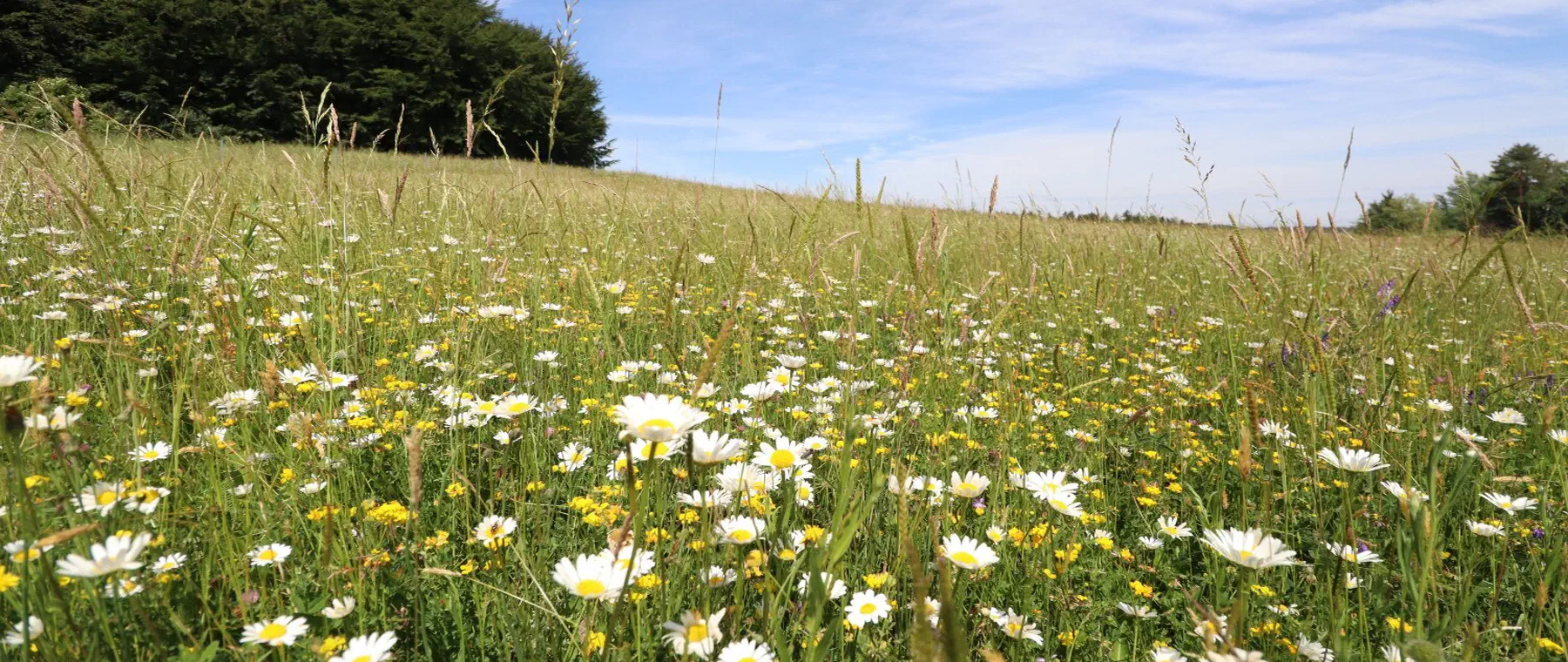
Eco-points and compensation areas
District of Hersfeld-Rotenburg
Hersfeld-Rotenburg district lies in the east Hessian Bergland around the middle Fulda valley, between the forested Knüll to the west and Fulda-Werra Bergland to the east. greeNature accompanies project developers in the district in nature conservation compensation under the Hessian compensation ordinance, from initial assessment in eco-points to permanently secured measures.
The District of Hersfeld-Rotenburg at a glance
The district belongs to the administrative region Kassel and comprises in essence the middle Fulda valley with tributary valleys of Haune, Geis and Solz as well as parts of the Werra valley.
Naturally the district lies in the east Hessian Bergland (BfN major landscape D47) with the characteristic units Knüll, Fulda-Haune plateau and Fulda-Werra Bergland.
Bad Hersfeld and the Kirchheim triangle at the junction of motorways A4, A5 and A7 have made the district a major logistics hub in central Germany.
In the Werra valley near Heringen and Philippsthal, potash mining has shaped the landscape and employment for over a hundred years.
🗺️ Associated natural regions
Go to natural region D47 ›
📍 Selected municipalities
🌿 Ecological features
- Knüll Nature Park extends over the forested western part of the district and forms a contiguous woodland and recreation area.
- The Fulda floodplain near Bad Hersfeld and Rotenburg is an FFH and bird protection site, part of the European Natura 2000 protected area network.
- The district's south has a share of the UNESCO Biosphere Reserve Rhön with its structured open land and forest areas.
- The extensive forests of Knüll, Seulingswald and Stölzinger Mountains are core habitat for wildcat and black stork.
- In the Werra valley, potash spoil heaps of the Werra mining district shape the landscape and pose special demands on restoration and compensation.
- The river valleys of Fulda, Haune and Werra run through the district as near-natural floodplains and important habitat network corridors.
✅ greeNature on the ground
greeNature operates nationwide and manages compensation projects in Hersfeld-Rotenburg district. We know the natural conditions of the east Hessian Bergland, from floodplains on Fulda and Werra through the Fulda-Haune plateau to closed forests of Knüll. For councils, developers and companies, we undertake impact-compensation assessment under the Hessian compensation ordinance, search and secure suitable sites and conduct expert coordination with the lower nature conservation authority. We work closely on regional habitat network targets and ensure permanent management and monitoring of measures.
Typical measures in the district of Hersfeld-Rotenburg
Floodplain development on Fulda, Haune and Werra
Development of near-natural riparian buffer strips, riparian woodlands and wet meadows along the river valleys to improve habitat networking and retention.
Forest conversion and forest edge management
Transfer of low-structure stands in Knüll and Fulda-Werra Bergland to native broadleaf mixed forests with staggered forest edges.
Grassland extensification and traditional orchards
Meadow and pasture upgrade through adapted use, and establishment and management of traditional orchard stands in valley locations.
Creation of small water bodies
New establishment and networking of pools and breeding waters as amphibian and dragonfly habitats, linked with extensively managed shorelines.
Land desealing and removal
Removal of redundant transport and commercial land with subsequent soil loosening and native vegetation establishment.
Habitat network connectivity for woodland species
Securing of migration corridors and stepping-stone habitats for wildcat and black stork between the district's large forest areas.
Protected species in the East Hessian Bergland, middle Fulda valley between Knüll and Werra
Black stork
The black stork breeds in the quiet, water-rich forests of Knüll and Seulingswald and depends on undisturbed old-growth stands and intact stream floodplains.
About this species ›Wildcat
The district's forests belong to the north Hessian core population of wildcat, which depends on large, contiguous and deadwood-rich forest areas.
About this species ›Kingfisher
On Fulda, Haune and Werra, the kingfisher finds near-natural bank collapses and clear, fish-rich watercourse sections as habitat.
About this species ›Hazel dormouse
The hazel dormouse inhabits structured forest edges, hedgerows and scrub and benefits from continuous boundary structures between forest and open land.
About this species ›Bats
Old broadleaf forests, traditional orchard stands and building roosts provide forest-bound bat species with hunting areas and nursing colonies important for species protection.
About this species ›Skylark
The skylark nests on the ground in the open arable landscapes of the plateaus and needs shrub-poor, extensively used areas.
About this species ›Which projects trigger a compensation obligation?
Logistics and commercial establishment
Large logistics and commercial sites develop around Bad Hersfeld and the Kirchheim triangle, land consumption from which must be compensated under the impact mitigation regulation.
Transport infrastructure
Extension and conversion of motorways A4, A5 and A7, federal roads and Bebra rail junction regularly trigger compensation requirements.
Wind energy in the uplands
Wind energy expansion in the high areas of Knüll and Seulingswald requires species protection assessments and supporting compensation measures.
Potash mining in the Werra mining district
Extraction and spoil management in the Werra potash district near Heringen and Philippsthal involve long-term requirements for restoration and compensation.
From enquiry to monitoring
Contact and enquiry
Tell us your compensation requirement and the natural region. We check availability.
Offer and advice
A transparent offer covering measure types, scope and availability.
Coordination with authorities
Full coordination with the lower nature conservation authority. We handle everything.
Long-term monitoring
Permanent securing of the land, management and documentation across the contract term.
Eco-points in adjoining districts
All about eco-points
in the district of Hersfeld-Rotenburg
Request eco-points in the district of Hersfeld-Rotenburg
We will promptly prepare a transparent offer with matching eco-points held in stock in the district of Hersfeld-Rotenburg.