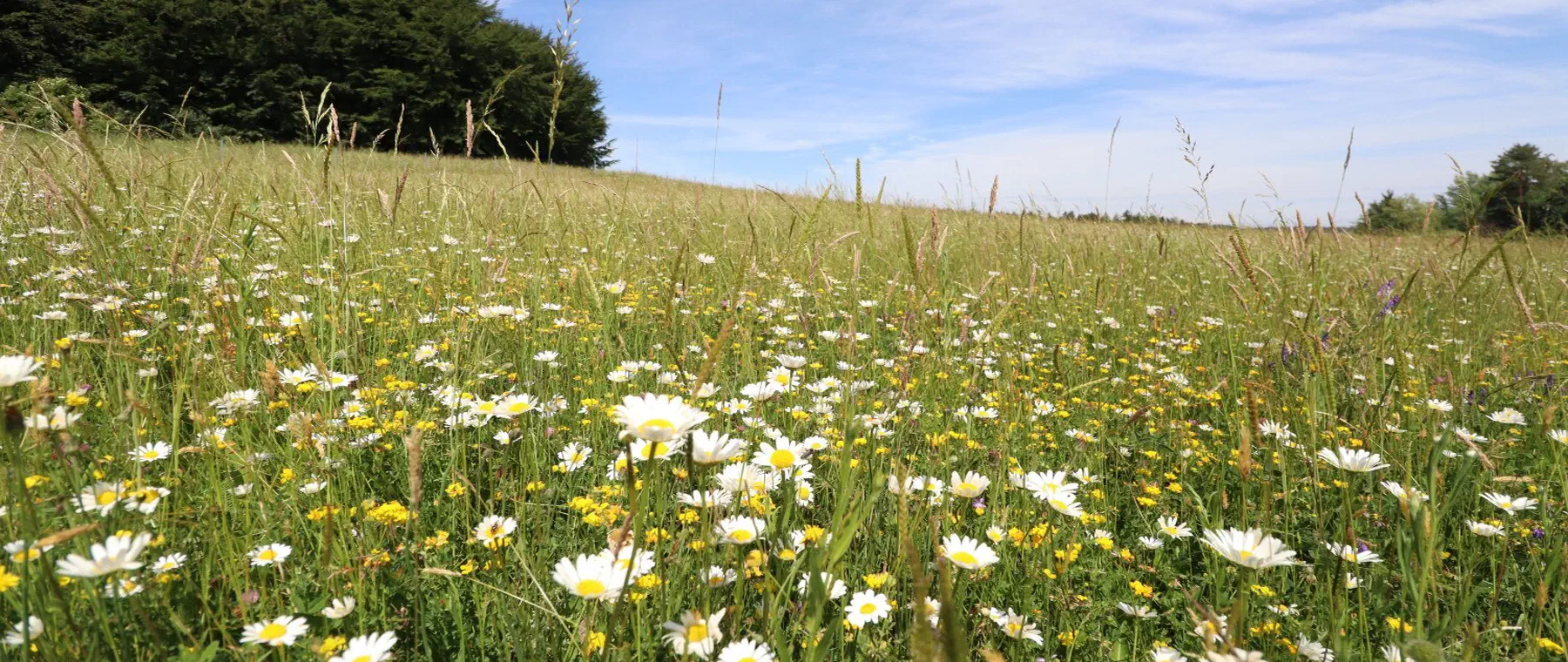
Eco-points and compensation areas
District of Bergstraße
Eco-points and compensation areas in Bergstraße district, assessed under the Hessian Compensation Regulation (KV) using the biotope value method. greeNature is your nationwide full-service partner for compensating impacts between the Hessian Ried and the Odenwald.
The District of Bergstraße at a glance
Bergstraße district lies in the far south-west of Hesse and belongs to the Darmstadt administrative region. The district seat and administrative centre is Heppenheim. The district comprises ten cities and twelve municipalities plus the unincorporated area of Michelbuch. By natural region, it is divided into two parts: the west belongs to the Upper Rhine Plain (BfN natural region D53) with the Hessian Ried, whilst the east is part of the Odenwald (BfN natural region D55, Odenwald, Spessart and Südrhön).
The Bergstraße itself, the climatically favoured western edge of the Odenwald between approximately 120 and 220 metres above sea level, is the area's namesake. Its mild location supports the Hessian Bergstraße wine region, one of Germany's smallest wine-growing areas, as well as extensive traditional orchards. To the east, the wooded sandstone Odenwald rises, home to the UNESCO Global Geopark Bergstraße-Odenwald with the Felsenmeer at Lautertal-Reichenbach.
The Hessian Ried in the west is a flat, shallow groundwater lowland plain with wind-blown sand fields, inland dunes and floodplain waters. Of ecological significance are the calcareous grasslands and relic forests around Lampertheim and Viernheim, the Weschnitz island of Lorsch, and the oxbow bends of the old Neckar. Overall, the district contains 34 Natura-2000 areas (27 FFH areas and seven bird protection areas), some crossing district boundaries and setting the framework for nature conservation-based compensation.
The district's economy is shaped by agriculture and specialist horticulture in the Ried, viticulture and fruit growing on the Bergstraße, and industry, commerce and logistics in the densely populated Rhine-adjacent area around Viernheim, Lampertheim and Bürstadt. Major infrastructure projects such as the ICE high-speed rail line Frankfurt,Mannheim and the decommissioning of Biblis nuclear power station generate substantial compensation requirements. Compensation in Hesse is based on the impact mitigation regulation under sections 13 to 15 of the Federal Nature Conservation Act (BNatSchG) and the Compensation Regulation (KV) using a biotope value method assessed in eco-points.
🗺️ Associated natural regions
Go to natural region D55 ›
Go to natural region D53 ›
📍 Selected municipalities
🌿 Ecological features
- Natural region division between Hessian Ried (D53) in the west and Odenwald (D55) in the east, connected by the eponymous Bergstraße
- 34 Natura-2000 areas within the district (27 FFH areas and seven bird protection areas), some crossing district boundaries
- FFH area and nature reserve Weschnitz island of Lorsch (approximately 199 ha) in the Rhine floodplain
- FFH area Viernheim Forest Heath and Lampertheim and Viernheim relic forest with calcareous grasslands and inland dunes of the Hessian Ried
- UNESCO Global Geopark Bergstraße-Odenwald with Felsenmeer at Lautertal-Reichenbach
- Hessian Bergstraße wine region, one of Germany's smallest wine-growing areas, with extensive traditional orchards
- Oxbow bends and floodplain waters in the Ried as habitat for amphibians, dragonflies and water birds
✅ greeNature on the ground
greeNature operates nationwide and is familiar with the Hessian compensation system. We assess impacts under the Compensation Regulation (KV) using the biotope value method with eco-points, coordinate measures with the lower nature conservation authority of Bergstraße district, and involve the Darmstadt Government Presidency as the upper nature conservation authority for Natura-2000 matters. We take account of the characteristics of both natural regions, the calcareous grasslands and floodplains of the Hessian Ried (D53) as well as the forests and traditional orchards of the Odenwald (D55). From determining the compensation requirement through to securing land, implementing, managing and monitoring, we support your project throughout.
Typical measures in the district of Bergstraße
Restore calcareous grasslands and inland dunes
Scrub clearance, nutrient removal and management grazing on the wind-blown sand locations of the Hessian Ried, for example in the area of relic forests at Lampertheim and Viernheim. Open calcareous grasslands are among the most species-rich and rarest biotopes of the Upper Rhine Plain and achieve high valuations in the biotope value method.
Floodplain and water body restoration
Ecological restructuring of Weschnitz, old Neckar bends and Ried ditches with riparian buffer strips, reconnection of oxbows and creation of small water bodies. Such measures create habitat for amphibians, dragonflies and kingfishers and strengthen the habitat network in the Ried.
Traditional orchards on the Bergstraße
New planting and restoration of high-stemmed traditional orchards on the climatically favoured slopes of the Odenwald margin. Old fruit trees, extensive meadow management and nesting opportunities benefit little owl, wryneck and numerous insect species.
Ecological woodland development in the Odenwald
Conversion of structurally poor coniferous forests into site-appropriate broadleaf and mixed forests with beech and oak, enrichment with dead wood and old wood, and non-intervention on partial areas. These measures upgrade the sandstone forests and secure habitats for woodland-dependent species.
Grassland extensification in the Ried
Conversion of intensively managed land into species-rich wet and fresh grassland with adapted mowing times and no fertiliser application. Extensively managed meadows benefit meadow-breeding birds, insects and the landscape character of the Ried plain.
Species protection CEF and FCS
Advanced compensation measures under section 44 of the Federal Nature Conservation Act (BNatSchG), such as habitat creation and replacement areas for sand lizards, replacement roosts for bats, and breeding ponds for amphibians, each coordinated to the specific project and affected species.
Protected species in the Bergstraße between Hessian Ried and Odenwald
Sand lizard on sandy locations
The sand lizard (Annex IV of the FFH Directive) inhabits calcareous grasslands, railway embankments and verges in the Hessian Ried. For construction and infrastructure projects, habitat creation and relocation are required as advanced CEF measures under section 44 of the Federal Nature Conservation Act (BNatSchG).
About this species ›European wildcat in the Odenwald
The contiguous forests of the Odenwald are habitat for the strictly protected European wildcat. Forest edge design, habitat network and the retention of structurally diverse old stands support the networking of their populations.
About this species ›Bats in forests and traditional orchards
Relic forests, old traditional orchards and buildings provide roosts for strictly protected bat species (Annex IV of the FFH Directive). In the event of demolition or tree felling, replacement roosts must be provided as CEF measures.
About this species ›Amphibians in the Ried floodplains
Tree frog, spadefoot toad and great crested newt inhabit small water bodies, oxbows and seasonal wetland depressions in the Ried. Newly created or restored breeding ponds in spatial context secure breeding sites where impacts occur.
About this species ›Kingfisher on Weschnitz and Ried waters
Ecologically sound river sections of Weschnitz and floodplain waters offer kingfishers steep banks for nesting. Steep bank modelling and river restoration are typical measures for water impacts.
About this species ›Hazel dormouse in hedgerows and forest margins
The hazel dormouse (Annex IV of the FFH Directive) lives in structurally diverse forests, forest margins and hedgerows of the Odenwald. Retention and new creation of connecting tree structures are proven species protection measures under section 44 of the Federal Nature Conservation Act (BNatSchG).
About this species ›Which projects trigger a compensation obligation?
ICE high-speed rail line Frankfurt,Mannheim
The planned high-speed track crosses the district in a north-south direction and runs partly in tunnel between Lorsch and Mannheim. The project triggers extensive compensation and replacement obligations plus species protection assessments, which can be covered through eco-points.
Decommissioning of Biblis nuclear power station
Decommissioning of the retired blocks A and B at Biblis and subsequent land redevelopment create impacts whose nature conservation compensation can be covered through existing eco-points and eco-accounts.
Road and transport infrastructure
The motorways A5, A67 and A659 plus bypass roads and cycle paths characterise the traffic-intensive Rhine-adjacent area. Expansion and new construction projects regularly trigger compensation and replacement obligations under the impact mitigation regulation.
Commercial and logistics development
Commercial and logistics areas are being developed in the densely populated west around Viernheim, Lampertheim and Bürstadt. The required compensation can be reliably and efficiently covered through existing eco-points.
From enquiry to monitoring
Contact and enquiry
Tell us your compensation requirement and the natural region. We check availability.
Offer and advice
A transparent offer covering measure types, scope and availability.
Coordination with authorities
Full coordination with the lower nature conservation authority. We handle everything.
Long-term monitoring
Permanent securing of the land, management and documentation across the contract term.
Eco-points in adjoining districts
All about eco-points
in the district of Bergstraße
Request eco-points in the district of Bergstraße
We will promptly prepare a transparent offer with matching eco-points held in stock in the district of Bergstraße.