Eco-points and compensation areas
District of Wunsiedel im Fichtelgebirge
For impacts in Wunsiedel im Fichtelgebirge district, we provide eco-points from recognised measures in natural region D48. greeNature solutions accompanies your project as a full-service partner from assessment under BayKompV to secured implementation.
The District of Wunsiedel im Fichtelgebirge at a glance
Wunsiedel im Fichtelgebirge district is located in the far north-east of Bavaria and forms part of the Bavarian-Czech border region with its border to Czechia (Karlovarský region). Neighbouring districts on the German side are Hof, Bayreuth and Tirschenreuth. The two large district towns Marktredwitz and Selb and the district seat Wunsiedel characterise the central settlement and business area.
Landscape-wise, the district is strongly formed by the Fichtel Mountains, which surround the district horseshoe-fashion from the north, west and south. Naturally, the area belongs to the BfN major region D48 (Thuringian-Franconian uplands, slate mountains) with the main units Fichtel Mountains and Selb-Wunsiedel plateau. Characteristic are the granite and other crystalline rocks with distinctive block heaps and stone castles, in between the gently rolling plateau at approximately 500 to 600 metres with forests, grassland and open valleys of the Eger and Röslau.
Ecologically, the district has a high density of protected habitats. The district has numerous nature conservation areas and FFH areas of the European Natura 2000 network, including wetlands around Selb and Großwendern, the Eger and Röslau valley and summit areas such as Große Kösseine. Moors, mountain meadows, bristle grass heaths, natural watercourses and the acidic forests of the Fichtel Mountains provide habitat for many species protected under European and national law.
Economically, the region is historically shaped by the porcelain industry (Selb, Marktredwitz) and glass, ceramics and stone processing. Today, commercial and industrial projects, transport infrastructure along the A93 motorway and the Marktredwitz railway hub as well as energy transition projects are added. Such impacts regularly trigger compensation and replacement obligations under BayKompV, requiring reliable and legally sound compensation areas.
🗺️ Associated natural regions
Go to natural region D48 ›
📍 Selected municipalities
🌿 Ecological features
- Border region district to Czechia (Karlovarský region) in the heart of the Fichtel Mountains Nature Park
- Naturally fully within the BfN major region D48 (Thuringian-Franconian uplands)
- High density of FFH areas and nature conservation areas such as wetlands around Selb and Großwendern or Große Kösseine
- Crystalline basement of granite with block heaps, stone castles and a multitude of designated geotopes
- Moors, mountain meadows and the natural valley areas of Eger and Röslau as sensitive compensation backdrop
- Industrial history of porcelain, glass and natural stone with continuous land demand for commerce and infrastructure
✅ greeNature on the ground
greeNature solutions develops and secures compensation areas in the natural region of the Fichtel Mountains suited to the habitats of Wunsiedel im Fichtelgebirge district. We assess your impact under BayKompV, coordinate measures with the lower nature conservation authority and, as a full-service partner, handle planning, implementation and permanent management and legal securing. This way you receive recognised eco-points without having to search for land yourself or manage measures.
Typical measures in the district of Wunsiedel im Fichtelgebirge
Moorland restoration and rewetting
Restoration of damaged high and low moors in the Fichtel Mountains, for example by increasing water level and removing shrubs. Such measures bind carbon, stabilise water balance and create habitat for highly specialised moorland species.
Watercourse development on Eger and Röslau
Restoration of watercourses through removal of riverbank structures, creation of watercourse margins and promotion of self-regulating development. This improves passage for fish and habitat quality for kingfisher and aquatic insects.
Extensification of mountain and wet meadows
Conversion of intensively-used areas into species-rich grassland through adapted mowing and no fertilisation. Bristle grass heaths and mountain meadows of the plateau are among the valued habitats of the region.
Natural forest conversion
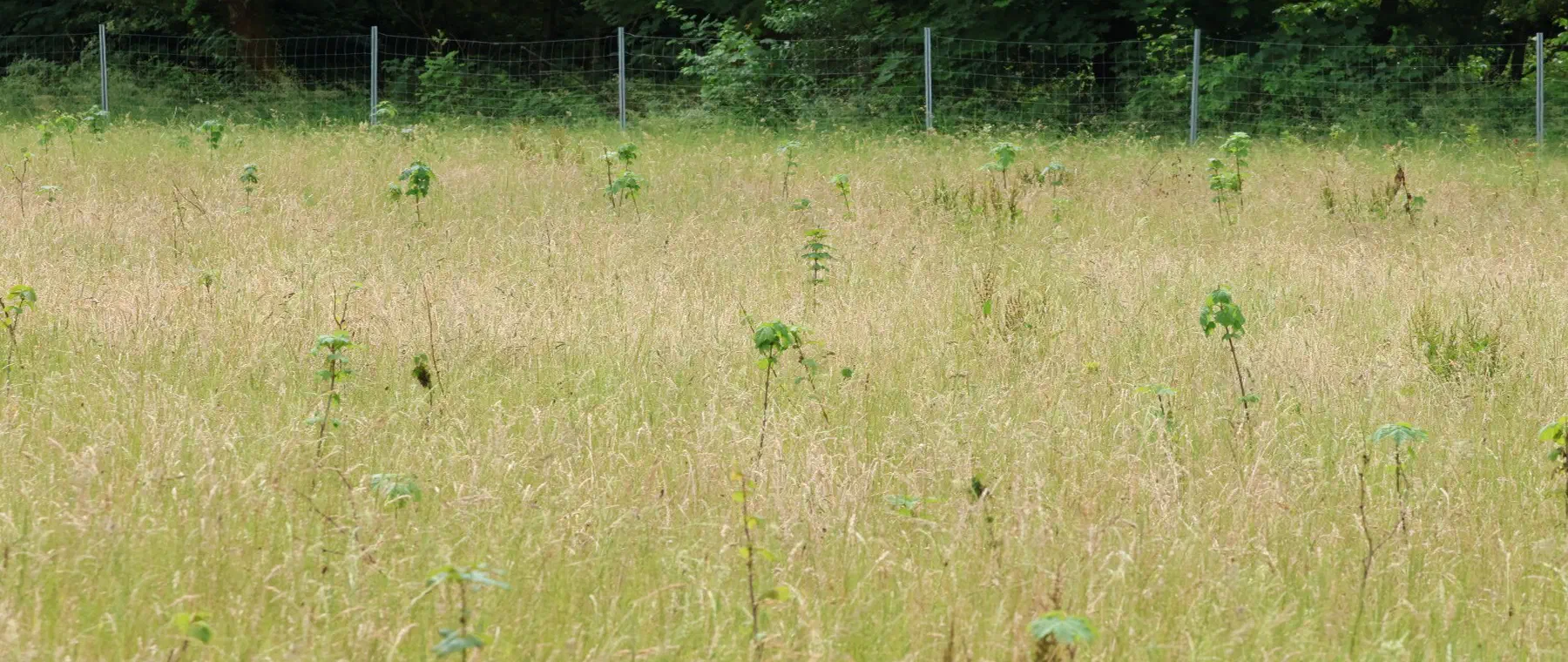
Conversion of structurally poor spruce plantations into climate-stable, site-appropriate mixed forests with silver fir, beech and sycamore. Conversion increases biodiversity and makes forests more resilient to drought and bark beetle.
Management of calcareous grassland and block heaps
Clearing and exposing granite block heaps, rock surfaces and dry marginal sites. These thermophilic special sites are habitat for reptiles and light and heat-requiring plants.
Traditional orchards and hedge structures
Establishment and management of traditional orchard meadows with tall regional varieties and establishment of hedgerows and copses. They network habitats in the open plateau and promote cavity-nesting birds, insects and small mammals.
Protected species in the Fichtel Mountains and Selb-Wunsiedel plateau
Black stork
The black stork breeds in the large, low-disturbance forests of the Fichtel Mountains and hunts in natural streams and wet areas. It is strictly protected, which requires careful assessment under § 44 BNatSchG for impacts in forest areas.
About this species ›Kingfisher
On Eger, Röslau and other watercourses, the kingfisher finds steep banks for breeding and clear, fish-rich waters for feeding. Watercourse restorations act as CEF measures directly in its favour.
About this species ›Bats
Old mining tunnels, rock crevices and cavity-rich forests provide bats with roosts. Roost checks and advance replacement of roosts under § 44 BNatSchG are regularly required for demolition and felling projects.
About this species ›Sand lizard
Sunny granite block heaps, railway embankments and warm-dry slopes are typical habitats for the sand lizard. Impacts on it usually require CEF measures with replacement habitats before impact begins.
About this species ›Amphibians
Moorland ponds, pools and wetlands around Selb and Großwendern harbour significant amphibian populations. Creation and optimisation of spawning waters is among the effective compensation measures of the region.
About this species ›Skylark
The skylark breeds on the open arable and grassland of the Selb-Wunsiedel plateau as a characteristic species of the field landscape. Extensification and creation of skylark windows improve its breeding habitats.
About this species ›Which projects trigger a compensation obligation?
Commercial and industrial land
Expansions of commercial and industrial areas in the Marktredwitz, Selb and Arzberg region claim previously unsealed land and trigger compensation obligations under BayKompV.
Transport infrastructure
Expansion and new construction of roads along the A93 and federal roads as well as measures at the Marktredwitz railway hub lead to impacts on soil, nature and landscape that must be compensated.
Renewable energies
Wind power and free-area photovoltaic installations in the open areas of the plateau require nature conservation support and compensation of remaining impacts.
Settlement development
New residential and mixed-use areas in the towns and municipalities of the district seal land and require compensation and replacement measures as part of land-use planning.
From enquiry to monitoring
Contact and enquiry
Tell us your compensation requirement and the natural region. We check availability.
Offer and advice
A transparent offer covering measure types, scope and availability.
Coordination with authorities
Full coordination with the lower nature conservation authority. We handle everything.
Long-term monitoring
Permanent securing of the land, management and documentation across the contract term.
Eco-points in adjoining districts
All about eco-points
in the district of Wunsiedel im Fichtelgebirge
Request eco-points in the district of Wunsiedel im Fichtelgebirge
We will promptly prepare a transparent offer with matching eco-points held in stock in the district of Wunsiedel im Fichtelgebirge.