Eco-points and compensation areas
District of Weilheim-Schongau
Immediately available eco-points from authority-recognised eco-accounts for the district of Weilheim-Schongau. greeNature is your full-service partner for compensation according to BayKompV in the Pfaffenwinkel and Bavarian Alpine foothills.
The District of Weilheim-Schongau at a glance
The district of Weilheim-Schongau is located south of Munich in the administrative region Upper Bavaria and comprises most of the Pfaffenwinkel. It extends from the Lech in the west via Ammer and Ammersee to the Loisach in the east. The district seat is Weilheim i. OB, other important towns are Penzberg, Peißenberg, Schongau and Peiting.
Landscape-wise, the district is characterised by the ice-age young moraine landscape of the Alpine foothills, with extensive moorlands, numerous lakes (Ammersee, Staffelsee, Osterseen) and a lively relief of moraine ridges and dead-ice holes. To the south, the terrain rises via the pre-Alps to the Northern Limestone Alps, the highest point is Niederbleick at 1,589 metres.
Ecologically significant are the Ammersee bird protection area (7932-471) as a resting and overwintering area, the calcareous lowland moorlands and meadow plots of the Pfaffenwinkel, the Middle Lech valley (8031-471) with its river dynamics and the near-natural pre-Alpine rivers Ammer and Loisach. These habitats are home to numerous strictly protected species and place high specialist requirements on compensation.
The economy is small and medium-sized and broadly based, with strong skilled trades, a significant biotechnology location in Penzberg, tourism and agriculture. Commercial, infrastructure, energy and raw material projects regularly generate compensation requirements according to BayKompV, which greeNature covers with regional land knowledge and full-service.
🗺️ Associated natural regions
Go to natural region D66 ›
📍 Selected municipalities
🌿 Ecological features
- EU bird protection area Ammersee area (7932-471), significant resting and overwintering area for water and meadow birds
- Middle Lech valley (SPA 8031-471) with alpine river dynamics and heat-loving Lech heat-loving grasslands
- Calcareous lowland moorlands and meadow plots of the Pfaffenwinkel, habitat for highly endangered species
- Ammergau range (SPA 8330-471) to the south, transition to the Northern Limestone Alps
- Near-natural pre-Alpine rivers Ammer and Loisach with floodplain forests and gravel banks
- Ice-age young moraine landscape with lakes such as Ammersee, Staffelsee and the Osterseen near Iffeldorf
✅ greeNature on the ground
greeNature is active throughout Bavaria for nature conservation compensation and knows the practice of the Lower Nature Conservation Authority (Untere Naturschutzbehörde) Weilheim-Schongau. Especially in the moorland and lake-rich Pfaffenwinkel and in the alpine-influenced south of the district, compensation measures are technically demanding. We combine regional land knowledge with experience in moorland restoration, floodplain development and species protection according to BayKompV.
Typical measures in the district of Weilheim-Schongau
Moorland restoration and rewetting
Restoration of drained lowland and transitional moorlands in the Pfaffenwinkel by raising water level. These measures secure rare meadow plot species, bind carbon and generate high-value eco-points according to BayKompV.
Meadow plot and wet meadow extensification
Conversion of intensively used meadows to single-cut, late mowing without fertilisation. Habitat for meadow-breeding birds such as northern lapwing and curlew, as well as for calcareous meadow plot plants.
Floodplain restoration on Lech and Ammer
Reactivation of bank dynamics, oxbows and gravel banks along the pre-Alpine rivers. Habitat for kingfisher, little ringed plover and gravel-spawning fish species, combined with flood retention.
Species protection CEF and FCS
Tailored measures according to BayKompV, such as fish-free spawning waters for great crested newt and amphibians, sunlit habitats for sand lizard and replacement roosts for bats at buildings and bridges.
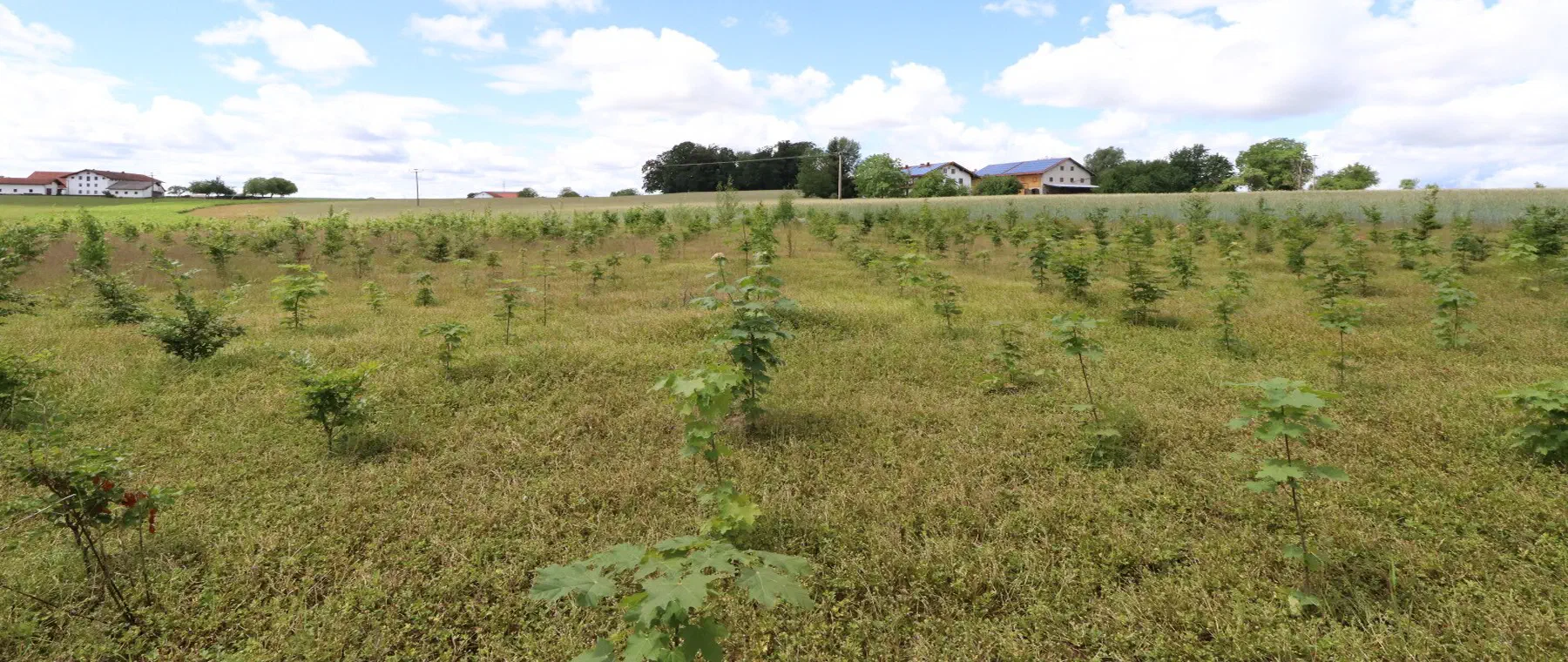
Site-appropriate forest conversion and new afforestation
Development of climate-stable broadleaf and mixed forests on suitable sites and bank vegetation on waters, for upgrading cleared moraine areas and as habitat network.
Hedgerows and habitat network
Creation of hedgerows, field woodlands and calcareous grasslands as stepping-stone habitats in the moraine hilly landscape, for networking moorland, meadow and floodplain habitats.
Protected species in the Pfaffenwinkel and Bavarian Alpine foothills
Meadow-breeding birds (northern lapwing, curlew)
The meadow plots and lowland moorlands in the Ammersee area and Pfaffenwinkel are among southern Germany's most important breeding and resting areas for meadow-breeding birds. For the northern lapwing and curlew, extensive wet meadows with high groundwater level and late mowing are of central importance as CEF measures.
About this species ›Yellow-bellied toad and tree frog
Yellow-bellied toad and tree frog occur in the floodplains of Lech and Ammer and in extraction waters. Both are strictly protected species under Annex IV of the FFH Directive, for which new small water bodies and temporary pools as advance compensation measures often have to be created in the event of impacts.
About this species ›Sand lizard
The sand lizard lives on railway embankments, gravel extraction areas and heat-favoured Lech heat-loving grasslands. As an Annex IV species, it regularly triggers CEF measures in construction and infrastructure projects, such as the creation of sunlit habitat structures with stone accumulations and sand lenses.
About this species ›Bats (greater mouse-eared bat)
Along the Lech and in the structured pre-Alpine landscapes, several bat species hunt, including the greater mouse-eared bat. Roosts in attics, old trees and bridge structures require replacement roosts and adapted construction times in renovations and new buildings.
About this species ›Kingfisher
The kingfisher breeds in near-natural sections of Ammer, Lech and Loisach in steep banks. Riverbank cliffs, near-natural watercourse dynamics and artificially modelled breeding banks are typical measures to secure its population in watercourse expansions.
About this species ›Great crested newt
The great crested newt lives in calcareous moorland waters and ponds of the Pfaffenwinkel, a species of Annex II and IV of the FFH Directive. Creation and networking of fish-free spawning waters with structured surroundings is a proven compensation measure.
About this species ›Which projects trigger a compensation obligation?
Commercial enterprises and industry
The district is characterised by small and medium-sized enterprises, with significant locations such as the biotechnology site in Penzberg. Business extensions and new commercial areas in Weilheim, Penzberg and Schongau regularly trigger compensation requirements according to BayKompV.
Infrastructure and traffic
Bypasses, the expansion of federal and state roads, as well as measures on the railway lines in the Highlands lead to impacts that entail compensation and replacement obligations.
Energy and renewables
Photovoltaic freestanding installations on moraine sites, hydropower use on the Lech and individual wind power projects require nature conservation compensation as well as species protection CEF and FCS measures.
Raw material extraction and settlement
Gravel extraction in the river and shale plains of Lech and Ammer, as well as residential and settlement development in the district's growing municipalities, generate impacts for which compensation areas must be provided.
From enquiry to monitoring
Contact and enquiry
Tell us your compensation requirement and the natural region. We check availability.
Offer and advice
A transparent offer covering measure types, scope and availability.
Coordination with authorities
Full coordination with the lower nature conservation authority. We handle everything.
Long-term monitoring
Permanent securing of the land, management and documentation across the contract term.
Eco-points in adjoining districts
All about eco-points
in the district of Weilheim-Schongau
Request eco-points in the district of Weilheim-Schongau
We will promptly prepare a transparent offer with matching eco-points held in stock in the district of Weilheim-Schongau.