Eco-points and compensation areas
District of Straubing-Bogen
Eco-points and compensation areas in Straubing-Bogen district, from the Danube floodplain through the Gäuboden to the Bavarian Forest. greeNature supports your project as a full-service partner, from impact assessment through to permanently secured compensation under BayKompV.
The District of Straubing-Bogen at a glance
Straubing-Bogen district is located in the north-west of Lower Bavaria and completely surrounds the independent city of Straubing, where the District Office also has its seat. With around 103,100 inhabitants on 1,201.63 km² and 37 municipalities, it is a geographically large, rurally characterised district. It borders Cham in the north, Regen in the east, Deggendorf in the south-east, Dingolfing-Landau in the south, Landshut in the south-west and Regensburg in the west. Federal motorway A3 and the Danube as a federal waterway form the most important traffic axes.
The Danube divides the district into two very different landscapes. North of the river, the base rock of the Bavarian Forest rises and reaches elevations of over 1,000 metres. South of the Danube, the undulating Danube-Isar hill country follows. In between lies the Gäuboden (Dungau) along the river, a loess-covered plain whose fertile soils rank among Bavaria's most productive arable land and have made the district famous as a breadbasket. The area is traversed by the Große Laber, Aiterach, Kinsach and Bogenbach.
Ecologically, the river floodplains are particularly valuable. With the Habitats Directive site Danube floodplains between Straubing and Vilshofen and the Öberauer Danube loop nature reserve, significant areas of the European Natura 2000 network lie in the district, with several Habitats Directive sites designated in total. Geographically, the district belongs to two BfN major regions, the Bohemian and Bavarian Forest (D63) and the Lower Bavarian Hill Country and Isar-Inn gravel plains (D65). The intensively used agricultural landscape of the Gäuboden is species-poor and thus offers considerable enhancement potential, whilst the near-natural forests of the Bavarian Forest provide habitat for demanding species.
Economically, agriculture and food industry characterise the district, supplemented by the bioeconomy location around Straubing with the BioCampus and the Technology and Promotion Centre for Renewable Raw Materials. Sand and gravel are extracted from the Danube gravels, complemented by commercial and logistics areas, Straubing-Sand harbour as well as the expansion of transport, renewable energies and settlements. These projects regularly trigger compensation obligations under BayKompV, for which early-secured compensation areas and eco-points are needed.
🗺️ Associated natural regions
Go to natural region D65 ›
Go to natural region D63 ›
📍 Selected municipalities
🌿 Ecological features
- The Gäuboden (Dungau) with its deep loess soils is one of Bavaria's most fertile arable landscapes and is regarded as the breadbasket.
- The Danube divides the district into the Bavarian Forest in the north and the Danube-Isar hill country in the south.
- The independent city of Straubing is completely surrounded by the district and houses the administrative seat.
- With the Habitats Directive site Danube floodplains between Straubing and Vilshofen and the Öberauer Danube loop, significant Natura 2000 areas lie in the district.
- Straubing is a nationally renowned centre of bioeconomy and renewable raw materials.
- Two natural regions characterise the area: the Bohemian and Bavarian Forest (D63) and the Lower Bavarian Hill Country and Isar-Inn gravel plains (D65).
✅ greeNature on the ground
greeNature acts as a full-service partner for compensation under BayKompV throughout Lower Bavaria and knows the requirements in Straubing-Bogen district. We develop compensation measures that suit the respective landscape, from production-integrated enhancements in the Gäuboden through floodplain and water body restoration at the Danube to near-natural forest conversion in the Bavarian Forest. We coordinate with the lower nature conservation authority at the District Office in Straubing and take on permanent securing and monitoring of the land for you.
Typical measures in the district of Straubing-Bogen
Arable extensification and skylark gaps
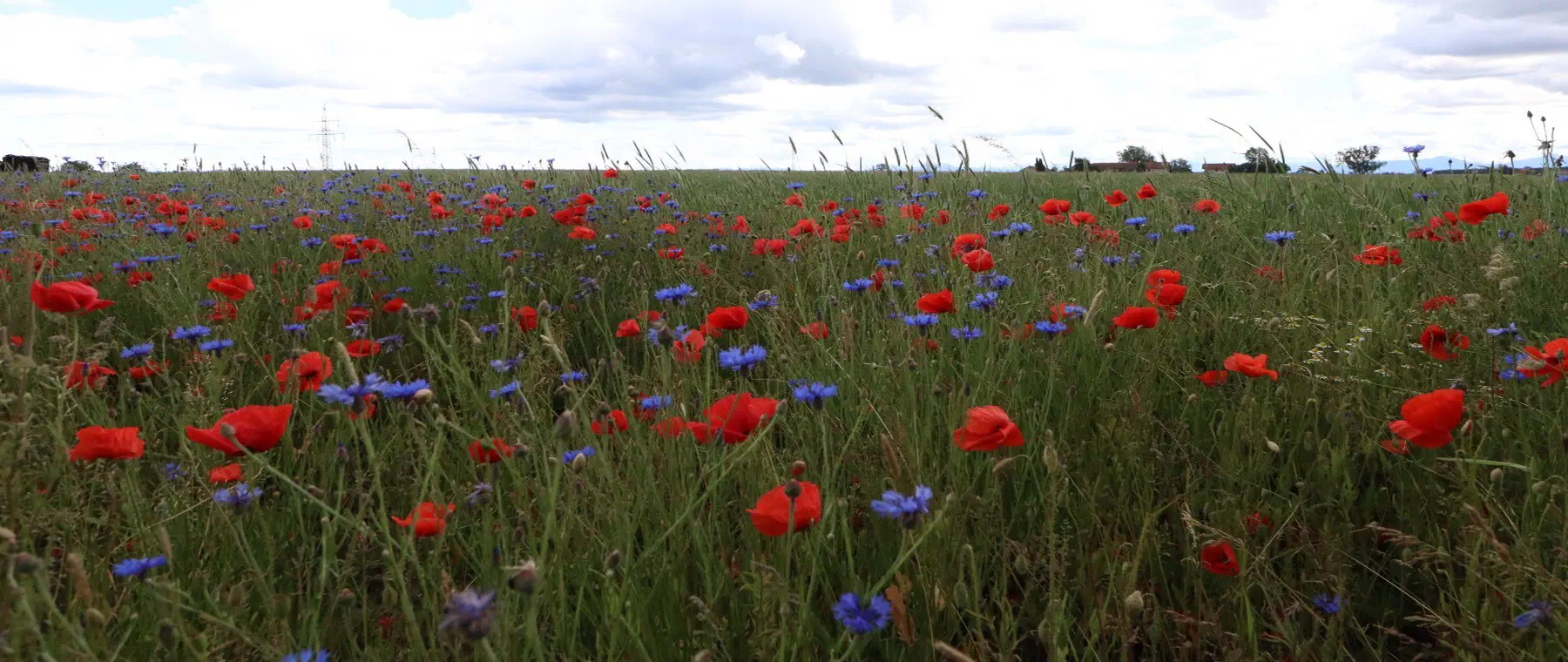
In the intensively managed Gäuboden, production-integrated measures such as skylark gaps, flower strips and extensive arable margins create valuable structures for field birds and insects.
Water body and floodplain restoration
On the Danube, Große Laber, Kinsach and Bogenbach, banks can be freed, old channels reconnected and riparian forest developed, significantly increasing biotope value.
Hedgerows, field copses and traditional orchards
New shrub structures and orchard meadows network the simplified agricultural landscape and provide habitat, cover and food for many species.
Near-natural forest conversion
In the forests of the Bavarian Forest (natural region D63), conversion to structured mixed stands and preservation of old and dead wood promote biological diversity.
Small water bodies and amphibian habitats
Newly created pools and shallow water zones in the Danube floodplain create breeding ponds for amphibians and habitat for dragonflies and other wetland species.
Extensively managed grassland and wet meadows
Conversion of intensive arable land into extensively managed grassland and wet meadows supports meadow-breeding birds such as the northern lapwing and strengthens the water balance.
Protected species in the Gäuboden and Bavarian Forest
Skylark
Characteristic bird of the open Gäuboden, which suffers under intensive arable use. For preservation of the local population, CEF measures such as skylark gaps and flower areas are suitable.
About this species ›Northern lapwing
Meadow-breeding bird of moist lowlands and arable land in the Danube valley. It requires open, extensively managed areas with moist hollows and benefits from grassland extensification.
About this species ›Kingfisher
Breeds on the Danube, Große Laber and Kinsach in steep banks. Near-natural, structured flowing waters with clear water are decisive for its presence.
About this species ›Sand lizard
Inhabits railway embankments, path margins and warm, dry borders. In impacts, it is strictly protected under § 44 BNatSchG and is frequently relocated with advanced CEF measures.
About this species ›Bats
Several species use the forests of the Bavarian Forest and buildings as roosts as well as the floodplains as hunting territory. Compensation is provided through roost provision and securing of hunting habitats.
About this species ›Black stork
Breeds in the low-disturbance, water-rich forests of the Bavarian Forest. It is sensitive to disturbance, which is why nest protection and undisturbed feeding waters are important.
About this species ›Which projects trigger a compensation obligation?
Traffic and infrastructure
Expansion and new construction of A3, state roads, railway lines as well as measures on the Danube and Straubing-Sand harbour have impacts on nature and landscape.
Commercial and industrial
New and expanded commercial, logistics and industrial areas, including in the vicinity of the bioeconomy location Straubing, trigger compensation obligations.
Gravel and sand extraction
Raw material extraction in the Danube gravels of the Gäuboden requires compensation and replacement as well as ecologically valuable subsequent uses.
Renewable energies and settlement
Ground-mounted photovoltaic facilities, wind energy installations and new residential and construction areas lead to land consumption and corresponding compensation requirements.
From enquiry to monitoring
Contact and enquiry
Tell us your compensation requirement and the natural region. We check availability.
Offer and advice
A transparent offer covering measure types, scope and availability.
Coordination with authorities
Full coordination with the lower nature conservation authority. We handle everything.
Long-term monitoring
Permanent securing of the land, management and documentation across the contract term.
Eco-points in adjoining districts
All about eco-points
in the district of Straubing-Bogen
Request eco-points in the district of Straubing-Bogen
We will promptly prepare a transparent offer with matching eco-points held in stock in the district of Straubing-Bogen.