Eco-points and compensation areas
District of Regen
Immediately available eco-points from officially recognised eco-accounts for impacts in Regen district. greeNature is your full-service partner for compensation under BayKompV in the Bavarian Forest.
The District of Regen at a glance
Regen district is located in north-eastern Lower Bavaria and is the northernmost district of the administrative region. It borders the Czech Republic in the north-east and lies entirely within the Bavarian Forest. The district town is Regen, with further centres being Zwiesel and Viechtach. As ARBERLAND, the region markets itself by its defining peak, the Großer Arber.
The district territory belongs to the BfN natural region D63 (Bohemian and Bavarian Forest) and is divided into the Front and Inner Bavarian Forest, separated by the distinctive quartz ridge of the Pfahl. Geologically, gneisses and granites of the base rock determine the mid-mountain landscape. The highest elevation is the Großer Arber at 1,456 metres, on whose slopes the Großer and Kleiner Arbersee lie as Ice Age-shaped karst lakes.
Extensive mountain mixed forests and mountain spruce forests, high and transitional moors (the so-called mire areas) as well as the flowing water system of the Regen with the Black and White Regen characterise the natural features. Large areas belong to the Natura 2000 network, including the Habitats Directive site Großer and Kleiner Arber with Arbersee (6844-373). The district also has a share in the Bavarian Forest National Park. Species such as lynx, capercaillie, black stork and barbastelle bat find large, low-disturbance habitats here.
Economically, the traditional glass industry (Zwiesel, Frauenau), wood-processing companies and tourism characterise the region. Expansion and renewal of transport infrastructure, business areas, renewable energy installations and settlement development regularly trigger impacts that must be compensated under BayKompV. greeNature provides eco-points from recognised eco-accounts for this purpose and handles the entire process.
🗺️ Associated natural regions
Go to natural region D63 ›
📍 Selected municipalities
🌿 Ecological features
- Habitats Directive site Großer and Kleiner Arber with Arbersee (6844-373) with Ice Age karst lakes and relics
- Share in Bavarian Forest National Park (Rachel area in the south of the district)
- The Pfahl, a quartz ridge as a geotope and warmth-loving dry habitat
- High and transitional moors (mire areas) of the Inner Bavarian Forest
- Flowing water system of the Regen with the Black and White Regen
- Barbastelle bat, one of the most significant winter quarters in Central Europe in the Arber region
- Mountain mixed forests as habitat for lynx and capercaillie
✅ greeNature on the ground
greeNature supports compensation projects throughout the Bavarian Forest. We know the requirements of the lower nature conservation authority at Regen District Office, the natural region peculiarities of natural region D63 and the regional land potential for eco-accounts from practice. From natural region classification of the impact through to completion, we handle the entire procedure.
Typical measures in the district of Regen
Restoration of flowing waters on the Regen
Restoration of near-natural bank structures, reconnection of old channels and promotion of permeability on the Black and White Regen and their tributaries, habitat for fish, kingfisher and otter.
Moor restoration and rewetting
Rewetting of drained high and transitional moors (mire areas) by blocking ditches, restoration of intact peat bodies as carbon storage and habitat for specialised moor species.
Mountain meadows and bristle grass grasslands
Extensification and traditional mowing of species-rich mountain meadows and bristle grass grasslands in the mid-mountain areas, preservation of Habitats Directive habitat types and habitat for insects and meadow-breeding birds.
Near-natural forest conversion
Conversion of low-structure spruce forests into stable mountain mixed forests of fir, beech and sycamore maple, increase of structure and old wood proportions in favour of cavity-breeding birds, bats and capercaillie.
Species protection CEF and FCS
Advanced compensation measures under § 44 BNatSchG as well as measures to preserve favourable conservation status (FCS) under § 45 BNatSchG, such as bat roosts, habitat management for capercaillie and sand lizard habitats on railway embankments and in quarries.
Hedgerows and habitat networks
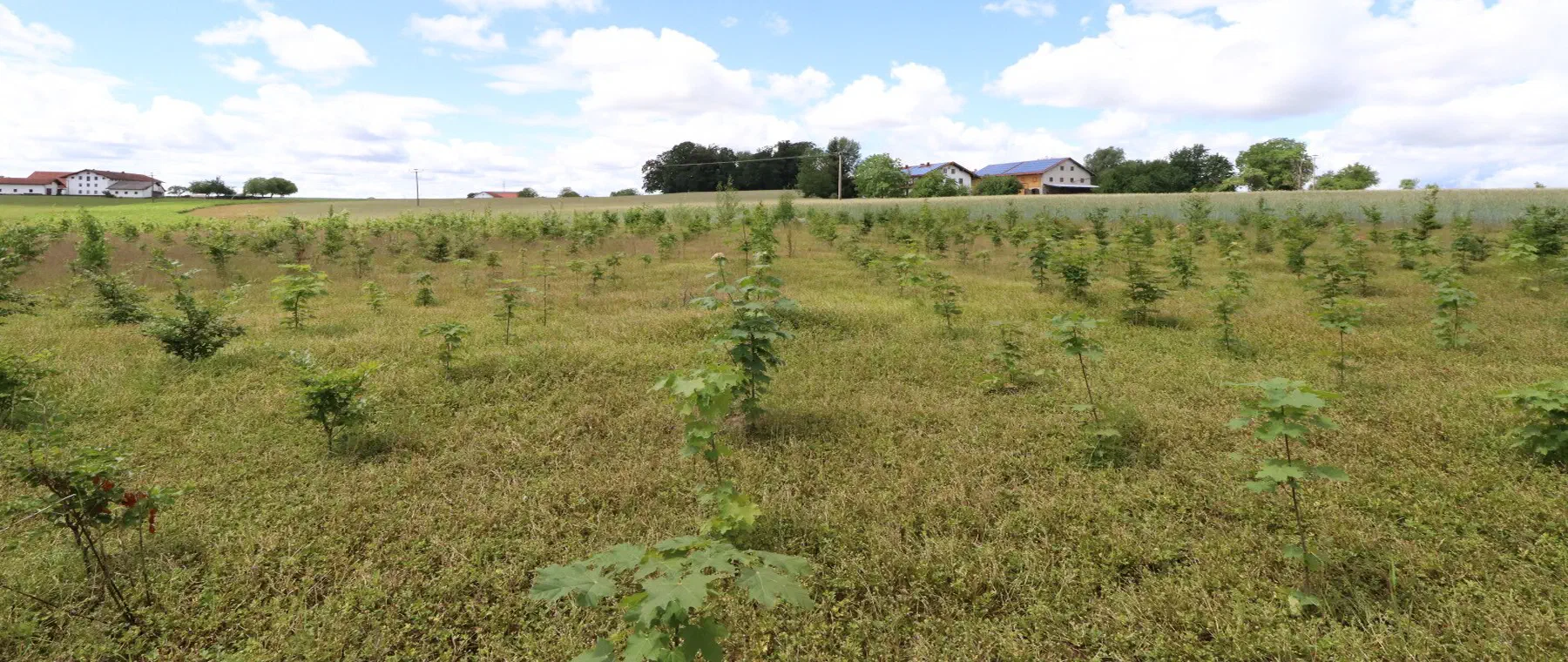
Establishment of hedgerows, field copses and dry stone walls in the open valleys of the Front Bavarian Forest, stepping-stone habitats for hazel dormouse, red-backed shrike and wild bees.
Protected species in the Arberland (Bavarian Forest)
European wildcat
The low-disturbance, structured forests of the Bavarian Forest rank among the core areas of the European wildcat in Bavaria. Forest connectivity and old wood islands are typical targets of compensation measures.
About this species ›Black stork
The black stork breeds in quiet, old forest stands and hunts at near-natural forest streams and wet meadows. Low-disturbance nest environments and restored flowing waters secure its habitat.
About this species ›Barbastelle bat and other bats
The Arber region is home to one of the most significant winter quarters of the barbastelle bat in Central Europe. Roost securing, crevice roosts and preservation of old wood are central CEF measures.
About this species ›Hazel dormouse
The hazel dormouse inhabits well-interlocked forest edges, hedgerows and berry-bearing scrub. In impacts, preservation and new creation of networked shrub structures as well as advanced compensation measures are required.
About this species ›Amphibians
Fire salamander, alpine newt and yellow-bellied toad inhabit spring-fed forest streams and temporary small water bodies. New breeding ponds and mitigation of migration barriers count among typical measures.
About this species ›Kingfisher
Along the Regen and its tributaries, the kingfisher breeds in natural bank collapses. Restored banks with steep faces and clean, fish-rich water create suitable breeding habitats.
About this species ›Which projects trigger a compensation obligation?
Traffic and infrastructure
Expansion and renewal of federal and state roads (such as B11 and B85), bypass routes, bridge structures as well as measures on the Plattling to Bayerisch Eisenstein railway line (Forest Railway) trigger compensation and replacement obligations under BayKompV.
Energy and renewable energies
Wind energy sites in the high areas, ground-mounted photovoltaic installations and modernisation of hydropower installations on the Regen require nature conservation compensation and often CEF measures for wind-sensitive species.
Commercial and industrial
Extensions of the glass and wood industry (Zwiesel, Frauenau, Teisnach) as well as new business areas lead to land sealing and tree loss, which are impacts requiring compensation.
Settlement and tourism
Residential and commercial areas in Regen, Zwiesel and Viechtach as well as tourism infrastructure in tourist destination municipalities (Bodenmais, Arber) require compensation measures. Landowners can participate as providers of compensation areas.
From enquiry to monitoring
Contact and enquiry
Tell us your compensation requirement and the natural region. We check availability.
Offer and advice
A transparent offer covering measure types, scope and availability.
Coordination with authorities
Full coordination with the lower nature conservation authority. We handle everything.
Long-term monitoring
Permanent securing of the land, management and documentation across the contract term.
Eco-points in adjoining districts
All about eco-points
in the district of Regen
Request eco-points in the district of Regen
We will promptly prepare a transparent offer with matching eco-points held in stock in the district of Regen.