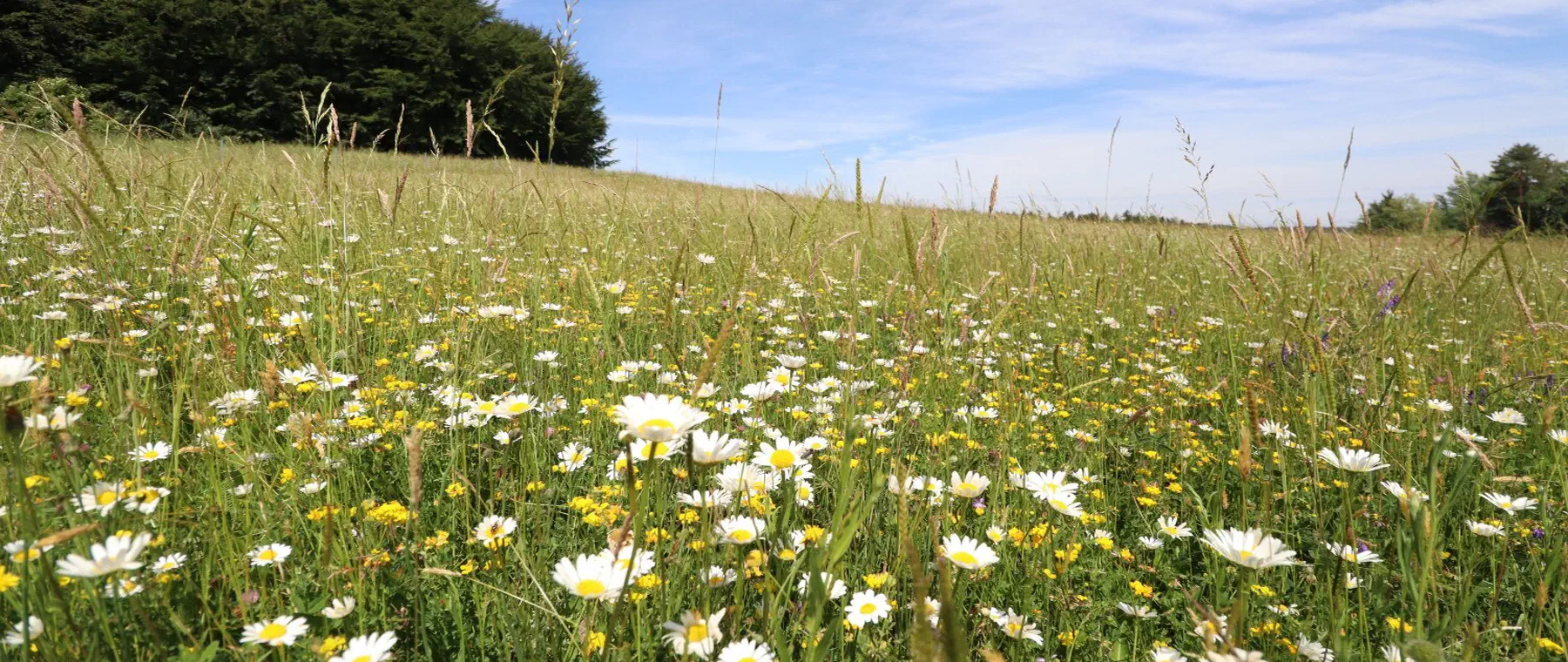
Eco-points and compensation areas
District of Nürnberger Land
Eco-points immediately available from officially recognised eco-accounts for the district of Nürnberger Land. greeNature is your full-service partner for compensation under the BayKompV between the Nürnberger Reichswald and the Hersbrucker Alb.
The District of Nürnberger Land at a glance
The district of Nürnberger Land lies in eastern Mittelfranken and borders directly on the independent city of Nuremberg. As part of the Nuremberg metropolitan region, it connects densely populated areas in the west with the quiet valleys and ridges of the Frankenalb in the east. The Pegnitz runs through the district from east to west, linking the two defining landscape areas, the Nürnberger Reichswald and the Hersbrucker Alb.
Geologically, the western part lies within the Fränkisches Keuper-Liasland (natural region D59), with its nutrient-poor sandstone and sandy soils, on which the extensive Nürnberger Reichswald stands. The east belongs to the Fränkische Alb (natural region D61) and is shaped by Jurassic limestone and dolomite. Characteristic features here are the steep escarpment slopes, dolomite knolls, dry valleys and an extensive cave system of the Hersbrucker Alb.
Ecologically, the entire Nürnberger Reichswald is designated as an EU Special Protection Area (SPA DE-6533-471), with open pine woodland, sandy grassland and a remarkable bird life. The district contains 13 FFH sites, including the escarpment slopes and stream valleys of the Hersbrucker Alb as well as the Dolomitkuppenalb. Calcareous grassland, juniper heaths and bat roosts in the caves of the Alb give the district a high nature conservation significance.
Economically, the district benefits from its proximity to the Nuremberg metropolitan region and a strong manufacturing base (technical ceramics, automotive suppliers, mechanical and tool engineering, the plastics industry). Transport corridors such as the A6, A9 and A3 motorways, the expansion of the railway line and the ongoing settlement pressure in the Nuremberg hinterland regularly generate a considerable compensation requirement under the BayKompV.
🗺️ Associated natural regions
Go to natural region D59 ›
Go to natural region D61 ›
📍 Selected municipalities
🌿 Ecological features
- EU Special Protection Area Nürnberger Reichswald (SPA DE-6533-471), extensive pine woodland with sandy habitats
- 13 FFH sites, including the Traufhänge der Hersbrucker Alb, Bachtäler der Hersbrucker Alb and Dolomitkuppenalb
- Calcareous grassland and juniper heaths on the dry slopes of the Fränkische Alb
- Cave-rich dolomite knolls of the Hersbrucker Alb as important winter roosts for bats
- Pegnitz valley as a continuous watercourse habitat network with remnant floodplain woodland
- Sandy grassland and open pine woodland of the Reichswald with warmth-loving insect communities
- Return of the European wildcat to the Nürnberger Reichswald
✅ greeNature on the ground
We support compensation projects across the entire Nuremberg metropolitan region and know the ecological particularities between the Reichswald and the Frankenalb from practical experience. We are familiar with coordinating with the lower nature conservation authority in Lauf an der Pegnitz, the regional land pools and the requirements around the Reichswald Special Protection Area.
Typical measures in the district of Nürnberger Land
Open woodland & woodland edge design
Thinning dense pine plantations, developing woodland edges and open sandy areas in the Reichswald, habitat for the nightjar, woodlark and warmth-loving species. Conversion to structurally rich mixed woodland on suitable sites.
Calcareous grassland & juniper heaths
Restoration and management of species-rich calcareous grassland on the dry slopes of the Hersbrucker Alb through extensive sheep and goat grazing, scrub clearance and mowing, habitat for the Alcon blue butterfly and rare orchids.
Pegnitz valley & stream valleys
Restoration of watercourses, reactivation of oxbows and development of near-natural floodplain woodland along the Pegnitz and the stream valleys of the Alb, habitats for kingfisher, beaver, bullhead and brook lamprey.
Species protection CEF/FCS
Sand lizard habitats on railway embankments and sandy areas, securing bat roosts in caves and buildings, wildcat corridors and dead wood structures, planned and implemented precisely in line with the BayKompV.
Traditional orchards & hedgerows on the Alb escarpment
Establishing and reactivating traditional orchards and hedgerow structures at the transitions between the Alb and the valley, stepping-stone habitats and habitat network for little owl, wryneck, hazel dormouse and wild bees.
Sandy grassland & de-sealing
Developing open sandy habitats and de-sealing around the Reichswald, habitat for sand-nesting bees, the sand lizard and the blue-winged grasshopper, an effective offset for sealed commercial land.
Protected species in the Nürnberger Reichswald and Hersbrucker Alb
European wildcat in the Reichswald
The European wildcat is increasingly settling in the Nürnberger Reichswald and adjacent woodland. Structurally rich woodland with plenty of dead wood, as well as unfragmented corridors, are essential, a typical target species for impacts on woodland habitats.
About this species ›Bats in the caves of the Alb
The dolomite knolls and caves of the Hersbrucker Alb are important winter roosts for the greater mouse-eared bat, the barbastelle and other species. Securing roosts and hunting habitats are common CEF measures for construction and infrastructure projects.
About this species ›Kingfisher & beaver in the Pegnitz valley
The near-natural stretches of the Pegnitz and the stream valleys of the Alb offer valuable habitats for kingfisher and beaver. Shaping steep banks, creating eroding banks and developing floodplain woodland are typical compensation measures.
About this species ›Sand lizard on dry sites
The sandy grassland of the Reichswald, railway embankments and the dry calcareous slopes of the Alb are core habitats of the sand lizard. As a specially protected species, it is one of the most frequent target species for CEF measures in commercial and transport projects.
About this species ›Great crested newt & amphibians
The great crested newt, yellow-bellied toad and European tree frog inhabit small water bodies and still waters in the FFH sites of the Hersbrucker Alb and the surroundings of the Reichswald. Creating and connecting spawning waters secures a favourable conservation status.
About this species ›Birds of the Reichswald
As an EU Special Protection Area, the Reichswald is home to the nightjar, woodlark, black woodpecker and honey buzzard. Open woodland structures, open sandy areas and old and dead wood are essential for the conservation of these species.
Which projects trigger a compensation obligation?
Industry & manufacturing
The district is a strong industrial location (technical ceramics, automotive suppliers, mechanical and tool engineering, plastics processing). Business expansions and new commercial areas regularly generate a compensation requirement, greeNature takes full responsibility for land and measures management.
Transport & infrastructure
The A6, A9 and A3 motorways, the expansion of railway lines as well as bypasses and bridge structures in the heavily trafficked Nuremberg hinterland trigger compensation and replacement obligations as well as species protection measures under § 44 BNatSchG.
Energy & renewables
Ground-mounted photovoltaic installations on conversion and marginal sites, as well as wind energy and repowering projects around the Reichswald, require statutory nature conservation compensation and CEF measures for birds and bats.
Settlement development
Settlement pressure from the Nuremberg metropolitan region is leading to new residential and commercial areas in Lauf, Altdorf, Röthenbach and Feucht. Owners of suitable land can offer their land for compensation measures.
From enquiry to monitoring
Contact and enquiry
Tell us your compensation requirement and the natural region. We check availability.
Offer and advice
A transparent offer covering measure types, scope and availability.
Coordination with authorities
Full coordination with the lower nature conservation authority. We handle everything.
Long-term monitoring
Permanent securing of the land, management and documentation across the contract term.
Eco-points in adjoining districts
All about eco-points
in the district of Nürnberger Land
Request eco-points in the district of Nürnberger Land
We will promptly prepare a transparent offer with matching eco-points held in stock in the district of Nürnberger Land.