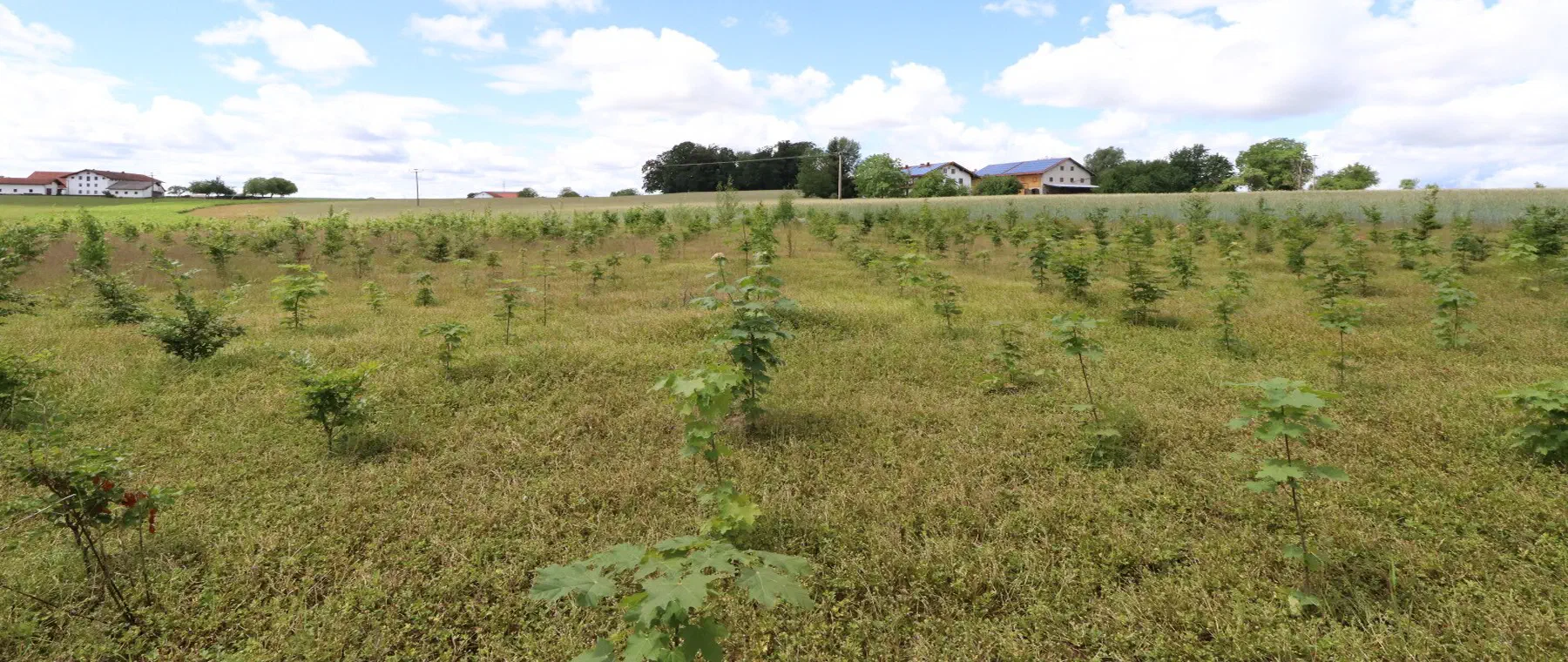
Eco-points and compensation areas
District of Hof
Eco-points available immediately from officially recognised eco-accounts in the north-eastern Bavarian hill country. greeNature solutions, your full-service partner for compensation under BayKompV in the Franconian Forest and Bavarian Vogtland.
The District of Hof at a glance
Hof district is located in the far north-east of Bavaria in the administrative region of Upper Franconia, in the tri-state border area with Thuringia, Saxony and Czechia. The administrative seat is the independent city of Hof, which is surrounded by the district area. Characteristic are the Franconian Forest to the north-west, the agriculturally-used Münchberger Hochfläche in the centre and the Bavarian Vogtland to the east.
Naturally, the district belongs to the BfN main region D48 (Thuringian-Franconian uplands). The Franconian Forest reaches 794.6 metres at Döbraberg and is composed of greywackes and shales of the Variscan basement. The Münchberger Hochfläche, known as the Münchberger gneiss complex, consists of ancient metamorphic rocks and forms a gently rolling plateau. Numerous watercourses such as the Sächsische Saale, the Selbitz and the Südliche Regnitz cut through the landscape in deeply incised gorge valleys.
Ecologically significant are the natural stream valleys with their cold, oxygen-rich waters, which still harbour relict populations of the highly endangered freshwater pearl mussel and freshwater mussel. The district has shares in several FFH areas, including the Selbitz valley with the distinctive Höllental and the Saal valley from Joditz to Blankenstein. Large parts are within the Franconian Forest Nature Park, and the Green Band runs along the former inner-German border as a valuable habitat network. Mountain meadows, high moors and closed forest areas provide habitat for black stork, European wildcat and numerous bat species.
The district is above-average industrialised with traditionally strong textile and plastics industries (including the REHAU Group in Rehau), mechanical engineering and automotive suppliers. As a border region, it benefits from structural change programmes. Expansion of transport routes (Hof motorway junction with A9 and A93, electrification of the Franconia-Saxony trunk line), industrial estate extensions, wind energy in the Franconian Forest and flood protection on Saale and Selbitz regularly generate compensation requirements under BayKompV.
🗺️ Associated natural regions
Go to natural region D48 ›
📍 Selected municipalities
🌿 Ecological features
- Franconian Forest Nature Park, one of the largest continuous forest areas in northern Bavaria
- FFH area Selbitz, Muschwitz and Höllental (approximately 434 hectares) with the gorge valley Höllental
- FFH area Saal valley from Joditz to Blankenstein (approximately 323 hectares) with freshwater pearl mussel populations
- Döbraberg (794.6 m), highest elevation of the Franconian Forest
- Münchberger Hochfläche (gneiss complex), agriculturally-characterised plateau
- Green Band along the former inner-German border (Mödlareuth near Töpen)
- Cold upland streams as relict habitats for freshwater pearl mussel and freshwater mussel
✅ greeNature on the ground
greeNature solutions advises developers throughout Bavaria. We know the lower nature conservation authority at the District office Hof, the regional land pools and the natural region characteristics of the Franconian Forest, Münchberger Hochfläche and Bavarian Vogtland. For compensation in natural region D48, we develop measures that match the impact functionally and are secured in accordance with BayKompV.
Typical measures in the district of Hof
Moorland restoration
Rewetting of high moors and spring moors in the elevated areas of the Franconian Forest. Water level increase, removal of drainage ditches and promotion of peat-forming vegetation, also effective for climate protection.
Watercourse restoration
Improvement of structure and water quality at Selbitz, Saale and Südliche Regnitz. Creation of natural bank zones and gravel bars as habitats for freshwater pearl mussel, freshwater mussel and bullhead.
Climate-stable forest conversion
Conversion of structurally poor spruce stands into site-appropriate deciduous and mixed forests with beech, silver fir and sycamore. Greater structural and old wood richness for black stork, bats and cavity-nesting birds.
Mountain meadow extensification
Management and restoration of species-rich mountain hay meadows and bristle grass heaths in the Franconian Forest. Extensive mowing without fertilisation preserves rare plant species and insect communities.
Traditional orchards and hedgerows
Establishment of traditional orchard stands and hedge structures on the Münchberger Hochfläche. Stepping-stone habitats and habitat networks for great grey shrike, skylark and wild bees in open countryside.
Species protection CEF/FCS
Wildcat corridors, bat roosts, black stork nest protection and amphibian migration facilities. Measures before impact begins under § 44 BNatSchG, tailored and legally documented.
Protected species in the Franconian Forest and Bavarian Vogtland
Black stork
The extensive, low-disturbance forests of the Franconian Forest are breeding areas for the black stork. Nest protection zones and securing fish-rich stream valleys as feeding habitats are typical FCS measures for impacts in forest areas.
About this species ›European wildcat
The Franconian Forest is among the resettlement areas for the European wildcat (Annex IV FFH Directive). Forest connectivity, deadwood structures and preservation of fragmentation-free areas secure its spread.
About this species ›Bats
Greater mouse-eared bat, Bechstein's bat and brown long-eared bat use old forests and traditional orchards as hunting and roost areas. Replacement roosts and preservation of cavity trees are frequent CEF measures.
About this species ›Kingfisher
On the natural banks of Saale and Selbitz, the kingfisher breeds in steep banks. Modelling of riverbank erosion and securing structurally diverse watercourse margins create lasting suitable breeding sites.
About this species ›Amphibians in the Höllental
Fire salamander, common frog and alpine newt inhabit the moist stream and forest gorges of the Höllental. Creation of new small ponds and amphibian migration facilities on roads reduce conflicts during infrastructure projects.
About this species ›Freshwater pearl mussel
The cold, clean upland streams harbour the last populations of the highly endangered freshwater pearl mussel and freshwater mussel. Reduction of fine sediment inputs and natural watercourse management are central conservation measures.
Which projects trigger a compensation obligation?
Transport and infrastructure
At Hof motorway junction, A9 and A93 meet. Expansion and maintenance measures, bypass roads and electrification of the Franconia-Saxony trunk line regularly trigger compensation and replacement obligations under BayKompV.
Industry and commerce
The highly industrialised region with plastics processing (REHAU Group), textiles, mechanical engineering and automotive suppliers continuously expands production and commercial space. Business expansions generate compensation requirements, which greeNature solutions covers as a full-service partner.
Wind energy and photovoltaics
Wind power projects in the elevated areas of the Franconian Forest and free-area photovoltaics on marginal yield sites require nature conservation compensation and frequently FCS measures for wind-sensitive species.
Settlement and flood protection
Residential and commercial areas and flood protection measures on Saale and Selbitz require compensation areas. Farmers and forest owners can offer suitable land as compensation areas.
From enquiry to monitoring
Contact and enquiry
Tell us your compensation requirement and the natural region. We check availability.
Offer and advice
A transparent offer covering measure types, scope and availability.
Coordination with authorities
Full coordination with the lower nature conservation authority. We handle everything.
Long-term monitoring
Permanent securing of the land, management and documentation across the contract term.
Eco-points in adjoining districts
All about eco-points
in the district of Hof
Request eco-points in the district of Hof
We will promptly prepare a transparent offer with matching eco-points held in stock in the district of Hof.