Eco-points and compensation areas
District of Bayreuth
Immediately available eco-points from officially recognised eco-accounts. greeNature is your full-service partner for compensation under the BayKompV in the Fränkische Schweiz and the Fichtelgebirge.
The District of Bayreuth at a glance
The Landkreis Bayreuth lies in the north-east of Bavaria in the Oberfranken administrative region and forms a ring around the independent city of Bayreuth, which is also its administrative seat. With around 1,273 km², it is one of the largest districts in Franconia by area and borders a total of ten districts, which explains its great natural-region diversity.
In terms of landscape, the district unites three very different areas. To the south and west, the Fränkische Schweiz, part of the Nördliche Frankenalb, forms a karst landscape of limestone and dolomite with rock towers, dry valleys and numerous caves. The central area belongs to the Obermainisches Hügelland, with gentle Keuper and Lias landscapes, while to the east the granite Fichtelgebirge rises with the Ochsenkopf.
Ecologically, the district is richly endowed. Large parts lie within the Fränkische Schweiz-Veldensteiner Forst Nature Park and the Fichtelgebirge Nature Park. Calcareous grassland and juniper heaths, karst caves as bat roosts, near-natural watercourses such as the Wiesent, and raised mires and extensive forests such as the Veldensteiner Forst form a mosaic of protected habitats, secured by several FFH sites.
The economy is shaped by small and medium-sized businesses, with industrial sites in Pegnitz and Bindlach, significant tourism in the Fränkische Schweiz and Fichtelgebirge, and raw material extraction in the Frankenalb. Motorways (A9 and A70), wind power and ground-mounted photovoltaics in the Fichtelgebirge, and settlement development in the Bayreuth area regularly generate compensation requirements under the BayKompV.
🗺️ Associated natural regions
Go to natural region D61 ›
Go to natural region D62 ›
Go to natural region D48 ›
📍 Selected municipalities
🌿 Ecological features
- Fränkische Schweiz-Veldensteiner Forst Nature Park, one of the largest nature parks in Germany by area
- Fichtelgebirge Nature Park with the Ochsenkopf, raised mires and near-natural spruce-beech forests
- Karst landscape of the Nördliche Frankenalb with numerous caves as bat roosts
- Calcareous grassland and juniper heaths with heat-loving insect and reptile species
- Wiesent valley and Rotmain valley as near-natural watercourses with kingfisher and beaver
- Veldensteiner Forst as a large contiguous forest area and habitat for the European wildcat
- Bordering a total of ten districts, with correspondingly diverse natural regions
✅ greeNature on the ground
greeNature supports compensation projects throughout Bavaria and knows the requirements of the lower nature conservation authority at the Landratsamt Bayreuth from practical experience. We are familiar with the natural-region particularities of the Nördliche Frankenalb, the Obermainisches Hügelland and the Fichtelgebirge, as well as the regional land pools, from calcareous grassland management to forest conversion.
Typical measures in the district of Bayreuth
Calcareous grassland and juniper heaths
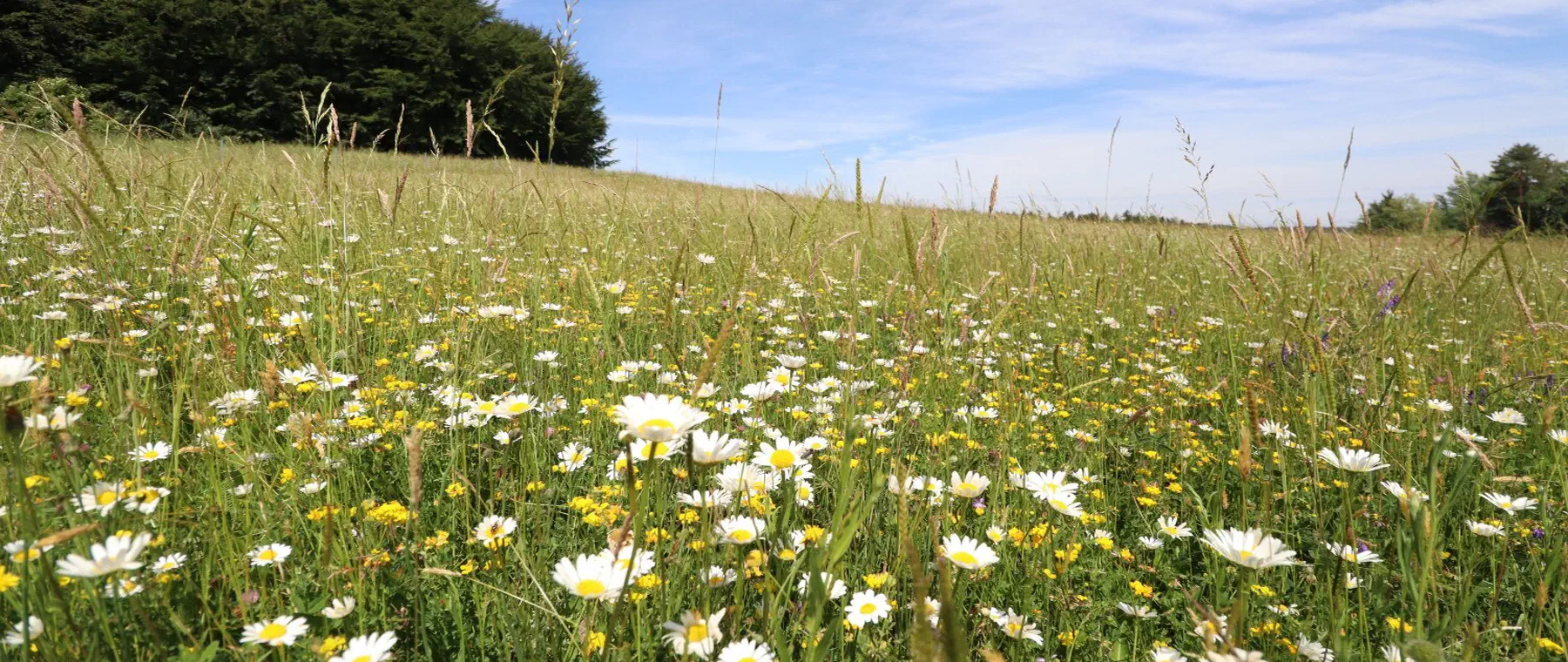
Management and restoration of species-rich dry grassland in the Frankenalb through scrub clearance, grazing with sheep and goats, and mowing regimes. Habitat for wild bees, butterflies, the sand lizard and rare orchids.
Cave and roost protection
Securing caves, mine tunnels and building roosts as hibernation sites and maternity roosts for bats, complemented by replacement roosts and the enhancement of structurally rich foraging habitat on forest edges and in traditional orchards.
Watercourse restoration
Restoration of near-natural watercourse structures on the Wiesent, Rotmain and Ölschnitz, with bank erosion, gravel banks and continuous stream beds. Habitat for kingfisher, brown trout, bullhead and beaver.
Near-natural forest conversion
Conversion of structurally poor spruce plantations in the Fichtelgebirge into climate-stable mixed and beech forests, enrichment with deadwood and old trees as habitat for the black stork, woodpeckers and the European wildcat.
Traditional orchards and hedgerows
Creation and reactivation of traditional orchards and hedgerow structures in the Obermainisches Hügelland, stepping-stone habitats for the red-backed shrike, wryneck and wild bees in the cleared agricultural landscape.
Species protection, CEF/FCS
Tailored measures under the BayKompV: migration corridors and forest edge design for the European wildcat, nest protection for the black stork, habitat creation for the sand lizard, and spawning waters for the yellow-bellied toad and great crested newt.
Protected species in the Fränkische Schweiz and Fichtelgebirge
Bats in the karst caves
The caves and mine tunnels of the Nördliche Frankenalb are among the most important bat roosts in Bavaria. The greater mouse-eared bat, barbastelle and Geoffroy's bat use them as hibernation sites and maternity roosts. Typical CEF measures include preserving roosts, providing replacement roosts and protecting foraging habitat.
About this species ›Sand lizard on calcareous grassland
The heat-loving calcareous grassland and juniper heaths of the Frankenalb are core habitat for the sand lizard. For impacts on railway embankments, quarries and dry slopes, relocation and the creation of sunlit stone piles and habitat structures are common compensation measures.
About this species ›European wildcat in the Veldensteiner Forst
The large contiguous forests of the Veldensteiner Forst and the Frankenalb are habitat for the European wildcat. Forest edge design, deadwood structures and the securing of migration corridors are typical FCS measures for road and forest impacts.
About this species ›Black stork in large forest areas
The black stork breeds in the quiet forests of the Fichtelgebirge and the Frankenalb. It requires low-disturbance old-growth stands and near-natural streams as foraging habitat. Nest protection zones and the restoration of forest streams are among the suitable measures.
About this species ›Kingfisher on the Wiesent and Rotmain
The near-natural watercourses Wiesent, Rotmain and Ölschnitz offer the kingfisher steep banks for breeding and fish-rich sections. CEF measures include creating bank erosion and steep banks, and improving watercourse structure.
About this species ›Amphibians of the Frankenalb
The yellow-bellied toad and great crested newt inhabit ponds, water-filled wheel ruts and small water bodies in forests and extraction sites. Creating new sunlit spawning waters and small water body complexes is a well-established compensation measure.
About this species ›Which projects trigger a compensation obligation?
Transport and infrastructure
The A9 (Munich to Berlin) and A70 motorways pass through the district, along with the expansion of federal and state roads and railway lines. Corridors, bypasses and bridge structures regularly trigger compensation and replacement obligations.
Raw material extraction
Limestone and dolomite quarries in the Frankenalb, as well as sand and clay extraction, cause impacts on dry habitats. Expansions and recultivation require nature-conservation compensation, often of value to the sand lizard and eagle owl.
Energy and renewables
Wind power sites in the Fichtelgebirge and on the ridges, as well as ground-mounted photovoltaic installations, require species protection assessments and CEF and FCS measures, particularly for wind-power-sensitive species such as the black stork and bats.
Commerce and settlement
Commercial areas in the Bayreuth area (such as Bindlach and Pegnitz) and residential development sites in the growing surrounding municipalities require statutory nature-conservation compensation. Landowners can benefit here as providers of compensation areas.
From enquiry to monitoring
Contact and enquiry
Tell us your compensation requirement and the natural region. We check availability.
Offer and advice
A transparent offer covering measure types, scope and availability.
Coordination with authorities
Full coordination with the lower nature conservation authority. We handle everything.
Long-term monitoring
Permanent securing of the land, management and documentation across the contract term.
Eco-points in adjoining districts
All about eco-points
in the district of Bayreuth
Request eco-points in the district of Bayreuth
We will promptly prepare a transparent offer with matching eco-points held in stock in the district of Bayreuth.