Eco-points and compensation areas
District of Zollernalbkreis
Eco-points immediately available from officially recognised eco-accounts for impacts in the Zollernalbkreis. greeNature supports your compensation under the Ökokonto-Verordnung (ÖKVO) as a full-service partner, from requirement analysis through land allocation to recognition by the lower nature conservation authority.
The District of Zollernalbkreis at a glance
The Zollernalbkreis lies in the south of Baden-Württemberg and belongs to the Tübingen administrative region. The district seat and seat of the Landratsamt is Balingen, and the district's largest town is Albstadt. The district comprises 25 towns and municipalities and takes its name from the ancestral castle of the Hohenzollern family and the Swabian Jura.
In landscape terms, the district is shaped by the Swabian Jura (D60) natural region, with the Hohe Schwabenalb, the Großer Heuberg around Meßstetten as one of the highest-lying landscapes of the Jura, the striking Alb escarpment and karstified limestone plateaus. In the north-west, the district passes into the Alb foreland of the Schwäbisches Keuper-Liasland (D58) and the Obere Gäue of the Neckar- und Tauber-Gäuplatten (D57) around Hechingen and Haigerloch.
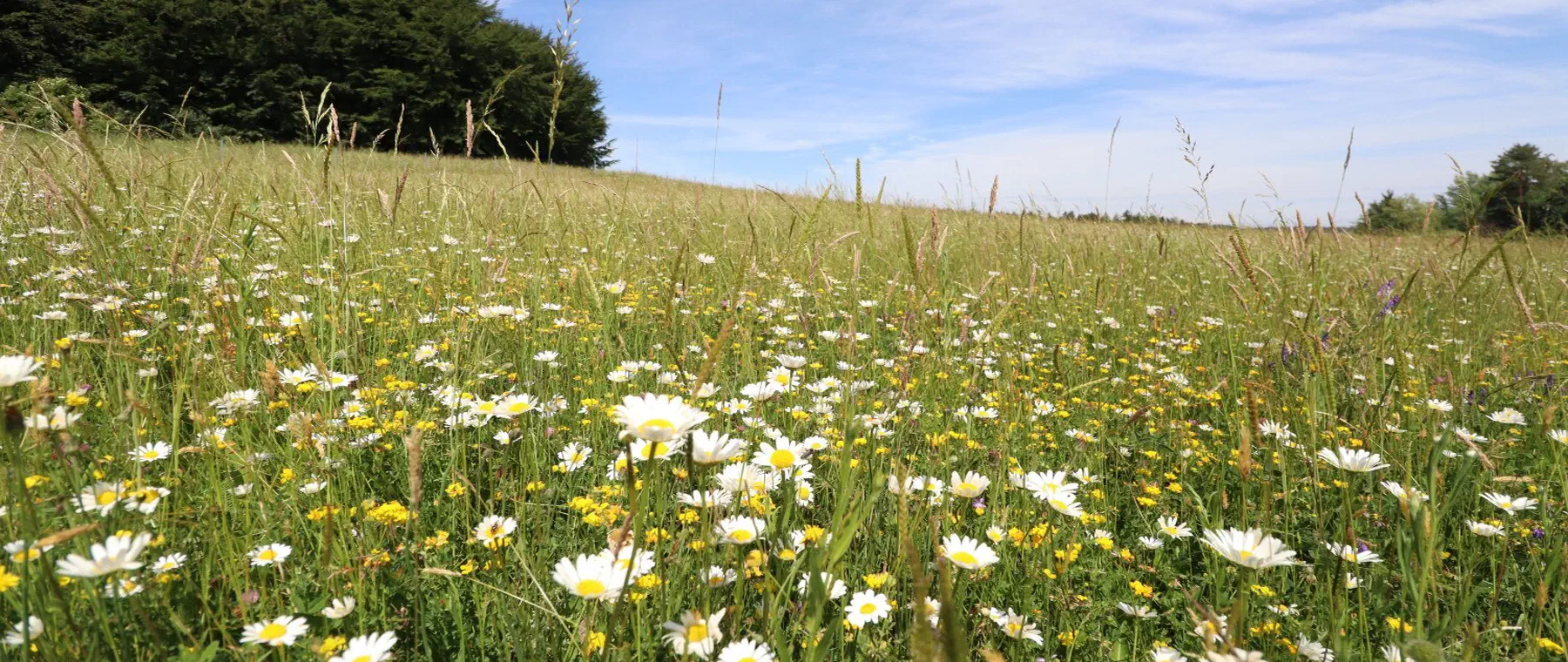
Ecologically significant are the juniper heaths and calcareous grassland of the Jura, the near-natural valleys of the Eyach, Starzel, Schmiecha and Bära, and extensive beech woodland along the Alb escarpment. The district has a share in several Natura 2000 sites, including the FFH site Schmeietal (DE-7820-341), the Truppenübungsplatz Heuberg (7820-342) and the Südwestalb und Oberes Donautal bird sanctuary (7820-441), as well as numerous nature reserves and the Naturpark Obere Donau.
Economically, the district is shaped by the textile and mechanical engineering tradition around Albstadt, the metal and precision engineering industry, limestone extraction at the Plettenberg and the cement works in Dotternhausen, and wind energy on the Heuberg. Such projects regularly trigger compensation and replacement obligations under §§ 13 to 15 BNatSchG, assessed in Baden-Württemberg through the Ökokonto-Verordnung in eco-points.
🗺️ Associated natural regions
Go to natural region D60 ›
Go to natural region D58 ›
Go to natural region D57 ›
📍 Selected municipalities
🌿 Ecological features
- Share of the FFH site Schmeietal (DE-7820-341) in the Schmiecha valley, part of the Hohe Schwabenalb and Mittlere Flächenalb natural regions
- FFH site Truppenübungsplatz Heuberg (7820-342) with extensive open-land and calcareous grassland habitats
- Südwestalb und Oberes Donautal bird sanctuary (7820-441), a supraregionally significant bird sanctuary
- Juniper heaths and calcareous grassland of the Hohe Schwabenalb and the Großer Heuberg around Meßstetten
- Striking Alb escarpment with outlier hills, including the Hohenzollern with Hohenzollern Castle
- Limestone and oil shale deposits at the Plettenberg near Dotternhausen
- Near-natural spring courses and valleys of the Eyach, Starzel, Schmiecha and Bära
✅ greeNature on the ground
greeNature operates nationwide and works consistently in Baden-Württemberg with the assessment system of the Ökokonto-Verordnung (ÖKVO). We coordinate measures with the lower nature conservation authority of the Zollernalbkreis, know the natural differences between the Swabian Jura, the Alb foreland and the Obere Gäue, and assign eco-points from recognised eco-accounts precisely to the relevant impact. From requirement analysis through land allocation to implementation, management and monitoring, we handle the whole compensation process.
Typical measures in the district of Zollernalbkreis
Juniper heaths and calcareous grassland
Managing and restoring juniper heaths and calcareous grassland of the Hohe Schwabenalb and the Großer Heuberg through extensive sheep grazing and scrub clearance, habitat for warmth-loving insects, sand lizard and rare plant species.
Traditional orchards
Creating and reactivating traditional orchards on the Alb escarpment, valley edges and in the foreland, habitat for cavity-nesting birds, bats and wild bees.
Watercourse restoration
Revitalising the Eyach, Starzel, Schmiecha and Bära with bank flattening, deadwood and reconnection of former channels, improving connectivity and creating habitats for kingfisher and fish.
Species protection CEF and FCS
Advance compensation measures (CEF) and measures to maintain favourable conservation status (FCS) under § 44 BNatSchG, for example replacement habitats for the sand lizard, bat roosts and spawning waters for the yellow-bellied toad.
Dry stone walls and habitat network
Creating dry stone walls, stone ridges and hedgerows on the Jura, stepping-stone habitats for reptiles, small mammals and insects between isolated marginal sites.
Farmland and woodland edges
Enhancing the open farmland of the Gäu areas with skylark plots, flowering strips and extensive field margin structures, and developing structurally rich, graded woodland edges along the Alb escarpment.
Protected species in the Zollernalb between the Swabian Jura and the Obere Gäue
Sand lizard on marginal sites
Juniper heaths, calcareous grassland, railway banks and quarry embankments are core habitats for the sand lizard. In the case of impacts, advance relocation and creating replacement habitats with stone ridges and deadwood are common practice.
About this species ›Bats of the Jura caves
The cave- and rock-rich Jura provides important roosts, for example for the greater mouse-eared bat and Bechstein's bat. Traditional orchards and structurally rich woodland serve as foraging grounds. Roost protection and preserving cavity trees are typical CEF measures.
About this species ›Black stork in the Jura woodland
The extensive, low-disturbance beech woodland along the Alb escarpment and in the valleys provides breeding opportunities for the black stork. Preserving old woodland stands and near-natural streams as foraging habitat is essential for the species.
About this species ›Kingfisher on the Eyach and Starzel
Near-natural bank sections on the Eyach, Starzel, Schmiecha and Bära provide breeding sites for the kingfisher in steep banks. Restoration works with bank scarps and structurally rich watercourse margins create new habitats.
About this species ›Yellow-bellied toad and amphibians
Quarries, extraction sites and oil shale pits at the Plettenberg are home to pioneer species such as the yellow-bellied toad and the great crested newt. Temporary small water bodies and water-filled wheel ruts are central elements of compensation planning.
About this species ›Skylark of the Gäu landscape
The open arable landscapes of the Obere Gäue and the Alb foreland are habitat for the skylark and other farmland birds. Skylark plots, flowering strips and extensive field margin structures are suitable enhancement measures.
About this species ›Which projects trigger a compensation obligation?
Limestone extraction and cement industry
Limestone extraction at the Plettenberg and the cement works in Dotternhausen are among the region's significant mineral extraction projects. Extensions and reclamations regularly trigger compensation requirements, for which greeNature develops suitable eco-account measures.
Wind energy on the Heuberg
The expansion of wind energy in the higher elevations of the Großer Heuberg requires species protection assessments and compensation measures, particularly for wind-sensitive species. greeNature supports compensation under the ÖKVO and coordination with the authority.
Commercial and settlement development
The designation of commercial and residential areas in the Balingen and Albstadt economic area leads to impacts on soil, nature and landscape. We determine the compensation requirement and assign immediately available eco-points.
Transport and infrastructure
Road construction and infrastructure projects along the B27 and other transport corridors generate compensation requirements. greeNature plans and implements the necessary compensation and replacement measures.
From enquiry to monitoring
Contact and enquiry
Tell us your compensation requirement and the natural region. We check availability.
Offer and advice
A transparent offer covering measure types, scope and availability.
Coordination with authorities
Full coordination with the lower nature conservation authority. We handle everything.
Long-term monitoring
Permanent securing of the land, management and documentation across the contract term.
Eco-points in adjoining districts
All about eco-points
in the district of Zollernalbkreis
Request eco-points in the district of Zollernalbkreis
We will promptly prepare a transparent offer with matching eco-points held in stock in the district of Zollernalbkreis.