Eco-points and compensation areas
District of Freudenstadt
Readily available eco-points from officially recognised eco-accounts. greeNature solutions, your full-service partner for compensation under the Eco-account Regulation (ÖKVO) in the North Black Forest and Upper Gäue.
The District of Freudenstadt at a glance
Freudenstadt District lies in the administrative region of Karlsruhe in the south-west of Baden-Württemberg and extends from the main ridge of the North Black Forest to the open Gäu landscapes on the upper Neckar. By far the largest part of the district belongs to the BfN natural region D54 (Black Forest), the eastern strip around Horb on Neckar, Empfingen and Eutingen in the Gäu counts geographically to the Upper Gäue in the natural region D57 (Neckar and Tauber Gäu plateaus).
Characteristic is the heavily forested Buntsandstein and bedrock Black Forest with extensive conifer and mixed forests, deeply cut valleys of Kinzig, Murg and Glatt, and open highlands with grasslands and high moors at Kniebis and Schliffkopf. These cool, wet mountain sites bear a mosaic of protected forests, glacial lakes and mountain meadows of high significance for species and biotope protection.
In the north-west the district has a share in the Black Forest National Park and lies almost entirely in the Schwarzwald Mitte/Nord Nature Park, one of Germany's largest nature parks. Glacial lakes such as the Glaswaldsee and Wilde See are ice-age relics that, together with grasslands and moors, host numerous FFH habitat types and European-protected species.
Economically tourism, forestry and timber industry as well as small and medium-sized mechanical engineering and metalworking are determining. The expansion of wind energy on the ridge lines, road projects on B28, B294 and B462 as well as settlement and business development in the Gäu areas regularly create compensation requirements under §§ 13 to 15 BNatSchG in conjunction with the Eco-account Regulation (ÖKVO).
🗺️ Associated natural regions
Go to natural region D54 ›
Go to natural region D57 ›
📍 Selected municipalities
🌿 Ecological features
- Share in the Black Forest National Park with protected forests, glacial lakes and grasslands in the north-west of the district
- Schwarzwald Mitte/Nord Nature Park, one of Germany's largest nature parks
- High moors and grasslands on the Black Forest heights (Kniebis, Schliffkopf), FFH habitat types of moors and heaths
- Ice-age glacial lakes such as Glaswaldsee and Wilder See with adjoining moors
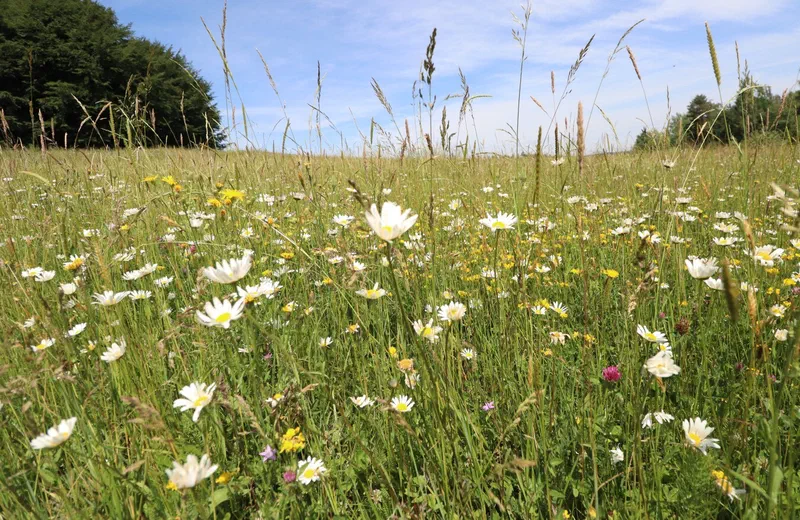
- Species-rich mountain meadows (FFH-LRT 6520) in mid and higher valley areas
- Upper Gäue in the east with fertile loess soils, traditional orchards and open field area on the upper Neckar
- Flowing water system of Kinzig, Murg, Glatt and upper Neckar with brown trout and kingfisher
✅ greeNature on the ground
greeNature operates nationwide and manages compensation projects in Baden-Württemberg under the Eco-account Regulation (ÖKVO). We know the nature conservation requirements in the North Black Forest and Upper Gäue, cooperation with the lower nature conservation authority at Freudenstadt district office and the regional land potentials for naturally region-appropriate eco-account measures.
Typical measures in the district of Freudenstadt
Near-natural forest conversion
Conversion of structurally poor spruce forests into site-appropriate, mixed-age forests of fir, beech and sycamore maple, enrichment with old and dead wood and habitat trees. Upgradeable forest stands count among the core eco-account measures in the forest-rich Black Forest.
Moor and grassland restoration
Rewetting of drained high moors and keeping grasslands open on the highlands (Kniebis, Schliffkopf). These measures secure rare FFH habitat types and bind carbon permanently.
Flowing watercourse restoration
Removal of riverbank structures, creation of gravel bars and near-natural bank structures on Kinzig, Murg, Glatt and upper Neckar, improvement of continuity for brown trout, bullhead and kingfisher.
Mountain meadows and grassland
Extensification and restoration of species-rich mountain meadows (FFH-LRT 6520) and calcareous grasslands through adapted mowing or grazing, habitat for meadow birds, butterflies and wild bees.
Species protection CEF and FCS
Habitat enhancement for capercaillie and black stork, securing of bat roosts, creation of sand lizard habitats on sunny slopes, tailored under § 44 BNatSchG as advance (CEF) or conservation-securing (FCS) measures.
Traditional orchards and hedgerows in Gäu
Creation and management of traditional orchard meadows, hedgerows and field copses in the Upper Gäue for biotope networking, habitat for little owl, great grey shrike, wryneck and rare wild bees.
Protected species in the North Black Forest and Upper Gäue
Capercaillie and forest game birds
The North Black Forest hosts one of Germany's last capercaillie populations. Open, structurally rich mountain conifer forests with bilberry understorey are decisive, forest conversion and targeted opening are typical habitat measures.
Black stork
The black stork breeds in disturbance-free old timber stands of the Black Forest valleys and hunts at clear streams and forest pools. Nesting protection zones and restoration of flowing watercourses count among effective FCS measures.
About this species ›Wildcat
The European wildcat is expanding again across the connected forest areas of the Black Forest. Old and dead-wood-rich forests, forest edges and networking shrub structures promote its migration corridors.
About this species ›Forest bats
Bechstein's bat, barbastelle and large mouse-eared bat use old broadleaf and mixed forests as nurseries and hunting areas. Preservation of cavity trees and roost trees is a frequent compensation task.
About this species ›Amphibians of streams and moors
Fire salamander, alpine newt and grass frog inhabit cool forest streams, yellow-bellied toad and common toad use small waterbodies and water-filled ruts. New spawning water creation is a proven CEF measure.
About this species ›Skylark and field birds in Gäu
In the open field area of the Upper Gäue, skylark, grey partridge and quail breed. Lark windows, flower strips and extensive arable margins improve breeding success during agricultural impacts.
About this species ›Which projects trigger a compensation obligation?
Wind energy in the Black Forest
Wind farms on the ridge lines of the North Black Forest are a focus of the energy transition in Baden-Württemberg. They trigger extensive compensation and replacement obligations and require species protection measures (§ 44 BNatSchG) for capercaillie, red kite, black stork and bats.
Transport infrastructure
Expansion and maintenance of federal roads B28, B294 and B462, town bypasses and measures on the Kinzig Valley railway create impacts on forest, waterbodies and open land with corresponding compensation requirements.
Settlement and business
Residential building and business areas in Freudenstadt, Horb on Neckar and Gäu municipalities require nature conservation compensation. Owners of arable, grassland and forest areas can bring their areas in as eco-account sites.
Free-area photovoltaics
Solar parks on conversion and agricultural areas in the Gäu areas and on sun-exposed slopes are being expanded. Nature conservation supervision and compensation under ÖKVO are part of the permitting process.
From enquiry to monitoring
Contact and enquiry
Tell us your compensation requirement and the natural region. We check availability.
Offer and advice
A transparent offer covering measure types, scope and availability.
Coordination with authorities
Full coordination with the lower nature conservation authority. We handle everything.
Long-term monitoring
Permanent securing of the land, management and documentation across the contract term.
Eco-points in adjoining districts
All about eco-points
in the district of Freudenstadt
Request eco-points in the district of Freudenstadt
We will promptly prepare a transparent offer with matching eco-points held in stock in the district of Freudenstadt.