Eco-points and compensation areas
City of Freiburg im Breisgau
Eco-points immediately available from officially recognised eco-accounts. greeNature is your full-service partner for compensation under the Ökokonto-Verordnung (ÖKVO) in the independent city of Freiburg im Breisgau, between the Rhine plain, the Mooswald and the Schauinsland.
The City of Freiburg im Breisgau at a glance
Freiburg im Breisgau is an independent city (Stadtkreis) in the south-west of Baden-Württemberg and the seat of the Regierungspräsidium Freiburg. With an area of around 153 km² and about 232,800 residents, it is the state's fourth-largest city. It is almost entirely surrounded by the Breisgau-Hochschwarzwald district and borders the Emmendingen district to the north.
The city area spans two BfN natural regions. The western and central part, with the city centre, the Mooswald and the Rhine plain, belongs to the Freiburger Bucht within the Oberrheinisches Tiefland (natural region D53). To the east and south, the terrain rises across the foothill zone into the Black Forest (natural region D54), up to the Schauinsland at around 1,284 m. The difference in elevation, from the warm loess plain to the mountain meadows, shapes the diversity of habitats.
Within the city area and its immediate surroundings lie several Natura 2000 sites, including the FFH site Mooswälder bei Freiburg, with remnants of floodplain woodland, near-natural streams and a significant population of the club-tailed damselfly (Helm-Azurjungfer), the FFH site Schauinsland, with mountain meadows and slopes shaped by the ice age, and the Rieselfeld nature reserve in the west of the city. The Dreisam, Glotter and Elz run through the area as defining watercourses.
As a growing university and business city with high housing pressure, Freiburg is designating large-scale building and infrastructure projects. New residential and commercial areas, the expansion of the light rail and road network, and infill development regularly trigger impacts, whose compensation in Baden-Württemberg must be assessed under the Ökokonto-Verordnung (ÖKVO) in eco-points.
🗺️ Associated natural regions
Go to natural region D53 ›
Go to natural region D54 ›
📍 City districts
🌿 Ecological features
- FFH site Mooswälder bei Freiburg, with remnants of floodplain woodland, near-natural streams and populations of the club-tailed damselfly
- FFH site Schauinsland, with mountain meadows, mat-grass swards and slopes shaped by the ice age in the high Black Forest
- Rieselfeld nature reserve in the west of the city, developed from former sewage farmland
- FFH sites Kandelwald, Roßkopf und Zartener Becken, and Schönberg, with Black Forest slopes around the city
- Dreisam, Glotter and Elz as defining, largely near-natural watercourses
- Elevation range from the Freiburger Bucht in the Rhine plain up to the Schauinsland at around 1,284 m
✅ greeNature on the ground
greeNature operates nationwide and is versed in compensation law in Baden-Württemberg. We coordinate with the lower nature conservation authority in the City of Freiburg's environment office, know the assessment under the Ökokonto-Verordnung (ÖKVO) in eco-points, and the requirements of natural regions D53 (Oberrheinisches Tiefland) and D54 (Black Forest) between the Rhine plain, the Mooswald and the Schauinsland.
Typical measures in the city of Freiburg im Breisgau
Watercourse restoration on the Dreisam, Glotter and Elz
Developing near-natural banks, reconnecting tributaries and adding structure to the watercourses within the city area. This creates spawning and foraging habitats, steep faces as breeding sites for the kingfisher, and habitat for dragonflies such as the club-tailed damselfly. The enhancement can be assessed as an ÖKVO measure in eco-points.
Desealing and removal of sealed surfaces
Removal of no-longer-used transport, yard and operational areas and conversion into root-penetrable soil, grassland or woody vegetation. Desealing improves the water balance and soil functions and is an effective, creditable form of compensation in the densely built-up city area.
Enhancing the Mooswald and floodplain woodland remnants
Promoting site-appropriate mixed broadleaf woodland, preserving old and dead wood, and rewetting floodplain woodland sites at the foot of the foothill zone. These measures support habitats for bats, woodpeckers and amphibians in the Mooswald.
Extensively managed grassland and traditional orchards on the Tuniberg and Schönberg
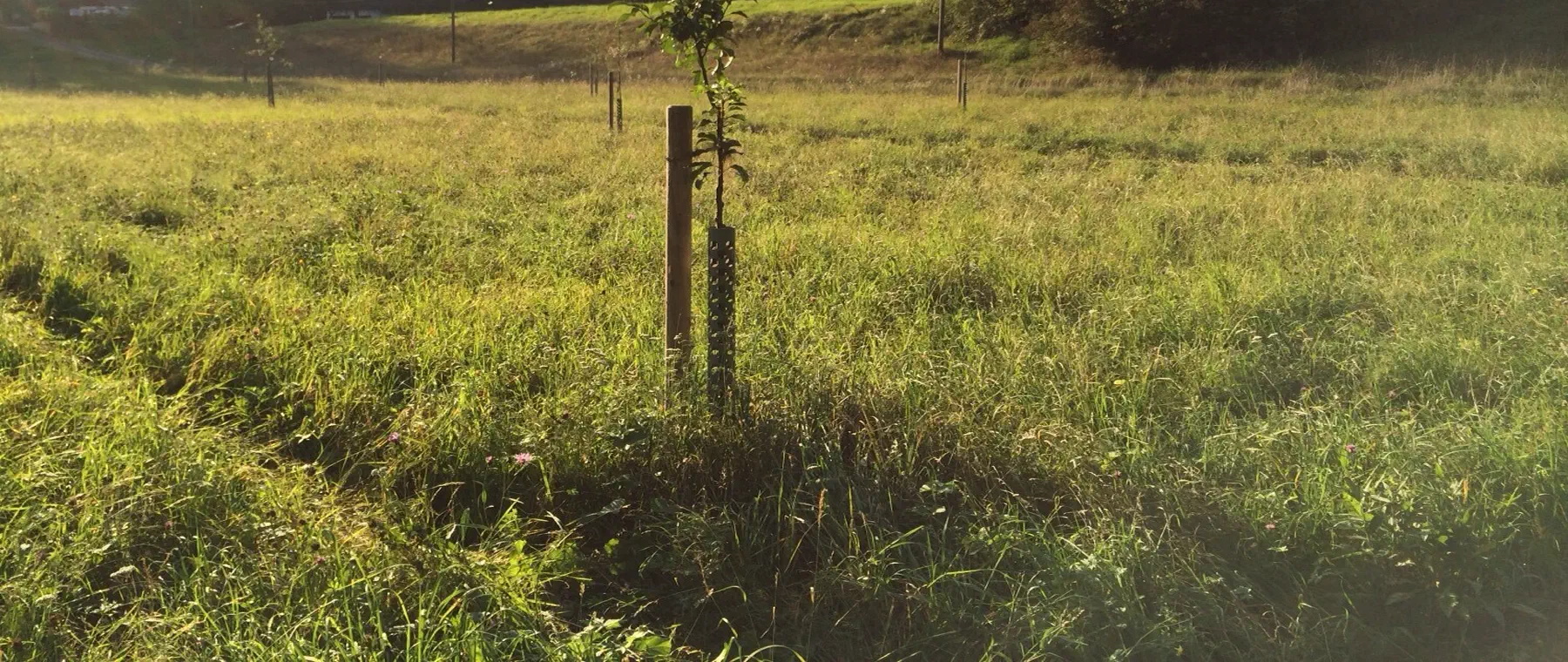
Converting intensively farmed land into species-rich grassland, managing traditional orchards, and preserving calcareous grassland and dry stone walls in the warm foothill zone. Such structures are habitat for reptiles, wild bees and farmland birds.
Species protection CEF and FCS
Replacement roosts for bats, habitat structures and relocations for the sand lizard, and replacement spawning waters for amphibians, each as an advance CEF measure or as an FCS measure to maintain favourable conservation status under § 44 BNatSchG.
Habitat network and green corridors
Creating hedgerows, field copses and flowering areas, and connecting inner-city green corridors with the open countryside. Stepping-stone habitats link the Rhine plain, the Mooswald and the foothill zone, and secure exchange between habitats.
Protected species in the Freiburger Bucht between the Rhine plain and the Black Forest
Bats in woodland and the city
Several strictly protected bat species (Annex IV of the FFH Directive) use the Mooswald, traditional orchards and buildings within the city as roosts and foraging grounds. Where demolition, refurbishment and clearance occur, replacement roosts are required as a CEF measure.
About this species ›Sand lizard on railway banks and dry sites
The sand lizard (Annex IV of the FFH Directive) inhabits railway banks, embankments, fallow land and the warm dry sites on the Schönberg and Tuniberg. For building projects, habitat design and proper relocation are among the typical measures.
About this species ›Kingfisher on the watercourses
The kingfisher breeds in steep banks on the Dreisam, Glotter and Elz. It depends on near-natural, fish-rich waters with suitable breeding faces. Bank restoration and preserving steep faces secure its breeding sites.
About this species ›Amphibians in floodplains and small water bodies
Yellow-bellied toad, natterjack toad and other amphibians inhabit pools, ditches and floodplain waters in the Mooswald and the western neighbourhoods. Replacement spawning waters and terrestrial habitats in spatial proximity secure their populations during building projects.
About this species ›Skylark in the western farmland
The skylark breeds in the open agricultural landscape on the Tuniberg and in the western districts. As a declining ground-nesting bird, it benefits from fallow arable land, flowering strips and extensively farmed land as a CEF measure.
About this species ›European wildcat on the Black Forest slopes
The European wildcat (Annex IV of the FFH Directive) uses the structurally rich, low-disturbance woodland of the foothill zone and the Black Forest slopes around the Schauinsland. For woodland and road impacts, wildlife corridors and habitat connectivity are central measures.
About this species ›Which projects trigger a compensation obligation?
New Dietenbach neighbourhood
In the west of the city, the new Dietenbach neighbourhood is being built on around 110 hectares, with several thousand homes. A project of this scale requires extensive compensation under nature conservation law under the impact mitigation regulation (§§ 13 to 15 BNatSchG), assessed in eco-points under the ÖKVO, as well as species protection measures around the Rieselfeld and Mooswald.
Commercial and industrial land
The further development of commercial sites in the west of the city and in the northern industrial area triggers impacts on soil, grassland and woody vegetation. Compensation is provided through eco-points, often combined with reptile and bat measures.
Transport and light rail
The expansion of the light rail network, works on the B 31, the Rheintalbahn and municipal roads generate compensation and replacement obligations, often with species protection relevance for the sand lizard and bats on embankments and slopes.
Infill development and conversion
Infill development within the existing urban fabric, as well as the development of conversion and rail sites, affects inner-city green structures and fallow land. Here too, the impact must be compensated in eco-points, supplemented by desealing and habitat networking.
From enquiry to monitoring
Contact and enquiry
Tell us your compensation requirement and the natural region. We check availability.
Offer and advice
A transparent offer covering measure types, scope and availability.
Coordination with authorities
Full coordination with the lower nature conservation authority. We handle everything.
Long-term monitoring
Permanent securing of the land, management and documentation across the contract term.
Eco-points in adjoining districts
All about eco-points
in the city of Freiburg im Breisgau
Request eco-points in the city of Freiburg im Breisgau
We will promptly prepare a transparent offer with matching eco-points held in stock in the city of Freiburg im Breisgau.