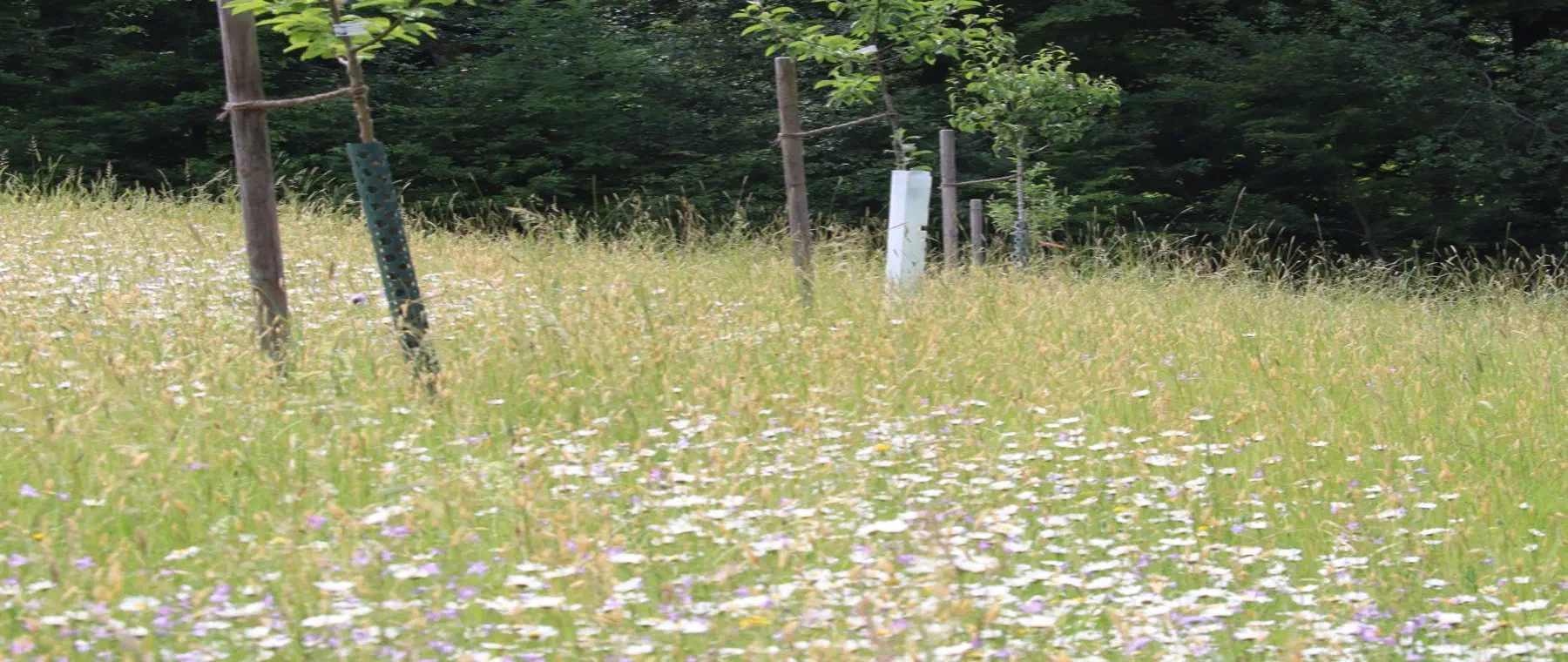
Eco-points and compensation areas
District of Enzkreis
Eco-points and compensation areas in Enzkreis, expertly planned under the Eco-account Regulation (ÖKVO) of Baden-Württemberg. greeNature guides project developers between Kraichgau, Stromberg and the North Black Forest from impact assessment through to recognised compensation measure.
The District of Enzkreis at a glance
Enzkreis lies in the administrative region of Karlsruhe and in the North Black Forest region. It encloses the independent city of Pforzheim in almost a ring and extends from the open Gäu and Kraichgau landscapes in the north to the forested heights of the North Black Forest in the south.
For compensation in Baden-Württemberg, the Eco-account Regulation (ÖKVO) is decisive. The value of impacts and compensation measures is assessed via a biotope value procedure in eco-points, which represents the nature conservation enhancement of an area.
The natural region diversity between wine-growing areas in Kraichgau and Stromberg, Heckengäu and Black Forest forests brings broad species protection assessment requirements under § 44 BNatSchG.
greeNature takes on compensation as a full service, from impact and compensation assessment through land securing to coordination with the lower nature conservation authority and long-term maintenance.
🗺️ Associated natural regions
Go to natural region D57 ›
Go to natural region D54 ›
📍 Selected municipalities
🌿 Ecological features
- Enzkreis encloses the independent city of Pforzheim; district administration and lower nature conservation authority are based in Pforzheim, not in the district area itself.
- With 31 nature reserves covering about 3 per cent of the district area, numerous high-value areas exist, in whose vicinity impacts must be assessed particularly carefully.
- Wine-growing areas in Kraichgau and Stromberg with their dry-stone walls, slopes and abandoned vineyards are habitat for strictly protected species such as sand lizard.
- The disturbance-free forests of the North Black Forest host demanding species such as black stork and wildcat, so projects near forests require assessment under § 44 BNatSchG.
- Traditional orchards characterise Heckengäu and Kraichgau and are well suited for enhancing compensation measures with high eco-point numbers.
- The district has shares in Stromberg-Heuchelberg Nature Park in the east and Schwarzwald Mitte/Nord Nature Park in the south, which serve as priority areas for near-natural development.
✅ greeNature on the ground
greeNature operates nationwide and consistently plans compensation in Enzkreis under Baden-Württemberg state law. The basis is the Eco-account Regulation (ÖKVO) in conjunction with the impact mitigation regulation of §§ 13 to 15 BNatSchG. We assess the impact using the biotope value procedure, develop suitable measures in the district's natural regions (Neckar and Tauber Gäu plateaus and Black Forest) and secure the necessary eco-points through recognised eco-accounts. Since Gäu, Kraichgau, Stromberg and North Black Forest differ significantly in soils, climate and species composition, we ensure functionally and as much as possible naturally region-appropriate compensation. We conduct the species protection assessment under § 44 BNatSchG independently alongside the eco-point balance, for example with CEF measures for sand lizard or skylark. We handle coordination with the lower nature conservation authority at Enzkreis district office for the project developer.
Typical measures in the district of Enzkreis
Create and manage traditional orchards
New creation and extensive management of traditional orchard stands in Kraichgau and Heckengäu, a classic, easily calculable enhancement path for eco-points with high value for insects and birds.
Renovate dry-stone walls and vineyard slopes
Restoration of dry-stone walls and sunny slopes in wine-growing areas of Stromberg and Kraichgau, effective as habitat and CEF measure for sand lizard.
Near-natural forest conversion
Development of structurally and dead-wood-rich broadleaf mixed forests in the North Black Forest, upgrading forest biotopes and benefiting species such as black stork and bats.
Watercourse and floodplain development
Restoration of Enz, Nagold and Würm with riparian margins, old arms and floodplain forest, linking watercourse and wet habitats and strengthening the eco-point balance.
Hedgerows and field copses in Heckengäu
Creation and management of hedgerows, margins and field copses as habitat networks, among others as habitat for hazel dormouse.
Extensify grassland and create arable margins
Conversion of intensively managed areas into species-rich extensive grassland and flower strips, suitable as a measure for skylark and open-land species of the Gäu landscape.
Protected species in the Between Kraichgau, Stromberg and North Black Forest
Sand lizard
Widespread in vineyards, at dry-stone walls, railway embankments and slopes. As a strictly protected species under § 44 BNatSchG, often reason for CEF measures before impact begins.
About this species ›Skylark
Characteristic species of open Gäu and Kraichgau landscape. Its population suffers from land loss, making compensation via extensification and arable margins sensible.
About this species ›Bats
Forest and building-dwelling species use old forests of Stromberg and roosts in settlement areas. Assessment under § 44 BNatSchG is required for building demolition and forest impacts.
About this species ›Hazel dormouse
Inhabitant of hedgerows, forest edges and shrub areas in Heckengäu. Its occurrence requires the preservation and replacement of woody networking structures.
About this species ›Black stork
Breeds in the disturbance-free forests of the North Black Forest and depends on quiet breeding sites and intact stream floodplains.
About this species ›Wildcat
Returns to forest areas of Stromberg and North Black Forest. Forest connectivity and disturbance-free refuge areas are decisive for it.
About this species ›Which projects trigger a compensation obligation?
Road and transport infrastructure
Expansion and conversion of federal and state roads in the Enz Valley and North Black Forest region trigger impacts that must be compensated via eco-points.
Business and residential areas
Development of business and residential areas in Mühlacker, Remchingen and other municipalities regularly creates compensation requirements under the impact mitigation regulation.
Wind energy in the North Black Forest
Expansion and repowering of wind energy installations in the highlands require compensation measures and careful species protection assessment.
Network expansion and transmission routes
Interregional power lines and network reinforcements cross the district area and trigger land-related compensation requirements.
From enquiry to monitoring
Contact and enquiry
Tell us your compensation requirement and the natural region. We check availability.
Offer and advice
A transparent offer covering measure types, scope and availability.
Coordination with authorities
Full coordination with the lower nature conservation authority. We handle everything.
Long-term monitoring
Permanent securing of the land, management and documentation across the contract term.
Eco-points in adjoining districts
All about eco-points
in the district of Enzkreis
Request eco-points in the district of Enzkreis
We will promptly prepare a transparent offer with matching eco-points held in stock in the district of Enzkreis.